How Much Water Does a Chicken Drink? The Number, Then the “Why”

How much water does a chicken drink is usually asked by someone comparing their specific flock’s consumption against what feels normal, often because a hen seems to be drinking noticeably more or less than expected. The baseline number is straightforward; for the full breakdown by life stage, weather, and waterer type, the companion guide on chicken water requirements covers that in depth.
Here, the focus is narrower and more practical: the quick number, then what it actually means if your bird’s daily water intake looks off from that baseline.
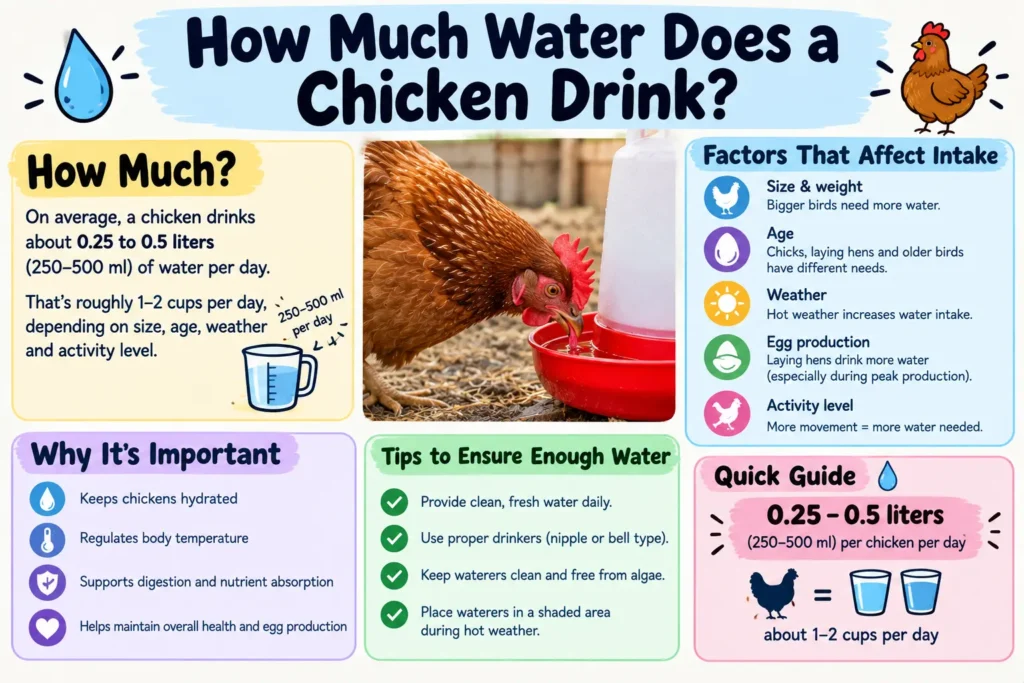
Quick Answer: A standard adult laying hen drinks roughly 8 to 16 fluid ounces (1 to 2 cups) of water per day in moderate weather, doubling or more in hot conditions. If a specific bird’s water intake looks meaningfully higher or lower than this baseline, especially without an obvious weather or laying explanation, it’s worth investigating rather than assuming it’s normal variation.
Table of Contents
The Baseline Number, Quickly
| Bird Type | Typical Daily Water Intake |
| Adult hen, moderate weather | 8–16 fl oz |
| Adult hen, hot weather | 16–32 fl oz |
| Growing pullet | 4–8 fl oz |
| Chick | 1–2 fl oz |
Did You Know? It’s genuinely difficult to measure individual bird consumption in a shared-waterer flock, so most of these figures represent flock averages divided by bird count rather than something you can precisely verify for one specific hen without isolating her.
Why a Chicken Might Drink More Than Expected
Heat
The most common explanation by far; hot weather alone can push water intake to 2 to 4 times the baseline without anything being wrong.
Heavy Laying
Hens in peak production drink more than less productive or non-laying birds, simply due to the water content of eggs themselves.
Illness or Kidney Issues
Certain health conditions cause increased thirst as a symptom, generally alongside other signs like changes in droppings or overall condition.
Recently Introduced Salty or Dry Treats
Salty snacks or very dry treats can temporarily increase thirst, similar to the effect in many other animals.
| Cause of Increased Drinking | Other Signs Present? |
| Heat | Panting, seeking shade |
| Heavy laying | Consistent egg production, otherwise normal |
| Illness/kidney issue | Often abnormal droppings, lethargy |
| Salty/dry treats | Temporary, resolves once treat stops |
Why a Chicken Might Drink Less Than Expected
Cold Weather
A modest, normal reduction in cold weather is expected and not concerning on its own.
Waterer Access Problems
A frozen, empty, or otherwise inaccessible waterer is one of the most common, purely mechanical reasons for reduced apparent intake, worth ruling out before assuming a health cause.
Illness
Reduced water intake alongside reduced appetite and lethargy can indicate a hen isn’t feeling well, making this pattern worth closer attention.
Bullying or Competition
In a crowded or poorly managed flock, a lower-ranking hen may be prevented from accessing water as freely as others, leading to reduced individual intake despite adequate flock-wide supply.
| Cause of Reduced Drinking | Other Signs Present? |
| Cold weather (mild reduction) | Normal, no other symptoms |
| Waterer access problem | Check equipment first |
| Illness | Reduced appetite, lethargy |
| Bullying/competition | Hen avoiding waterer area, flock dynamics issue |
Step-by-Step: Investigating Unusual Water Intake
- Rule out the obvious first. Check that waterers are functioning, accessible, and not frozen or empty.
- Consider recent weather. A hot spell or cold snap explains most non-concerning changes in either direction.
- Check laying status. A hen who just started laying, or one who’s stopped, will show corresponding water intake shifts.
- Watch for other symptoms. Changes in droppings, appetite, or activity alongside water intake changes point toward a health cause.
- Observe flock dynamics. If you suspect one hen is being kept from water access, consider adding a second water station in a different location.
Read More: https://lashegg.com/chicken-water-requirements/
Expert Tip
If you’re concerned about one specific hen’s water intake, a brief supervised period with a separate, easily observed water source can help you actually see how much she’s drinking, since flock-shared water makes individual tracking otherwise difficult.
Common Mistakes to Avoid
- Assuming any change in water intake is automatically a health problem without checking weather and laying status first
- Overlooking a simple mechanical issue like a clogged or frozen waterer
- Missing bullying as a cause of one hen’s apparently reduced water access
- Panicking over normal seasonal variation in either direction
- Not accounting for a recent treat, like salty scraps, temporarily increasing thirst
When to Call a Vet
Contact a poultry veterinarian if a bird’s water intake is significantly increased or decreased without an obvious explanation like weather, laying status, or a mechanical waterer issue, especially if it’s paired with other symptoms like lethargy, abnormal droppings, or reduced appetite.
People Also Ask
How much water does a chicken drink compared to how much it eats? Chickens generally drink roughly twice as much water by weight as they consume in feed under normal conditions, a ratio that increases further during hot weather.
Is it normal for chicken water intake to vary day to day? Yes, weather, activity level, and laying status all cause normal daily variation, so a single day’s difference usually isn’t cause for concern on its own.
What does it mean if my chicken suddenly drinks a lot more water? Heat, the start of heavy laying, or occasionally an illness affecting thirst are the most common explanations, with heat being by far the most frequent cause.
Can I tell how much water does a chicken drink in a shared flock waterer? Not precisely for an individual bird; flock-wide consumption divided by bird count gives a rough average, though truly individual tracking requires temporary separation.
Should I worry if my chicken’s daily water needs seem lower in winter? A modest reduction in cold weather is normal and expected; a dramatic drop or complete refusal to drink is what actually warrants closer investigation.
Final Thoughts
How much water does a chicken drink comes down to roughly 8 to 16 fluid ounces daily for an adult hen in moderate weather, though the more useful question is often why a specific bird’s intake looks different from that baseline. Weather, laying status, and simple mechanical issues explain most variation.
Rule out the obvious causes first, and reach out to a poultry veterinarian if unusual water intake persists without an explanation or comes paired with other symptoms of illness.
5. FAQ
Q: How much water does a chicken drink at minimum to stay healthy? A: Even at the lower end, consistent access to at least several ounces daily is necessary; prolonged periods without adequate water access can lead to dehydration relatively quickly.
Q: Does chicken water intake change with age? A: Yes, intake scales up from chicks to growing pullets to adult laying hens, generally increasing as body size and, eventually, laying activity increase.
Q: Can stress affect daily water needs? A: Yes, both increased and decreased water intake can occur with stress, depending on the individual bird and situation, making it one more factor to consider alongside weather and health.
Q: Is excessive water intake ever a sign of a serious health problem? A: Occasionally, yes; certain kidney or metabolic conditions can cause noticeably increased thirst, though this is far less common than simple heat or laying-related increases.
Q: How do I add a second water station to check on chicken water intake? A: Place it in a different area of the run, away from the primary waterer, and observe over a few days to see whether a specific hen uses it more freely than the main source.