How Salpingitis Causes Lash Eggs: The Full Explanation

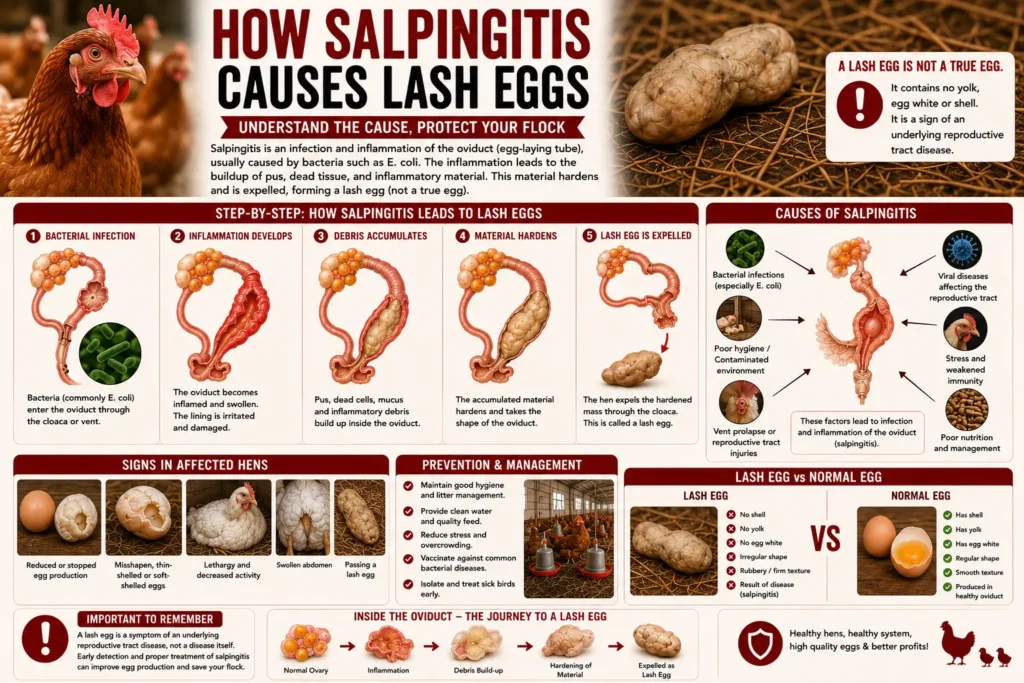
How salpingitis causes lash eggs comes down to one thing: infection disrupting the normal, orderly process of egg formation inside the oviduct. Instead of yolk, egg white, and shell layering together into a smooth egg, inflammation and bacteria cause these materials to clump into a solid, misshapen mass.
If you’ve found a strange, lumpy object in the nest box that isn’t quite an egg, understanding this process helps explain exactly what happened inside your hen — and what to do next. This guide breaks down the biology step by step, from healthy egg formation to the point where salpingitis takes over and produces a lash egg.
Table of Contents
What Is a Lash Egg, Exactly?
A lash egg isn’t a true egg at all. It’s a build-up of pus, inflammatory tissue, bacteria, and sometimes yolk material, all wrapped in a coating similar to egg white protein. The term “lash” comes from the older word “lash,” meaning refuse or waste matter, since these masses are essentially discarded infection byproducts shaped like an egg.
Read More: https://lashegg.com/chicken-reproductive-system/
Lash eggs typically appear:
- Firm to rubbery in texture
- Layered when cut open, like an onion
- Yellow, white, greenish, or blood-tinged in color
- Strongly foul-smelling
Lash Egg and Salpingitis: Why They’re Almost Always Linked
The connection between a lash egg and salpingitis is well documented in poultry pathology. While a small number of other reproductive issues can occasionally produce unusual masses, a true lash egg is considered a strong indicator of salpingitis in the vast majority of cases.
Healthy Egg Formation: The Baseline to Understand
To understand how salpingitis causes lash eggs, it helps to first know what’s supposed to happen. In a healthy hen, the oviduct processes each egg in five stages.
| Oviduct Section | Normal Function | Approximate Time |
| Infundibulum | Catches the yolk after ovulation | 15–18 minutes |
| Magnum | Adds egg white (albumen) | ~3 hours |
| Isthmus | Forms shell membranes | 1–1.5 hours |
| Uterus (Shell Gland) | Adds shell and pigment | 18–20 hours |
| Vagina | Egg exits, blunt end first | Brief |
This entire sequence normally runs smoothly, producing one complete, uniform egg roughly every 24–26 hours in a healthy laying hen.
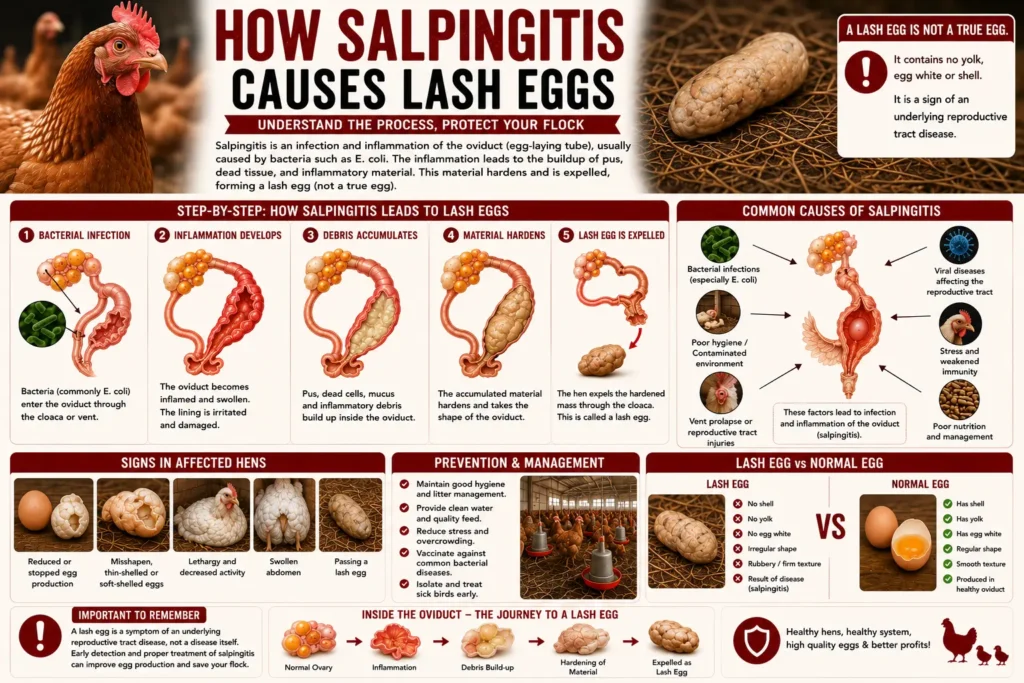
Step-by-Step: How Salpingitis Causes Lash Eggs
Step 1: Bacteria Enter the Oviduct
Most cases begin when bacteria, commonly E. coli, travel from the cloaca upward into the oviduct. This is called an ascending infection, and it’s the most frequent cause of salpingitis in laying hens.
Step 2: Inflammation Begins in the Oviduct Lining
Once bacteria establish themselves, the oviduct lining becomes inflamed and irritated. This immune response causes the tissue to release white blood cells, fluid, and inflammatory debris into the oviduct itself.
Step 3: Normal Egg-Forming Layers Are Disrupted
Instead of smoothly coating a single yolk with egg white and shell material, the infected magnum and uterus begin depositing these substances around clumps of pus and dead tissue instead.
Step 4: Layers Build Up Around the Infection
As the hen’s body continues trying to move material through the oviduct, more layers form around the infected mass, similar to how a healthy egg gains layers — except now the “core” is infection debris rather than a clean yolk.
Step 5: The Mass Is Passed as a Lash Egg
Eventually, the hen’s body expels this solid, layered mass through the vagina and cloaca, just as it would a normal egg. What comes out, however, is the lash egg — visible proof of the infection happening inside.
Did You Know? Some hens pass multiple lash eggs over several days or weeks if the underlying salpingitis isn’t treated, since the infection continues generating inflammatory material with each reproductive cycle.
Quick Answer: Salpingitis causes lash eggs by infecting the oviduct and disrupting normal egg formation, so instead of yolk and shell layering cleanly, pus and inflammatory debris get coated in egg-white-like material and passed as a solid mass.
Why This Happens More in Some Hens Than Others
High Egg Production
Hens that lay frequently have more ovulation cycles, which means more opportunities for the oviduct lining to be exposed to ascending bacteria over time.
Age
Hens over two years old are statistically more likely to develop salpingitis, as reproductive tissue becomes less resilient with repeated use.
Prior Respiratory Illness
Infections like infectious bronchitis virus or Mycoplasma gallisepticum can damage the oviduct lining early in life, creating vulnerability that shows up as salpingitis months or years later.
Poor Hygiene
Dirty nest boxes and damp bedding increase bacterial exposure near the vent, raising the risk of bacteria traveling into the oviduct.
Genetics
Commercial hybrid layers, bred for maximum egg output, show higher rates of oviduct disease compared to slower-laying heritage breeds.
Symptoms That Often Accompany a Lash Egg
Finding a lash egg rarely happens in isolation. Watch for these accompanying signs of salpingitis:
- Reduced or stopped egg-laying
- Swollen, firm, or fluid-filled abdomen
- A wide, upright “penguin” stance
- Lethargy or reduced appetite
- Pale comb and wattles
- Labored breathing in advanced cases
When One Lash Egg Isn’t the Whole Story
A single lash egg with no other symptoms sometimes reflects a mild, early-stage infection. Repeated lash eggs, or a lash egg combined with lethargy and abdominal swelling, points toward a more advanced case that needs veterinary attention.
When to Call a Vet: If a hen passes a lash egg and also shows lethargy, a swollen abdomen, labored breathing, or stops eating, veterinary evaluation is warranted rather than waiting to see if she improves on her own.
Lash Egg vs. Other Unusual Egg Findings
Not everything unusual in a nest box is a lash egg. Here’s how to tell the difference.
| Finding | Likely Cause | Key Feature |
| Lash egg | Salpingitis (oviduct infection) | Layered, foul-smelling, no true yolk/shell structure |
| Soft-shelled egg | Calcium deficiency, stress, first/last egg of cycle | Normal shape, thin or missing shell |
| Rubber egg | Same as soft-shelled, often young or old hens | Flexible, translucent shell |
| Blood-streaked egg | Minor vent trauma or early lay | Normal shell, blood on the outside |
| Double-yolk egg | Two ovulations released together | Larger than normal, normal shell |
| Yolkless egg (wind egg) | Reproductive tract irritation, young pullets | Small, no yolk inside |
If you’re ever unsure whether what you found is a lash egg, comparing it against these other possibilities — and consulting a vet if signs of illness are present — helps rule out simpler explanations first.
Diagnosing Salpingitis Behind a Lash Egg
A lash egg is a strong visual clue, but confirming salpingitis usually involves a few additional steps.
- Physical exam — checking the abdomen for swelling or fluid
- Palpation — feeling for masses or fluid buildup
- Radiographs or ultrasound — to visualize internal changes in the oviduct
- Bloodwork — checking for elevated white blood cells indicating infection
- Culture and sensitivity — identifying the exact bacteria involved, if discharge or fluid is available
- Necropsy — in the case of death, this is often the only way to confirm advanced salpingitis definitively, revealing a thickened, pus-filled oviduct
Treatment: Addressing the Cause, Not Just the Lash Egg
Since a lash egg is a symptom rather than the disease itself, treatment focuses on the underlying salpingitis.
Veterinary Treatment Options
- Targeted antibiotics, ideally chosen based on culture results
- Anti-inflammatory medication to reduce swelling and discomfort
- Fluid therapy for dehydrated or seriously ill hens
- Surgical removal of the oviduct in chronic or severe cases, allowing the hen to live without laying
- Hormonal implants in some cases, to pause egg production and give tissue time to heal
Supportive Home Care
- Isolate the hen to monitor her closely and reduce flock stress
- Keep her in a calm, quiet space with easy access to food and water
- Offer a high-quality, easily digestible diet
- Track symptoms daily, including appetite, droppings, and any further lash eggs
Warning: Giving random over-the-counter antibiotics without knowing the specific bacteria involved can allow the infection to worsen and contributes to antibiotic resistance. Professional guidance gives the treatment the best chance of working.
Expert Tip
Save or photograph any lash egg you find before disposing of it, along with the date. This record helps a veterinarian track how the condition is progressing if repeat episodes occur.
Can Salpingitis and Lash Eggs Be Prevented?
While no method guarantees a hen will never develop salpingitis, several practices lower the risk.
Coop and Nest Hygiene
- Clean nest boxes and bedding regularly
- Keep the coop dry, since damp litter encourages bacterial growth
- Provide enough nest boxes so hens aren’t forced into soiled bedding
Nutrition and Water
- Feed a complete, balanced layer ration
- Provide constant access to clean water
- Avoid abrupt feed changes that stress the digestive and reproductive systems
Flock Management
- Reduce overcrowding and general stress
- Quarantine new birds before introducing them to the flock
- Keep respiratory disease vaccinations current where recommended by a poultry veterinarian
Common Mistakes Owners Make
- Assuming a single lash egg means the problem is already over
- Waiting for severe symptoms before seeking veterinary care
- Treating with random antibiotics instead of getting a proper diagnosis
- Not isolating the affected hen, which increases her stress
- Overlooking gradual, weeks-long declines in egg production as unrelated
Prognosis After a Lash Egg
Outcomes vary depending on how early the underlying salpingitis is caught. Mild, early-stage infections identified quickly sometimes respond well to antibiotics, with hens returning to reduced or near-normal laying. Advanced cases, especially those involving significant abdominal fluid or repeated lash eggs, carry a more guarded outlook, and some hens do not fully recover even with treatment.
Hens that survive a serious episode linked to salpingitis and lash egg production often lay less afterward, since oviduct tissue may be permanently scarred.
FAQ
Q: How does salpingitis cause lash eggs? Salpingitis causes lash eggs by infecting and inflaming the oviduct, which disrupts the normal layering process. Instead of forming around a clean yolk, egg white and shell-like material build up around pus and inflammatory debris, forming a solid mass that’s passed like an egg.
Q: Is a lash egg the same as a normal egg gone wrong? No. A lash egg isn’t a malformed version of a regular egg. It’s made mostly of infection material and inflammatory tissue, coated in a protein layer, rather than containing a true yolk and standard egg structure.
Q: Can a hen pass more than one lash egg? Yes. If the underlying salpingitis isn’t treated, a hen can pass multiple lash eggs over days or weeks, since the infection continues to generate inflammatory material with each reproductive cycle.
Q: Does finding a lash egg always mean my hen has salpingitis? In the large majority of cases, yes — the link between a lash egg and salpingitis is well established. However, a veterinarian can confirm the diagnosis and rule out any less common causes.
Q: Is a hen in pain when passing a lash egg? Passing a lash egg can be uncomfortable, and hens with salpingitis often show signs of general illness, such as lethargy and reduced appetite, alongside or after passing one.
Q: Can salpingitis that causes lash eggs be cured? Mild, early cases sometimes resolve with prompt antibiotic treatment. Advanced or chronic cases are harder to fully cure and may require ongoing management or surgery rather than a complete resolution.
Q: Should I remove a lash egg from the coop right away? Yes. Remove it to prevent other birds from investigating or pecking at it, and consider photographing it first to share with a veterinarian if you’re seeking a diagnosis.