Fairy Egg vs Double Yolk Egg: Two Opposite Surprises From the Same Nest Box

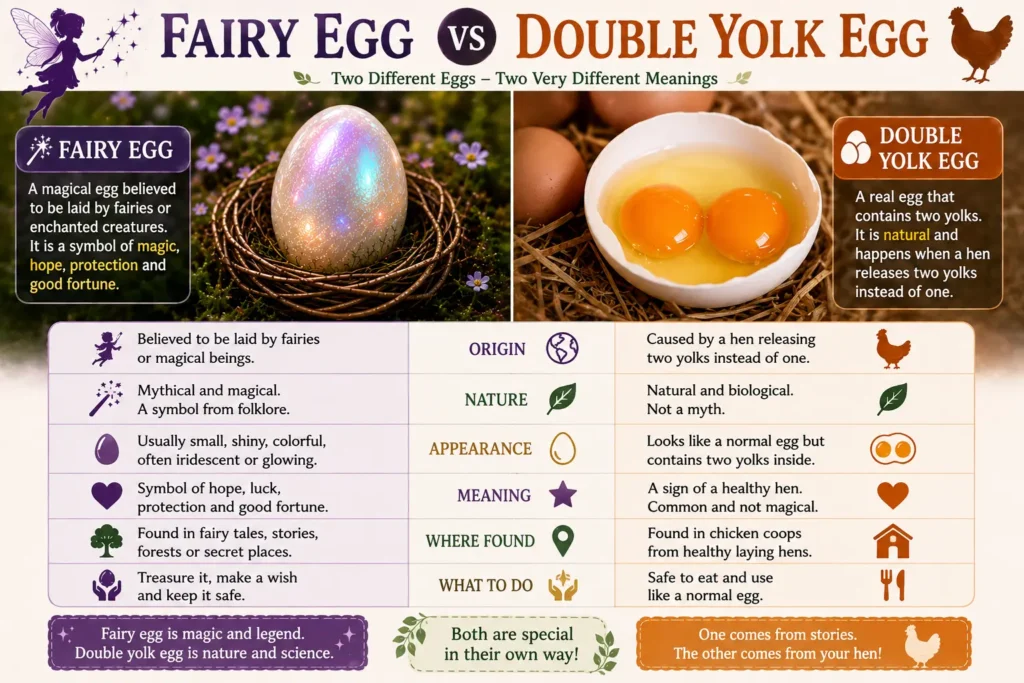
One morning you find an egg so small it fits in your palm. Another morning, a different egg feels heavier than usual and turns out to have two yolks inside. The fairy egg vs double yolk egg comparison covers two of the most talked-about oddities in backyard egg collecting, and they sit at completely opposite ends of the same spectrum.
A fairy egg is a tiny, usually yolkless egg. A double yolk egg is a larger-than-normal egg containing two yolks instead of one. Both are considered harmless quirks in most cases, but they happen for very different reasons and mean different things about your hen’s reproductive cycle. This guide breaks down exactly how they differ, why each occurs, and which one, if either, is worth watching more closely.
Quick Answer: A fairy egg forms when a tissue fragment gets coated in egg white and shell instead of a normal yolk, resulting in a tiny, mostly yolkless egg. A double yolk egg forms when two yolks release close together and get wrapped in one shell, resulting in a larger-than-normal egg. Both are generally harmless on their own.
Table of Contents
The Core Difference: Too Little Yolk vs. Too Much Yolk
The simplest way to understand fairy egg vs double yolk egg is to think of them as opposite ends of the same process. A hen’s oviduct is built to wrap whatever enters it — yolk or otherwise — in albumen and shell.
- Fairy egg: Something other than a yolk (usually a tissue fragment) enters the tract, resulting in little or no yolk inside a small egg.
- Double yolk egg: Two full yolks enter the tract close together, resulting in extra yolk inside a larger-than-normal egg.
One represents an egg with less material than usual moving through the system. The other represents an egg with more material than usual. Both are considered variations within normal reproductive function rather than signs of illness in the vast majority of cases.
Read More: https://lashegg.com/fairy-egg-vs-lash-egg/
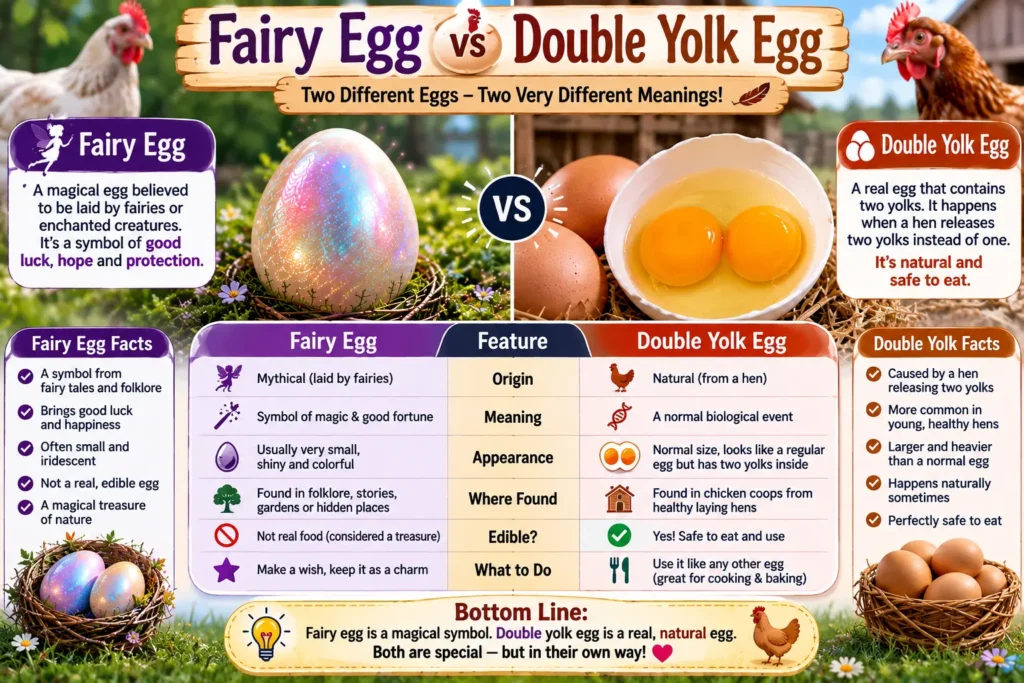
H3: Fairy Egg vs Double Yolk Egg — Side-by-Side Comparison
| Feature | Fairy Egg | Double Yolk Egg |
| Size | Much smaller than normal | Larger than normal |
| Yolk content | Usually none, sometimes a fragment | Two full yolks |
| Cause | Tissue fragment entering the oviduct | Two yolks released close together (double ovulation) |
| Most common in | Young pullets, older hens | Young pullets, some genetic lines |
| Shell | Fully formed, normal structure | Fully formed, often slightly irregular shape |
| Concern level | Low, watch for frequency | Low, occasionally linked to injury risk during laying |
| Safe to eat | Yes | Yes |
What Causes a Fairy Egg?
A fairy egg happens when a small piece of tissue, usually shed from inside the reproductive tract, enters the oviduct and gets processed the same way a yolk would be. The shell gland doesn’t distinguish between real yolk and stray tissue, so it wraps the object in albumen and shell, producing a miniature egg,
This is most common in:
- New pullets whose reproductive systems are still calibrating a laying rhythm
- Older hens whose ovulation is becoming less regular as their laying years wind down
What Causes a Double Yolk Egg?
A double yolk egg happens when two yolks release from the ovary close together — sometimes called double ovulation — and both travel down the oviduct at roughly the same time. Instead of forming two separate eggs, the tract wraps both yolks in one larger shell.
This is most common in:
- Young pullets, whose hormone levels haven’t yet settled into a fully regular single-ovulation rhythm
- Certain individual hens or genetic lines that show a higher natural tendency toward double ovulation
- Hens on accelerated lighting schedules, occasionally, though this connection is less consistently documented
Did You Know? Double-yolk eggs are common enough in young flocks that many commercial egg producers candle and sort them separately, since a hen’s first weeks of laying often produce a higher rate of double yolks before her cycle settles.
Which One Is More Common?
Double yolk eggs are generally reported more frequently than fairy eggs, especially in young flocks just starting to lay. Fairy eggs tend to be rarer and often become a memorable, photograph-worthy event precisely because they don’t happen as often.
Neither has a precisely documented occurrence rate across all backyard flocks, since reporting is largely anecdotal, but the general consensus among poultry keepers and hatcheries lines up with double yolks being the more frequent oddity of the two.
Is a Fairy Egg or a Double Yolk Egg More Concerning?
Both are usually harmless, but each carries a slightly different watch-point.
For fairy eggs, the concern arises with frequency. A single fairy egg from an otherwise healthy hen is a non-issue. Several fairy eggs from the same hen within a short window, especially alongside reduced normal laying or other symptoms, is worth monitoring.
For double yolk eggs, the concern is less about the egg itself and more about the physical strain of laying a larger-than-normal egg. Occasionally, a hen laying an unusually large double yolk egg can experience minor straining or, in rare cases, be more prone to related laying difficulties. A single double yolk egg rarely causes a problem; hens that consistently lay oversized eggs are the ones worth keeping an eye on.
Warning: A hen that appears to strain, stops eating, or shows abdominal swelling around the time of laying — whether it’s a fairy egg, a double yolk egg, or any egg — should be evaluated by a veterinarian rather than monitored indefinitely at home.
Fairy Egg vs Double Yolk Egg: Food Safety
Both are safe to eat. Neither condition affects the safety of the egg itself, since both are still formed through the hen’s normal egg-production process, just with an atypical amount of yolk involved.
- A fairy egg is safe to eat, though it contains little nutritional value given its size and lack of yolk.
- A double yolk egg is safe to eat and, if anything, offers more nutritional content than a standard egg due to the extra yolk.
| Question | Fairy Egg | Double Yolk Egg |
| Can you eat it? | Yes | Yes |
| Any special handling? | No, standard egg handling applies | No, standard egg handling applies |
| Nutritional difference | Lower than a normal egg | Higher than a normal egg |
| Can it hatch if fertilized? | No — no yolk to develop an embryo | Rarely successfully — two embryos competing for limited space usually don’t survive to hatch |
Tiny Egg Comparison: Ruling Out Other Explanations
Fairy eggs and double yolk eggs aren’t the only unusual finds in a nest box. A broader tiny egg comparison helps rule out other possibilities if you’re not sure what you’re looking at.
| Unusual Egg | Size | Likely Cause |
| Fairy egg | Very small | Tissue fragment triggering shell formation |
| Small first egg from a pullet | Small, but with a small yolk | Reproductive system still calibrating size |
| Double yolk egg | Larger than normal | Two yolks released close together |
| Soft-shell egg | Normal to small | Calcium deficiency, stress, or age |
| Lash egg | Variable, irregular shape | Bacterial infection (salpingitis) |
The lash egg is the one genuine outlier on this list. Unlike a fairy egg or double yolk egg, a lash egg isn’t a true egg at all — it’s a mass of pus, tissue, and infected material caused by inflammation of the oviduct, and it points to a health issue that needs veterinary attention.
Step-by-Step: How to Tell Which One You’ve Found
- Check the size first. Smaller than normal points toward a fairy egg; larger than normal points toward a double yolk egg.
- Crack it open if you’re curious. No yolk or a tiny fragment confirms a fairy egg. Two distinct yolks confirms a double yolk egg.
- Note the shell shape. Both usually have a normal, hard shell, though double yolk eggs sometimes look slightly elongated to accommodate the extra content.
- Consider the hen’s age and laying history. Young pullets are more likely to produce either type as their systems calibrate; older hens lean more toward fairy eggs as laying frequency declines.
- Watch for repeat occurrences. A one-time event of either type is rarely worth concern. A repeating pattern is worth tracking.
Expert Tip: If you keep a laying log, note unusual eggs by type and date. Over a few months, this makes it easy to see whether fairy eggs or double yolk eggs are a passing phase tied to a young hen settling in, or a recurring trait specific to one bird.
When to Call a Vet
When to Call a Vet: Neither a fairy egg nor a double yolk egg typically needs a vet visit on its own. Call a veterinarian if either type becomes frequent, if normal laying slows down alongside them, or if the hen shows straining, lethargy, abdominal swelling, or appetite loss.
Common Mistakes Owners Make
Common Mistakes
- Assuming any unusually sized egg must be one or the other without checking what’s actually inside
- Worrying about a single occurrence of either type instead of watching for a pattern
- Confusing a fairy egg or double yolk egg with a lash egg, which is a genuinely different and more concerning condition
- Not tracking which hen is producing unusual eggs, making it harder to spot a real pattern later
People Also Ask
Which is rarer, a fairy egg or a double yolk egg? Fairy eggs are generally reported less often than double yolk eggs, which tend to show up more commonly, especially in young flocks just starting to lay.
Can one hen lay both a fairy egg and a double yolk egg over her lifetime? Yes. Since both are tied to normal variation in the reproductive cycle rather than being mutually exclusive traits, the same hen can produce either type at different points in her laying life.
Is a double yolk egg more nutritious than a fairy egg? Yes, significantly. A double yolk egg contains extra yolk and is more nutrient-dense than a standard egg, while a fairy egg, lacking yolk, contains far less nutritional content.
Do fairy eggs or double yolk eggs affect a hen’s future laying? Neither typically affects a hen’s ongoing laying ability. Both are usually isolated events or short-term patterns rather than lasting changes to her reproductive function.
Can a double yolk egg hatch into two chicks? It’s extremely rare. Two embryos developing in the same shell typically don’t have enough space or resources to both survive to hatching.
Final Thoughts
The fairy egg vs double yolk egg comparison comes down to opposite ends of the same biological process — one with too little material moving through the oviduct, the other with too much. Both are common enough quirks in backyard flocks that most owners will encounter one or the other eventually, and both are generally harmless when they happen occasionally.
Keep watching the pattern rather than reacting to a single unusual egg. If either type becomes frequent, or if your hen shows other symptoms alongside them, that combination is worth a conversation with a veterinarian rather than continued guessing at home.
FAQ
What is the main difference between a fairy egg vs double yolk egg? A fairy egg is a tiny egg usually without a yolk, caused by a tissue fragment entering the oviduct. A double yolk egg is a larger egg containing two yolks, caused by two yolks releasing close together.
Are both fairy eggs and double yolk eggs safe to eat? Yes, both are safe to eat. Neither condition affects food safety, since both form through the hen’s normal egg-production process.
Which hens are more likely to lay a fairy egg vs a double yolk egg? Young pullets are prone to both as their reproductive systems calibrate. Older hens lean more toward fairy eggs, while double yolk eggs are more associated with younger layers and certain individual hens.
Is it bad if my hen lays a lot of double yolk eggs? Occasional double yolk eggs are generally not a concern. Frequent, very large double yolk eggs can occasionally increase strain during laying, so it’s worth monitoring if it becomes a consistent pattern.
Can a fairy egg or double yolk egg mean my hen is sick? Rarely, on their own. A single occurrence of either is typically normal variation. Frequent occurrences paired with other symptoms like lethargy or reduced laying are the pattern worth a veterinary opinion.
How do I know if I’m looking at a fairy egg, double yolk egg, or something else entirely? Check the size and crack it open if needed — no yolk points to a fairy egg, two yolks point to a double yolk egg. If what you’re seeing lacks a proper shell and looks like a mass of tissue, it may be a lash egg, which needs veterinary attention.