Misshapen Eggs: What Causes Them and How to Fix It

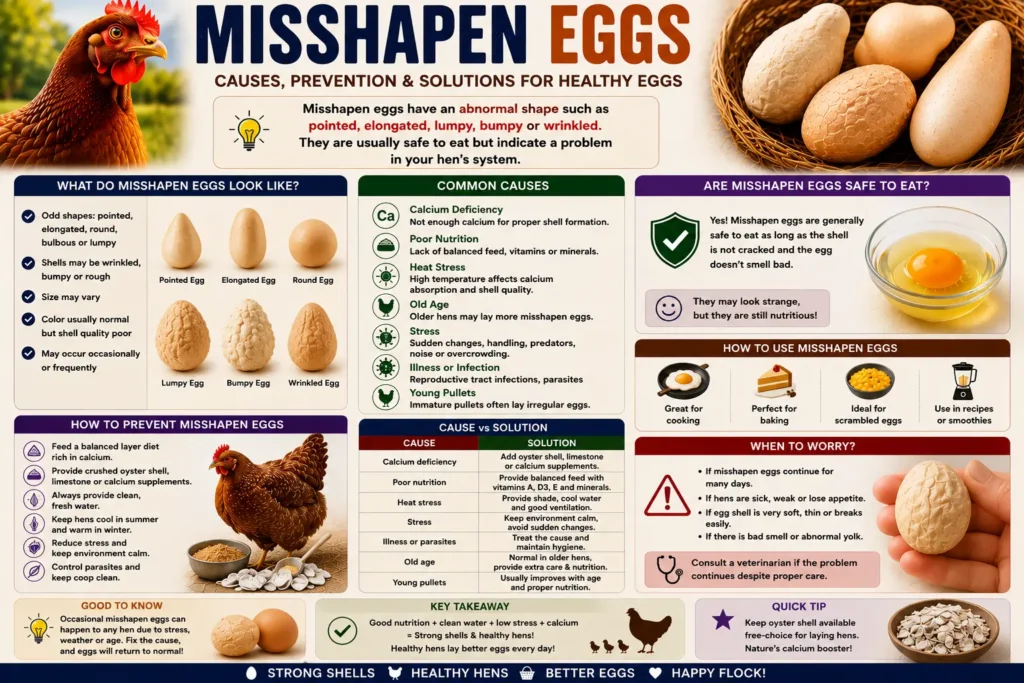
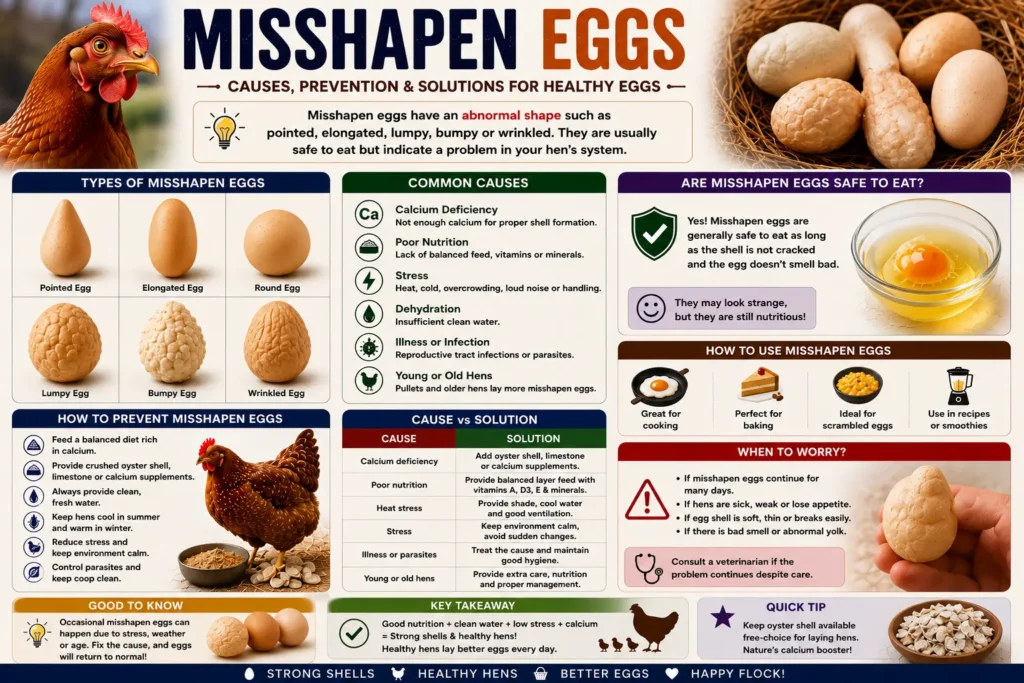
Misshapen eggs — lopsided, wrinkled, elongated, or oddly rounded — are one of the more unsettling things a flock owner can find in the nest box. Most of the time, misshapen eggs point to something ordinary: a young hen still figuring out her system, a stressful week, or a natural part of aging. Occasionally, they signal a disease that needs attention. This guide breaks down every known cause of misshapen eggs, how to tell a harmless case from a serious one, and exactly what to do about it.
Table of Contents
Quick Answer
Misshapen eggs are most often caused by hen age, stress, overcrowding in the nest box, or a disruption during shell formation. Infectious bronchitis is the most common disease-related cause. If misshapen eggs appear alongside respiratory symptoms or affect many hens at once, veterinary evaluation is warranted.
What Are Misshapen Eggs?
An egg takes roughly 24–26 hours to form inside a hen, moving through several sections of the reproductive tract that shape, smooth, and harden the shell in sequence. Misshapen eggs happen when something interrupts or rushes that process — a muscle contraction at the wrong moment, a second egg entering the shell gland too early, or physical pressure while the shell is still soft.
Read More: https://lashegg.com/thin-shell-eggs-causes-fixes-prevention/
Common shapes and what they usually mean:
- Wrinkled or ridged shells — often linked to infectious bronchitis or stress during shell hardening
- Elongated or torpedo-shaped eggs — usually a young hen’s reproductive tract still adjusting
- Flat-sided or dented eggs — pressure from another egg or nest crowding before the shell fully hardened
- Double-yolked or oversized misshapen eggs — two ovulations released too close together
- Body-checked eggs — a thin shell layer added after an initial crack inside the hen
How to Tell If Misshapen Eggs Are a Problem
One odd egg from one hen, especially a new layer, is rarely a concern. Misshapen eggs become a real signal when they show up across multiple hens in the same week, get worse over time, or appear alongside coughing, lethargy, or a drop in overall egg output.
Causes of Misshapen Eggs
Hen Age and Point of Lay
Pullets just starting to lay often produce a few misshapen eggs while their reproductive tract calibrates. This is completely normal and typically resolves within two to four weeks as the hen settles into a rhythm.
Stress and Environmental Disruption
A startled hen mid-lay, a loud noise, a predator scare, or a sudden coop change can interrupt the shell-forming process, producing wrinkles, dents, or an odd shape. Because shell formation happens over many hours, any disruption during that window can leave a visible mark.
Nest Box Crowding
When too many hens share too few nest boxes, eggs get pressed against each other or against the hen’s body before the shell fully hardens, leading to flat sides or dents. University extension poultry guidelines generally recommend one nest box for every four to five hens to reduce this risk.
Double Ovulation
Occasionally a hen releases two yolks close together, and both end up in one misshapen, oversized shell. This is a normal reproductive quirk, most common in young hens or certain heavy breeds, and isn’t a health concern on its own.
Expert Tip
Keep nest boxes clean, dim, and private. Hens that feel exposed while laying are more likely to rush the process or get interrupted, both of which raise the odds of misshapen eggs.
Table: Common Causes of Misshapen Eggs
| Cause | Typical Shape | Action Needed |
| Point of lay (young hen) | Small, elongated, or lopsided | None — resolves naturally |
| Stress or disruption | Wrinkled or dented | Reduce noise, secure coop, add privacy |
| Nest box crowding | Flat-sided or dented | Add more nest boxes |
| Double ovulation | Oversized, irregular | None — occasional and harmless |
| Infectious bronchitis | Wrinkled, rough, thin-shelled | Veterinary diagnosis and biosecurity review |
| Newcastle disease | Deformed + neurological signs | Immediate veterinary attention |
| Older hen decline | Gradual shape irregularity | Adjust expectations; monitor overall health |
| Calcium/nutrient imbalance | Soft or irregular shell edges | Review layer feed and calcium supplementation |
Disease-Related Causes of Misshapen Eggs
While most misshapen eggs are harmless, a few diseases directly interfere with the shell gland and reproductive tract, producing deformed eggs as a visible symptom.
Infectious Bronchitis Virus
Infectious bronchitis is the disease most frequently linked to misshapen and deformed eggs in both backyard and commercial flocks. The Merck Veterinary Manual identifies this coronavirus as a leading cause of wrinkled, rough, and misshapen shells, often paired with coughing, sneezing, or nasal discharge. Recovery is possible, but shell quality can stay affected for weeks after the respiratory symptoms clear.
Newcastle Disease
Newcastle disease can also disrupt normal shell formation, though it’s usually accompanied by more severe signs like tremors, twisted necks, or a sharp drop in flock health. This is a reportable disease in many countries, so any suspected case should go straight to a veterinarian or agricultural extension office.
Mycoplasma and Other Respiratory Infections
Chronic respiratory infections, including mycoplasma gallisepticum, can stress the reproductive system enough to produce occasional deformed eggs, usually alongside longer-term respiratory symptoms rather than as a standalone sign.
When to Call a Vet
Reach out to a poultry veterinarian if misshapen eggs appear alongside coughing, sneezing, nasal discharge, reduced appetite, or a sudden flock-wide drop in egg production. A single odd egg from a young hen doesn’t need medical attention — a pattern across the flock does.
Genetics and Breed Factors
Some breeds are simply more prone to occasional misshapen eggs due to their reproductive anatomy or heavier body size. This is a normal breed trait rather than a health defect, and it doesn’t usually worsen over time in an otherwise healthy hen.
Reproductive Tract Abnormalities
In rare cases, a hen may have a structural issue in her oviduct, either from injury, infection, or a congenital difference, that consistently produces deformed eggs. If one specific hen repeatedly lays misshapen eggs while the rest of the flock is normal, this individual-hen pattern is worth mentioning to a vet, even without other symptoms.
How to Reduce Misshapen Eggs: Step-by-Step
- Check nest box ratio — aim for one box per four to five hens.
- Reduce stress triggers — secure the coop against predators and minimize sudden changes.
- Review the feed — confirm a complete layer ration with balanced calcium and protein.
- Watch for illness signs — coughing, discharge, or lethargy point toward disease.
- Track which hens are affected — one hen versus many changes the likely cause.
- Give young hens time — most point-of-lay irregularities resolve within a month.
- Maintain biosecurity — limit exposure to new or visiting birds without quarantine.
Common Mistakes
- Assuming every misshapen egg means disease and panicking unnecessarily
- Overcrowding nest boxes to save space
- Ignoring a repeated pattern from the same hen
- Skipping quarantine when adding new birds, raising infectious bronchitis risk
Did You Know?
A hen’s egg spends most of its formation time — around 20 hours — inside the shell gland, which is exactly why stress or disruption during that window has such a visible effect on shape.
Misshapen Eggs vs. Other Egg Abnormalities
| Problem | Appearance | Most Likely Cause |
| Misshapen (deformed) eggs | Lopsided, wrinkled, dented, or irregular | Stress, age, nest crowding, or early disease |
| Thin shell eggs | Fragile, flexes under pressure | Calcium/vitamin D3 deficiency, heat, age |
| Soft shell eggs | Rubbery, little or no hard shell | Severe calcium deficiency, reproductive disorder |
| Double-yolked eggs | Oversized, sometimes irregular | Two ovulations close together |
| Wind eggs (yolkless) | Small, round, no yolk | Reproductive tract irritation, common in pullets |
Warning
A sudden increase in misshapen eggs across many hens, especially combined with respiratory symptoms or a sharp production drop, can point to a contagious disease spreading through the flock. This calls for prompt veterinary involvement rather than a wait-and-see approach.
Prevention Checklist for Fewer Misshapen Eggs
- Provide one nest box per four to five hens
- Keep nest boxes dim, clean, and private
- Feed a complete, age-appropriate layer ration
- Limit sudden noise, predator exposure, and coop disruptions
- Quarantine new birds before flock introduction
- Vaccinate against infectious bronchitis and Newcastle disease where regionally recommended (consult a vet)
- Track egg shape trends weekly to catch flock-wide patterns early
Conclusion
Misshapen eggs are usually explained by ordinary factors: a young hen still adjusting, a stressful afternoon, or a crowded nest box. Start by checking the basics — nest box space, feed quality, and recent disruptions — before assuming illness. If misshapen eggs continue for more than a few weeks, spread across multiple hens, or show up with respiratory symptoms, a veterinary evaluation is the safest way to rule out infectious causes like bronchitis or Newcastle disease.
5. FAQ
What causes misshapen eggs in chickens? Misshapen eggs are most often caused by hen age, stress during shell formation, nest box crowding, or double ovulation. Infectious bronchitis is the leading disease-related cause.
Are misshapen eggs safe to eat? Yes, misshapen eggs are safe to eat as long as the shell isn’t cracked and the egg has been handled and stored properly, following standard USDA egg safety guidance.
Can stress cause deformed eggs? Yes. Disruptions during the roughly 24-hour shell-forming process, like predator scares or sudden noise, can produce wrinkled, dented, or lopsided eggs.
Do young hens lay more misshapen eggs? Yes. Pullets just starting to lay commonly produce a few misshapen eggs while their reproductive tract adjusts, usually resolving within a few weeks.
What disease causes misshapen eggs? Infectious bronchitis is the most common disease linked to misshapen eggs, often paired with coughing, sneezing, or nasal discharge. Newcastle disease can also cause deformed eggs.
Should I worry about one misshapen egg? Not usually. A single odd egg, especially from a young or older hen, is common. A pattern across multiple hens or repeated illness signs is what warrants concern.