Internal Laying Treatment: Matching the Right Response to the Right Stage

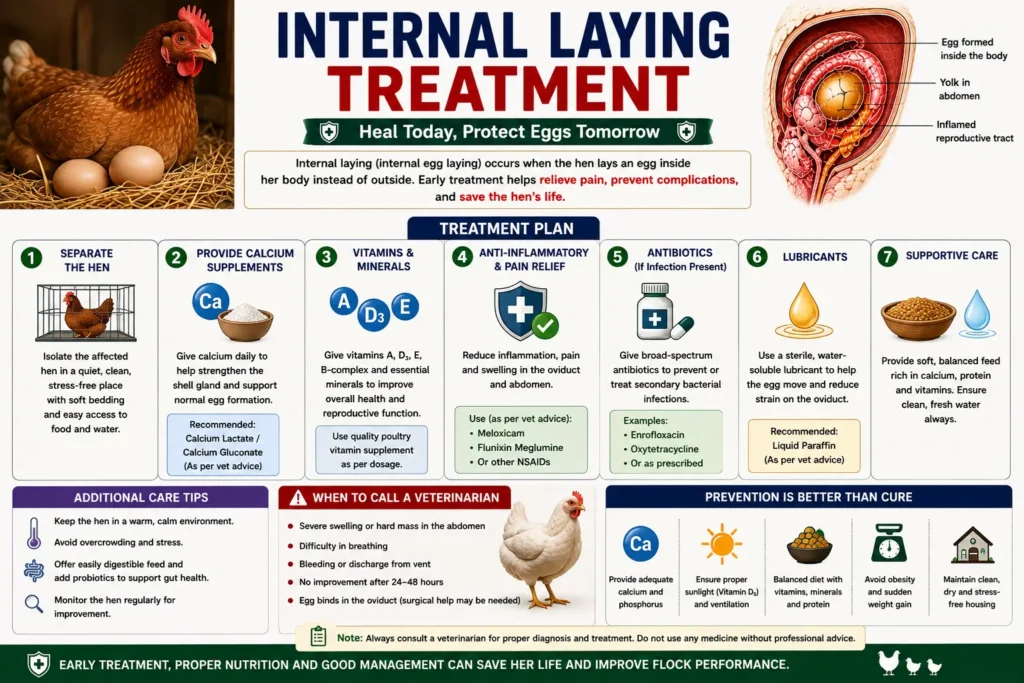
Internal laying treatment isn’t one-size-fits-all. What helps a hen in the earliest stage of internal laying — where a yolk has misdirected into the abdomen but no infection has set in yet — looks very different from what a hen needs once that yolk has triggered a full bacterial infection.
Internal laying happens when a released egg yolk misses the oviduct and drops into the abdominal cavity instead. Some hens handle a single, isolated event without much trouble. Others develop egg yolk peritonitis, a painful and potentially life-threatening inflammation and infection that needs prompt veterinary care.
This guide walks through the full internal laying treatment ladder — from home monitoring for mild cases to the medical and surgical options a vet may recommend for more advanced ones — so you know exactly what to expect at each stage.
Table of Contents
Quick Answer: Internal laying treatment ranges from close monitoring and supportive care for mild, early cases to vet-prescribed antibiotics, abdominal fluid drainage, hormone implants, or surgery for hens with infection or recurring episodes. There’s no home cure for advanced cases — diagnosis and treatment intensity should match what a vet finds on exam.
Why Internal Laying Treatment Depends on Severity
Not every internal-laying event turns into a medical emergency. A hen’s body can sometimes reabsorb a small amount of misdirected yolk without major complications, especially if it happens rarely. The real danger comes when yolk accumulates repeatedly, or when bacteria — commonly E. coli — reach the abdominal cavity and multiply.
Because of this range, effective internal laying treatment starts with figuring out where a hen actually sits on that spectrum, not applying the same fix to every case.
The Internal Laying Treatment Ladder
| Stage | What’s Happening | Typical Treatment Approach |
| Mild / isolated | Small amount of misdirected yolk, no clear infection | Close monitoring, supportive care, vet check advised |
| Moderate | Recurrent internal laying, mild inflammation | Vet exam, possible antibiotics, dietary and stress management |
| Advanced | Infection (egg peritonitis), fluid buildup | Culture-based antibiotics, fluid drainage, supportive care |
| Chronic / recurring | Repeated episodes despite treatment | Hormone implant, surgical removal of the oviduct |
Step 1: Confirming the Diagnosis Before Treating Anything
Treating internal laying without a proper diagnosis is one of the most common and costly mistakes owners make. A vet typically uses several tools together to confirm what’s happening and how advanced it is:
- Physical exam and palpation to check for abdominal fullness or firmness
- Ultrasound or radiographs to identify fluid or retained material
- Abdominocentesis (fluid tap) to sample and culture abdominal fluid
- Bloodwork to assess infection markers and organ function
Expert Tip: Ask specifically for a culture and sensitivity test on any fluid sample. This tells your vet exactly which bacteria are present and which antibiotic will actually work, rather than starting treatment based on guesswork.
How to Treat Internal Laying at Home: What’s Actually Appropriate
Home care plays a real supporting role, but it has clear limits. It supports recovery — it doesn’t replace diagnosis or medical treatment for anything beyond the mildest cases.
- Provide a warm, quiet, low-stress space away from an active flock
- Offer easily digestible, high-protein food to support recovery
- Ensure constant access to fresh water, with electrolytes if appetite is reduced
- Track weight, appetite, and droppings daily to catch changes early
- Reduce handling stress while still monitoring closely
Warning: Home care alone is not internal laying treatment for a hen with a swollen abdomen, labored breathing, or loss of appetite. These signs point to infection or fluid buildup that needs veterinary intervention, not just supportive care.
Read More: http://lashegg.com/internal-laying-symptoms/
Medical Internal Laying Treatment Options
Antibiotic Therapy
For hens with confirmed or suspected infection, vets prescribe antibiotics based on culture results whenever possible — commonly enrofloxacin or amoxicillin-based options, given for 7 to 14 days. Poultry metabolize medications differently than mammals, so dosing needs to come from a vet familiar with avian medicine, not general guidance found online.
Abdominal Fluid Drainage
When fluid buildup is pressing on the lungs or air sacs, a vet can perform abdominocentesis to remove fluid and relieve pressure. This provides fast relief and easier breathing, though it addresses the symptom rather than the underlying cause on its own.
Anti-Inflammatory and Supportive Medication
Vets may add anti-inflammatory or pain medication to reduce discomfort and support recovery alongside antibiotics, particularly in hens showing clear signs of distress.
Preventing Recurrence: Hormone Implant Treatment
One of the most effective long-term internal laying treatment options for hens with repeated episodes is a deslorelin (GnRH) hormone implant, placed by a vet. It suppresses ovulation for several months, which means fewer opportunities for yolk to misdirect into the abdomen in the first place.
Did You Know? Every ovulation cycle carries some risk of internal laying in hens prone to it. Reducing how often a hen ovulates is one of the few internal layer treatment strategies that addresses the root cause rather than just managing symptoms after the fact.
Surgical Internal Laying Treatment: Salpingohysterectomy
For hens with chronic, recurring internal laying, or where an egg is physically stuck and can’t pass, surgical removal of the oviduct may be recommended. It’s a more significant procedure, both financially and physically for the hen, but for the right case it removes the source of the problem rather than managing it repeatedly.
Internal Laying Treatment Options Compared
| Treatment | Best For | Limitations |
| Monitoring + supportive care | Mild, isolated, non-infected cases | Not sufficient once infection or fluid buildup is present |
| Antibiotics | Confirmed or suspected bacterial infection | Needs culture-based selection for best results |
| Fluid drainage | Breathing difficulty from fluid buildup | Relieves symptoms; doesn’t stop underlying cause |
| Hormone implant | Hens with repeated internal laying episodes | Temporary — needs re-implanting periodically |
| Surgery (salpingohysterectomy) | Chronic or severe recurring cases | Higher cost and recovery time; not needed for mild cases |
Recovery: What to Expect After Treatment
Recovery timelines vary depending on severity and treatment type. A hen treated early for a mild case may bounce back within one to two weeks. A hen recovering from surgery or a severe infection may need several weeks of restricted activity, close monitoring, and follow-up vet visits.
- Watch appetite and energy levels daily during recovery
- Keep the hen separated from an active flock until fully recovered
- Follow the complete antibiotic course even if symptoms improve early
- Schedule any recommended follow-up exams or fluid rechecks
- Discuss whether a hormone implant makes sense once the hen has stabilized
Common Mistakes: Stopping antibiotics early once a hen “seems better,” skipping the vet follow-up because symptoms have improved, and reintroducing a recovering hen to a stressful or crowded flock too soon are frequent setbacks in internal laying treatment.
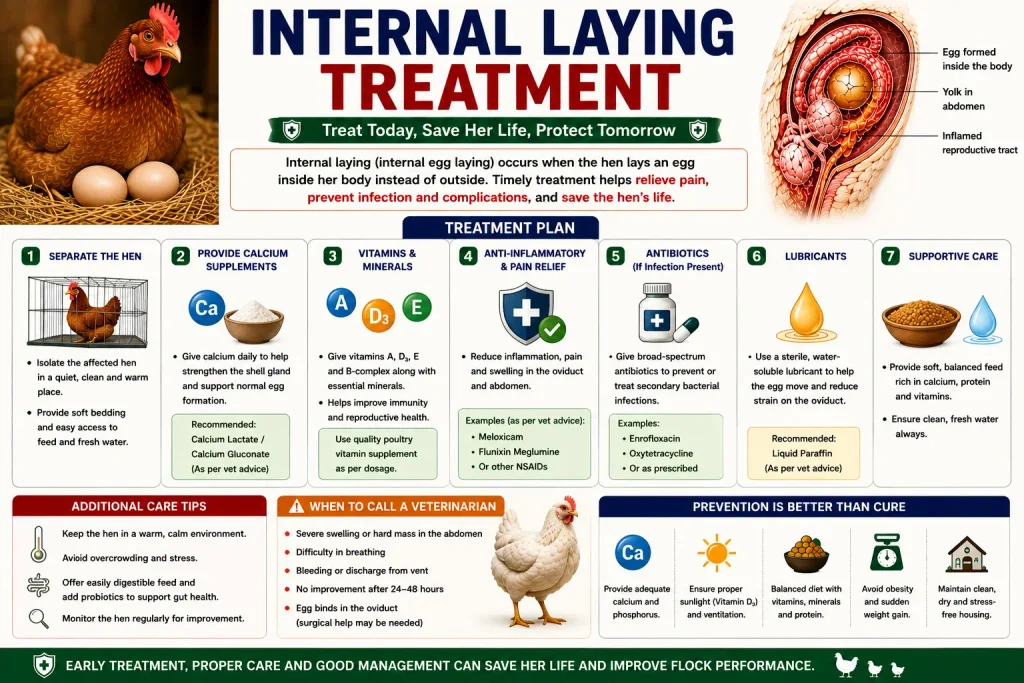
Reducing the Risk of Future Internal Laying
- Maintain a healthy body weight through balanced, portion-appropriate feeding
- Provide a quality layer diet with proper calcium and protein levels
- Minimize sudden stress: secure housing, predator-proofing, stable routines
- Monitor hens with a history of soft-shelled or misshapen eggs
- Give closer attention to hens over two years old
- Discuss preventive hormone therapy with a vet for high-risk or repeat cases
When to Call a Vet: Any hen with a swollen abdomen, labored breathing, sudden loss of appetite, or a stop in laying needs prompt veterinary evaluation. Waiting to see if things improve is one of the biggest factors that turns a treatable case into a critical one.
People Also Ask
How do you treat internal laying in chickens? Treatment depends on severity — mild cases may only need close monitoring and supportive care, while infected or advanced cases typically require vet-prescribed antibiotics, possible fluid drainage, and sometimes a hormone implant or surgery to prevent recurrence.
Can internal laying be treated without antibiotics? In very mild, non-infected cases, supportive care alone may be enough, but this should still be confirmed by a vet. Once infection is present, antibiotics are usually necessary for effective treatment.
Is surgery always needed for internal laying? No. Surgery is generally reserved for chronic, recurring cases or when an egg is physically stuck. Many hens respond well to antibiotics and supportive care without ever needing surgery.
How long does internal layer treatment take to work? Antibiotic courses typically run 7 to 14 days, with visible improvement often starting within the first few days if the correct antibiotic was chosen based on culture results. Full recovery can take longer depending on severity.
FAQ
What is the best internal laying treatment for a hen with a swollen abdomen? The best approach starts with a vet diagnosis, since a swollen abdomen can mean different things. If internal laying with infection is confirmed, treatment usually combines antibiotics, supportive care, and sometimes fluid drainage.
How to treat internal laying at home safely? Safe home care includes a warm, low-stress environment, easy-to-digest food, and close daily monitoring — but it should support, not replace, a vet diagnosis, especially once symptoms like abdominal swelling or reduced appetite appear.
Does internal layer treatment always require a hormone implant? No. Implants are typically recommended for hens with repeated episodes, not every case. A single mild event may not need one, though your vet can advise based on the hen’s history and breed.
Can internal laying come back after treatment? Yes, it can recur, particularly in hens with ongoing risk factors like high egg production or a prior infection. This is why many vets discuss hormone implants or, in severe repeat cases, surgery as longer-term solutions.
Is internal laying treatment expensive? Costs vary by region and severity. Basic monitoring and a vet exam are the least expensive path; antibiotics, imaging, fluid drainage, or surgery increase costs. Ask your vet for a treatment plan with cost options upfront.