Chicken Reproductive System: How Hens Actually Make an Egg

The chicken reproductive system is a finely tuned assembly line that turns a single yolk into a finished egg in about 24 to 26 hours. Most flock owners collect eggs daily without ever thinking about the internal process behind them, but understanding this system helps explain everything from soft-shelled eggs to sudden drops in laying.
This guide breaks down the hen reproductive system organ by organ, explains how the egg-laying cycle works, and covers the most common problems that affect a chicken’s ability to lay well.
Table of Contents
Overview: What Makes Up the Chicken Reproductive System
Unlike mammals, hens have a reproductive system built almost entirely around one functional ovary and one functional oviduct — usually the left side. The right ovary and oviduct typically stop developing early in a chick’s life, a trait believed to have evolved to reduce body weight for flight.
The chicken reproductive system has two main parts:
- The ovary — where yolks develop and are released
- The oviduct — a long, coiled tube where the yolk becomes a complete, shelled egg
Together, these structures work continuously through a hen’s productive years, guided by hormones, light exposure, and overall health.
Why Only One Side Develops
In the embryo, both ovaries start forming. As the chick develops, the right ovary and oviduct regress, leaving only the left side functional in nearly all hens. This is a normal, expected part of chicken oviduct anatomy and not a defect.
The Ovary: Where Egg Formation Begins
The ovary looks like a small cluster of grapes of different sizes, each one a developing yolk at a different stage of growth. A hen is born with all the potential egg cells she will ever have, though most never fully mature.
How Yolks Develop
Yolks grow in size over roughly 7–10 days, absorbing fats and proteins from the hen’s bloodstream. Nutrition directly affects yolk quality, which is why a poor diet often shows up as pale or watery yolks.
Read More:https://lashegg.com/salpingitis-in-laying-hens/
Ovulation
When a yolk reaches full size, it’s released from the ovary in a process called ovulation. This typically happens within 30–75 minutes after the hen lays her previous egg, which is why hens tend to lay at a similar time each day, gradually shifting later as daylight hours change.
Did You Know? A hen usually cannot lay two eggs from the same ovulation cycle in one day, which is why daily laying still leaves gaps on some days depending on the time ovulation occurs.
The Oviduct: The Egg-Building Assembly Line
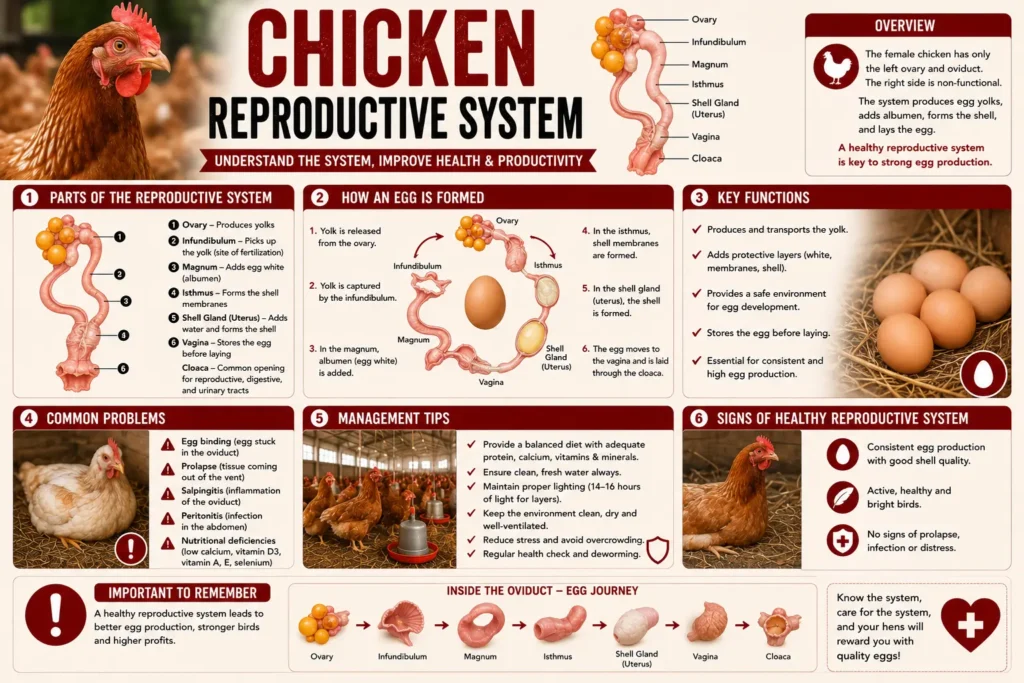
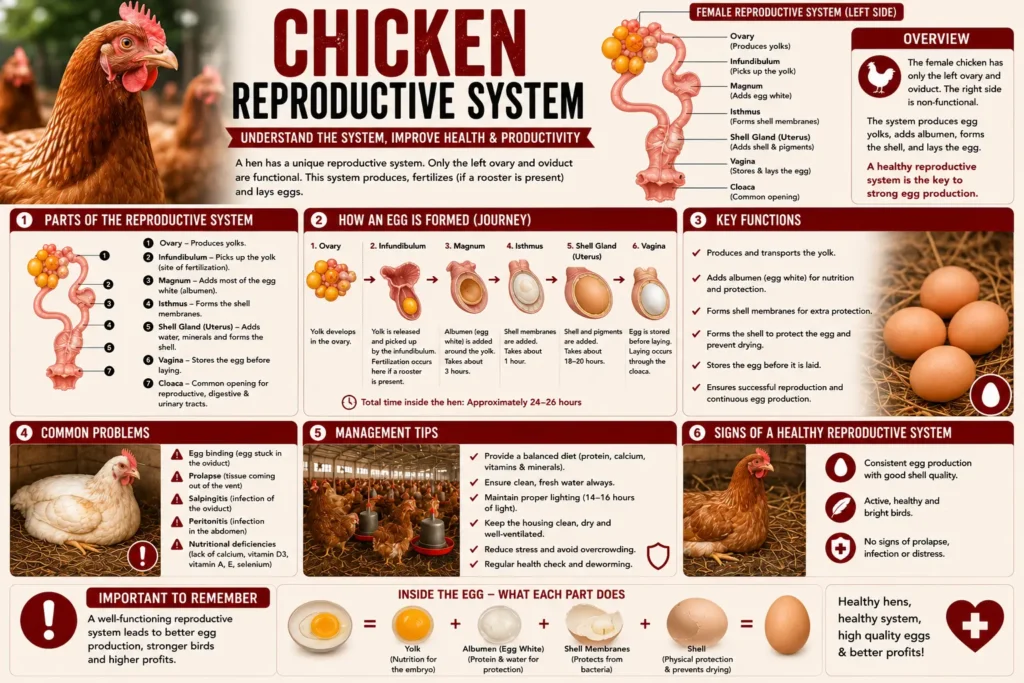
The oviduct is the core of the chicken oviduct system, a muscular, coiled tube roughly 25–27 inches long in a mature hen. It has five distinct sections, each responsible for a different part of the finished egg.
| Oviduct Section | Function | Approximate Time |
| Infundibulum | Catches the released yolk; site of fertilization if a rooster is present | 15–18 minutes |
| Magnum | Adds the egg white (albumen) | About 3 hours |
| Isthmus | Forms the inner and outer shell membranes | 1–1.5 hours |
| Uterus (Shell Gland) | Adds the hard shell and any pigment | 18–20 hours |
| Vagina | Final passage before the egg is laid; egg rotates to exit blunt-end first | Brief |
The Infundibulum
This funnel-shaped section captures the yolk right after ovulation. If a hen has mated with a rooster, fertilization happens here, within about 15 minutes of ovulation — otherwise, the yolk continues down unfertilized.
The Magnum
The magnum is the longest section and adds the thick and thin layers of egg white, which cushion and protect the yolk and later supply moisture and protein to a developing embryo, if fertilized.
The Isthmus
Here, two thin membranes form around the egg white. These membranes are what you sometimes see peeling away from the inside of an eggshell.
The Uterus (Shell Gland)
The uterus is where the egg spends most of its time — nearly 20 hours. Calcium carbonate is deposited here to form the hard shell, and pigment is added last for hens that lay brown, blue, or speckled eggs.
The Vagina and Cloaca
The finished egg passes through the vagina and exits through the cloaca, the shared opening for the reproductive, digestive, and urinary systems in birds. The egg is coated with a protective layer called the bloom or cuticle just before laying, sealing pores in the shell.
Hormones That Control the Chicken Reproductive System
Egg-laying isn’t automatic — it’s driven by a hormonal cycle similar in concept to other vertebrates, though the details differ.
- Light exposure triggers the pituitary gland to release hormones that stimulate the ovary
- FSH (follicle-stimulating hormone) encourages yolk development
- LH (luteinizing hormone) triggers ovulation
- Estrogen supports shell gland function and calcium metabolism
- Progesterone plays a role in the timing of ovulation
Because light exposure is a major trigger, hens naturally lay fewer eggs in winter unless supplemental lighting is provided, and laying typically slows or stops as daylight hours shorten in fall.
From Pullet to Layer: How the System Matures
Sexual Maturity
Most hens reach point of lay between 18–22 weeks of age, though this varies by breed. Lighter breeds and commercial hybrids often mature faster than large, heritage-type breeds.
Peak Production
Hens typically lay most consistently in their first 1–2 years, often producing 250–300+ eggs annually in high-production breeds, before egg output gradually declines with age.
Molting and Reproductive Rest
Once a year, most hens go through a molt, a period where they stop laying and regrow feathers. This natural rest period allows the reproductive system to recover before the next laying cycle.
Common Disorders of the Chicken Reproductive System
Because the hen reproductive system works so continuously, it’s prone to several well-documented health issues.
Egg Binding
An egg becomes stuck in the oviduct or vagina, often due to calcium deficiency, obesity, or an oversized egg. Signs include straining, a wide “penguin” stance, and no egg produced for a day or more.
Salpingitis
Bacterial infection or inflammation of the oviduct, often linked to E. coli. This can cause a hen to pass a lash egg — a firm, layered mass of infected material instead of a normal egg.
Egg Yolk Peritonitis
Happens when a released yolk fails to enter the oviduct and instead falls into the abdominal cavity, triggering inflammation. This condition frequently occurs alongside salpingitis.
Prolapse
The oviduct or vent tissue turns partially inside out and protrudes after laying, often in hens that lay very large eggs or start laying too young.
Soft-Shelled or Shell-less Eggs
Usually linked to calcium deficiency, stress, disease, or the very first and last eggs of a laying cycle, when shell gland function is less consistent.
Internal Laying
A yolk or partial egg is released but never makes it into the oviduct opening, similar to egg yolk peritonitis, and instead is reabsorbed or causes internal complications.
Warning: A hen showing a swollen, fluid-filled abdomen, labored breathing, or repeated abnormal eggs needs veterinary evaluation rather than home guesswork treatment, since several reproductive conditions look similar but require different care.
Comparing Common Reproductive Disorders
| Condition | Primary Cause | Key Sign | Passes an Egg? |
| Egg Binding | Stuck egg | Straining, no egg | Eventually, if resolved |
| Salpingitis | Bacterial infection | Lash egg, swollen belly | Lash egg, not a true egg |
| Egg Yolk Peritonitis | Yolk in abdomen | Fluid buildup, lethargy | No |
| Prolapse | Tissue protrusion | Visible tissue at vent | May follow a laid egg |
| Soft-Shelled Eggs | Calcium/stress issues | Thin or missing shell | Yes, abnormal shell |
Supporting a Healthy Chicken Reproductive System
Nutrition
- Feed a complete layer feed with 16–18% protein and adequate calcium once hens start laying
- Offer oyster shell or another calcium source free-choice alongside feed
- Avoid sudden feed changes, which can disrupt laying consistency
Environment
- Provide 14–16 hours of light for consistent laying, if supplemental lighting is used
- Keep nest boxes clean, dry, and private to reduce stress and contamination
- Minimize overcrowding, which raises stress hormones that can suppress laying
General Flock Health
- Watch for early signs of reproductive trouble, like soft shells or skipped laying days
- Maintain a parasite prevention routine, since heavy parasite loads can affect body condition and laying
- Keep vaccination status current for respiratory diseases that can later affect oviduct health
Step-by-Step: Monitoring Reproductive Health
- Track daily egg counts to catch drops in production early.
- Check eggs weekly for shell quality changes.
- Observe hens for abdominal swelling or posture changes.
- Note any lash eggs, soft eggs, or missed laying days in a simple log.
- Contact a poultry veterinarian if abnormal signs continue beyond a few days.
Expert Tip: A sudden, flock-wide drop in egg production often points to environmental stress, disease, or lighting changes, while a single hen’s decline more often points to an individual reproductive issue.
Factors That Affect Egg Quality
Egg quality is a direct reflection of how well each part of the chicken reproductive system is functioning. Several outside factors influence this beyond basic anatomy.
Age
Younger hens just starting to lay often produce smaller eggs with occasional shell irregularities as the shell gland fine-tunes its output. Older hens sometimes produce larger eggs with thinner shells, since calcium deposition becomes less efficient over time.
Diet
Calcium, vitamin D3, and phosphorus levels directly affect shell strength, while protein and fat intake influence yolk size and color. A deficiency in any of these can show up as thin shells, pale yolks, or reduced egg size within days.
Heat Stress
Hot weather reduces feed intake, which lowers calcium consumption and often leads to thinner-shelled eggs. Heat stress can also disrupt the hormonal signals that regulate the laying cycle, causing temporary drops in production.
Disease and Stress
Respiratory illness, parasites, and general stress from predators, transport, or flock disruptions can all interrupt normal function in the hen reproductive system, sometimes for days or weeks after the stressor is resolved.
Genetics
Breed plays a major role in egg size, shell color, and laying frequency. Commercial layer breeds have been selected over generations specifically for high, consistent output from the chicken oviduct, while heritage breeds tend to lay less often but sometimes with fewer reproductive health issues over their lifetime.
Chicken Reproductive System vs. Other Poultry Species
While the general layout — ovary, oviduct, cloaca — is shared across most female birds, laying frequency and egg size vary widely between species. Commercial layer hens have been selectively bred over decades for near-daily laying, while species like turkeys, ducks, and quail follow different natural laying rhythms. The underlying chicken oviduct structure, however, remains the reference point most poultry health research is built around, since domestic layer hens are the most extensively studied.
Veterinary references such as the Merck Veterinary Manual and university extension poultry programs describe this same five-part oviduct structure as the standard anatomical model for laying hens.
FAQ
Q: How does the chicken reproductive system work? The chicken reproductive system works by releasing a yolk from the ovary, which then travels through the five sections of the oviduct — infundibulum, magnum, isthmus, uterus, and vagina — where egg white, membranes, and shell are added in sequence before the egg is laid.
Q: Do hens need a rooster to lay eggs? No. Hens release yolks and form eggs on their own regardless of whether a rooster is present. A rooster is only needed for the eggs to be fertilized and potentially hatch into chicks.
Q: How long does it take for a hen to make one egg? From ovulation to laying, the full process through the hen reproductive system takes about 24–26 hours, with most of that time spent in the uterus forming the shell.
Q: Why do hens stop laying eggs? Common reasons include shorter daylight hours, molting, age, stress, illness, poor nutrition, or underlying reproductive disorders like salpingitis or egg binding.
Q: What is the chicken oviduct made of? The chicken oviduct is a muscular, glandular tube made of five distinct sections, each lined with specialized tissue that adds a different layer to the developing egg as it moves through.
Q: Can a hen’s reproductive system be damaged permanently? Yes. Chronic infections like salpingitis, repeated egg binding, or prolapse can cause lasting scarring or tissue damage, sometimes reducing or permanently stopping a hen’s ability to lay.
Q: At what age does a hen’s reproductive system stop working? There’s no fixed age, but egg production typically declines noticeably after 2–3 years, and many hens continue laying at a reduced rate well into their later years, depending on breed and health.