Salpingitis vs Internal Laying: Two Terms Backyard Chicken Owners Mix Up

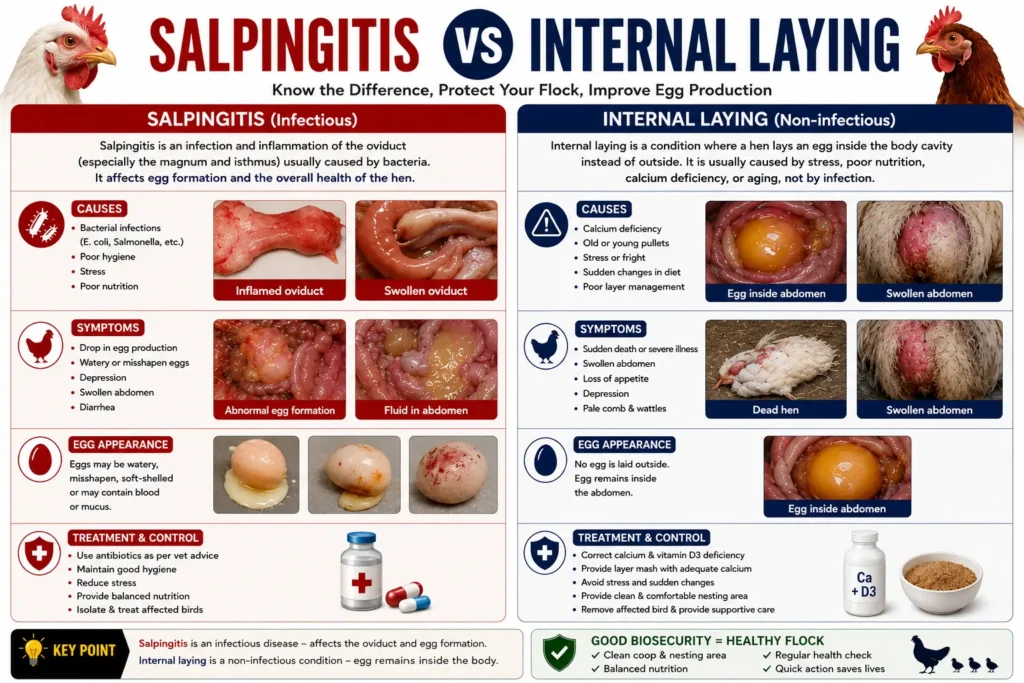
A hen that suddenly stops laying, develops a swollen belly, or seems “off” without an obvious reason often has owners searching for answers about salpingitis vs internal laying. These two terms get used almost interchangeably in backyard chicken forums, but they describe different things happening inside a hen’s body. One is an infection. The other is a misdirected biological event that can lead to infection.
This guide separates fact from confusion, compares both conditions in detail, and explains when a hen needs to see a vet right away versus when watchful waiting is reasonable.
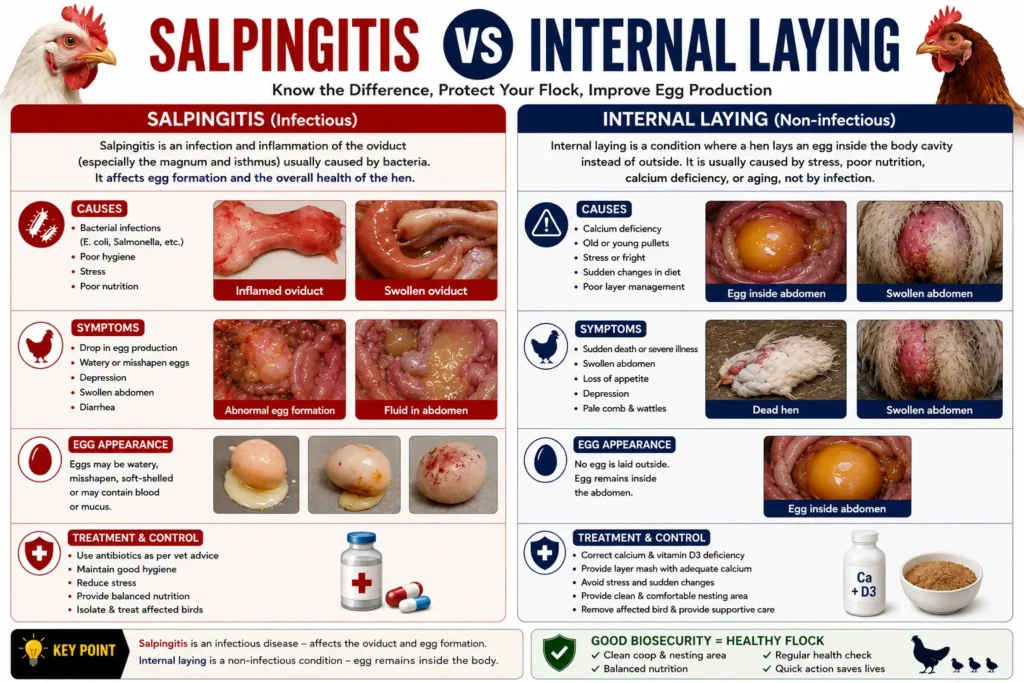
Quick Answer: Salpingitis is an infection or inflammation of the oviduct. Internal laying happens when a yolk or partially formed egg ends up in the abdominal cavity instead of moving through the oviduct as normal. Internal laying can trigger salpingitis, and salpingitis can also make internal laying more likely, since the two problems often feed into each other.
Table of Contents
What Is Salpingitis?
Salpingitis is inflammation or infection of the oviduct, the reproductive tube responsible for building an egg as it travels from the ovary toward the vent. Bacteria, most often E. coli, invade this tissue and disrupt the normal laying process. Left untreated, the infection can spread and become life-threatening.
Poultry pathology reviews from veterinary extension programs consistently rank salpingitis among the top causes of death in mature laying hens, particularly those several years into consistent egg production.
Read More: https://lashegg.com/salpingitis-vs-egg-peritonitis/
Common Causes of Salpingitis
- Bacterial infection, typically E. coli or occasionally Salmonella
- Ascending infection traveling upward from the cloaca
- Respiratory illness that spreads into the reproductive tract
- Chronic stress, including overcrowding or poor coop ventilation
- Age, with older hens facing higher risk
- Breed and genetics, since some high-production breeds show elevated rates
Symptoms of Salpingitis
- Gradually declining or stopped egg production
- Swollen, fluid-filled abdomen
- Lethargy and appetite loss
- Foul-smelling vent discharge
- Passing a lash egg, a firm mass of pus and tissue
- Penguin-like stance in advanced cases
What Is Internal Laying?
Internal laying describes what happens when a hen’s ovary releases a yolk, or the oviduct partially forms an egg, that never makes it out through the vent. Instead, this material ends up loose in the abdominal cavity. The hen’s body treats it as foreign material, which usually triggers inflammation and creates conditions where bacteria can multiply.
Internal laying is not a disease by itself. It’s a mechanical or physiological failure in the reproductive process, one that frequently leads to a secondary condition called egg yolk peritonitis if the material isn’t reabsorbed or addressed.
Common Causes of Internal Laying
- Oviduct blockage or scarring, often from a prior infection like salpingitis
- Reverse peristalsis, where abnormal muscle contractions push material backward
- Ruptured ovarian follicles, releasing yolk directly into the abdomen
- Anatomical abnormalities, present from hatch or developed over time
- Age-related decline in oviduct tone and function
Symptoms of Internal Laying
- Sudden or gradual drop in egg production
- Abdominal swelling, sometimes soft and fluid-like
- Lethargy and reduced activity
- Loss of appetite
- Labored breathing in more advanced cases
- General “off” behavior without a single obvious cause
Salpingitis vs Internal Laying: Side-by-Side Comparison Table
Placing salpingitis vs internal laying in a direct comparison makes the relationship between the two much clearer.
| Feature | Salpingitis | Internal Laying |
| Root cause | Bacterial infection or inflammation of the oviduct | Yolk or egg material misdirected into the abdomen |
| Nature of the problem | Infectious disease | Mechanical/physiological failure |
| Onset | Usually gradual | Can be sudden or gradual |
| Egg production | Declines steadily | Often drops suddenly |
| Discharge | Frequently present | Uncommon on its own |
| Lash egg present | Sometimes | Rare unless salpingitis is also present |
| Relationship | Can lead to internal laying if oviduct is damaged | Can trigger salpingitis if bacteria invade the misplaced material |
| Emergency level | Ranges from mild to severe | Ranges from manageable to life-threatening |
Internal Laying Comparison: How the Two Conditions Interact
An internal laying comparison with salpingitis shows a two-way relationship rather than two entirely separate problems. Damaged oviduct tissue from salpingitis can make it easier for yolk material to miss its intended path, causing internal laying. At the same time, yolk sitting in the abdominal cavity from internal laying creates an ideal environment for bacteria, which can trigger salpingitis or a related infection called egg yolk peritonitis.
Is Internal Laying the Same as Egg Yolk Peritonitis?
Not exactly, though the two terms are closely related and often confused. Internal laying refers to the event itself, yolk or egg material ending up in the abdomen. Egg yolk peritonitis refers to the inflammatory and often infectious response that develops afterward. In practice, many hens experiencing internal laying go on to develop egg yolk peritonitis, especially if the misplaced material isn’t reabsorbed naturally by the body.
Did You Know?
Some hens experience occasional, low-volume internal laying and reabsorb the material without ever showing obvious symptoms. This is more common in younger, healthy hens. Owners often never know it happened. Frequent or large-volume internal laying is far more likely to cause visible illness.
How Internal Laying Leads to Complications
When yolk material lands in the abdominal cavity, a hen’s immune system responds the way it would to any foreign substance. White blood cells and inflammatory fluid gather around the material, and if left unresolved, this response drives progressive abdominal swelling.
If bacteria are present, whether from a pre-existing infection or introduced through the reproductive tract, the situation escalates quickly. What started as a single misdirected yolk can become a serious bacterial infection spreading through the abdominal cavity.
Diagnosing Salpingitis and Internal Laying
Because the two conditions can look nearly identical from the outside, proper diagnosis requires veterinary tools rather than guesswork at home.
- Physical exam and abdominal palpation to check for swelling or fluid
- Radiographs or ultrasound to visualize the abdominal cavity and reproductive organs
- Abdominal fluid analysis, since fluid composition can hint at the underlying cause
- Bloodwork to assess infection markers and organ function
- Culture and sensitivity testing if discharge or fluid is present
- Necropsy, in hens that have already passed away, to confirm findings
Expert Tip
If your hen has a history of salpingitis and later develops new abdominal swelling, share that history with your vet immediately. It helps narrow down whether you’re dealing with recurring salpingitis, new internal laying, or both happening together.
Treatment Options
Salpingitis Treatment
- Antibiotics based on culture and sensitivity results
- Anti-inflammatory medication to manage swelling and discomfort
- Fluid drainage, for hens with notable abdominal fluid buildup
- Isolation and supportive home care, including clean bedding and easy access to food and water
Internal Laying Treatment
- Monitoring, for very mild, suspected cases in an otherwise healthy hen
- Antibiotics, if secondary infection develops
- Fluid drainage, if abdominal swelling becomes significant
- Hormonal treatment, sometimes used to reduce or pause further egg production
- Surgery, in select severe or recurring cases
Warning
Never assume mild abdominal swelling will resolve on its own without at least a phone consultation with a vet. Internal laying can look mild for days before escalating into a serious infection, especially once bacteria take hold in the misplaced yolk material.
Recovery and Long-Term Outlook
| Factor | Salpingitis | Internal Laying |
| Typical recovery time | Days to weeks with treatment | Variable; depends on volume and whether infection develops |
| Recurrence risk | Higher with chronic infection | Higher in hens with prior reproductive tract damage |
| Long-term laying | Often reduced in severe cases | Frequently reduced, especially after repeated episodes |
| Overall prognosis | Guarded to good, depending on stage | Guarded, worse if secondary infection develops |
Hens with a single, mild episode of either condition often recover well with prompt treatment. Recurrent internal laying or chronic salpingitis both point to a hen with ongoing reproductive tract vulnerability, which typically means closer long-term monitoring.
Prevention Strategies
- Feed a balanced, age-appropriate layer diet with adequate calcium
- Maintain a healthy body weight through proper portioning and activity
- Reduce stress with consistent routines and adequate coop space
- Support good ventilation to lower respiratory illness risk
- Treat any respiratory infection quickly before it spreads
- Monitor older hens more closely, since age raises risk for both conditions
- Follow up fully after any salpingitis diagnosis, rather than assuming symptoms improving means full resolution
Common Mistakes Owners Make
- Assuming any abdominal swelling means the same underlying cause
- Waiting to see if a hen “lays it out eventually” during suspected internal laying
- Not connecting a past salpingitis diagnosis to new symptoms
- Treating either condition with home remedies alone instead of veterinary care
- Ignoring a lash egg because it seems unrelated to internal laying concerns
- Skipping follow-up vet visits after initial treatment appears to work
When to Call a Vet
Contact a poultry-experienced veterinarian promptly if you notice:
- Sudden or worsening abdominal swelling
- A drop in egg production without an obvious cause
- Labored or open-mouth breathing
- Loss of appetite lasting more than a day
- Foul-smelling vent discharge
- Extreme lethargy or collapse
When to Call a Vet: Salpingitis vs Internal Laying Timing
Salpingitis symptoms tend to build gradually, giving some room to schedule a prompt appointment. Internal laying can be harder to predict, since a hen may look fine one day and show significant swelling within 24 to 48 hours if a secondary infection develops. Treat any rapid change as urgent.
Can a Hen Recover From Internal Laying Without Treatment?
Some very mild cases resolve on their own, particularly in younger hens whose bodies reabsorb small amounts of misplaced yolk material without complication. However, this outcome isn’t something to count on or wait for. Any visible symptoms, including swelling or lethargy, warrant a veterinary evaluation rather than assuming natural resolution.
Does Internal Laying Always Cause Salpingitis?
No. Internal laying can occur without ever developing into salpingitis, particularly if the volume of misplaced material is small and the hen’s immune system manages it effectively. However, larger or repeated episodes significantly raise the risk of bacterial infection setting in, which is when salpingitis or egg yolk peritonitis becomes a real concern.
Nutrition, Age, and Flock Management Factors
Diet quality plays a meaningful role in reducing risk for both salpingitis and internal laying. A balanced layer feed with adequate calcium and protein supports stronger oviduct muscle tone, which helps the reproductive tract capture and guide each yolk the way it should. Hens on inconsistent or unbalanced diets tend to show weaker reproductive tract function over time, raising the odds of misdirected yolk material.
Body condition matters too. Overweight hens face higher rates of both conditions, partly because excess abdominal fat can crowd the reproductive organs and interfere with normal muscle contractions during egg formation.
Age is one of the strongest risk factors for either condition. Hens well past their peak laying years have typically laid hundreds of eggs, and that cumulative activity gradually wears on oviduct tissue. Owners keeping hens into their third season or beyond should watch more closely for subtle changes in appetite, posture, or laying frequency, since early detection consistently leads to better outcomes than waiting for dramatic symptoms to appear.
Frequently Asked Questions
What’s the difference between salpingitis and internal laying? Salpingitis is a bacterial infection or inflammation of the oviduct. Internal laying is a mechanical event where yolk or egg material ends up in the abdominal cavity instead of passing through the oviduct normally. Comparing salpingitis vs internal laying, one is an infectious disease and the other is a physical misdirection that can lead to infection.
Can salpingitis cause internal laying? Yes. Damage or scarring from salpingitis can weaken the oviduct’s ability to properly capture and guide each yolk, increasing the chances of internal laying occurring afterward.
Is internal laying always visible from the outside? Not always. Mild cases can go completely unnoticed, especially in younger hens whose bodies reabsorb the material without complication. More significant cases usually cause visible swelling, lethargy, or appetite changes.
How is internal laying diagnosed? A veterinarian typically uses abdominal palpation, radiographs or ultrasound, and sometimes fluid analysis to confirm internal laying and rule out other causes of abdominal swelling.
Can a hen lay normal eggs again after internal laying? Some hens return to normal laying after a single, mild episode, particularly if no infection develops. Hens with repeated internal laying or significant oviduct damage often see reduced or stopped egg production long-term.
Is internal laying an emergency? It depends on severity. Mild, suspected cases in an otherwise healthy hen may warrant close monitoring and a prompt vet call. Sudden abdominal swelling combined with lethargy, labored breathing, or appetite loss should be treated as an emergency.
What’s the connection between internal laying and egg yolk peritonitis? Internal laying is the event where yolk material ends up in the abdomen. Egg yolk peritonitis is the inflammatory or infectious response that often follows. The two are closely linked, with internal laying frequently acting as the trigger for egg yolk peritonitis.