Egg Inside an Egg: The Science Behind This Rare Phenomenon

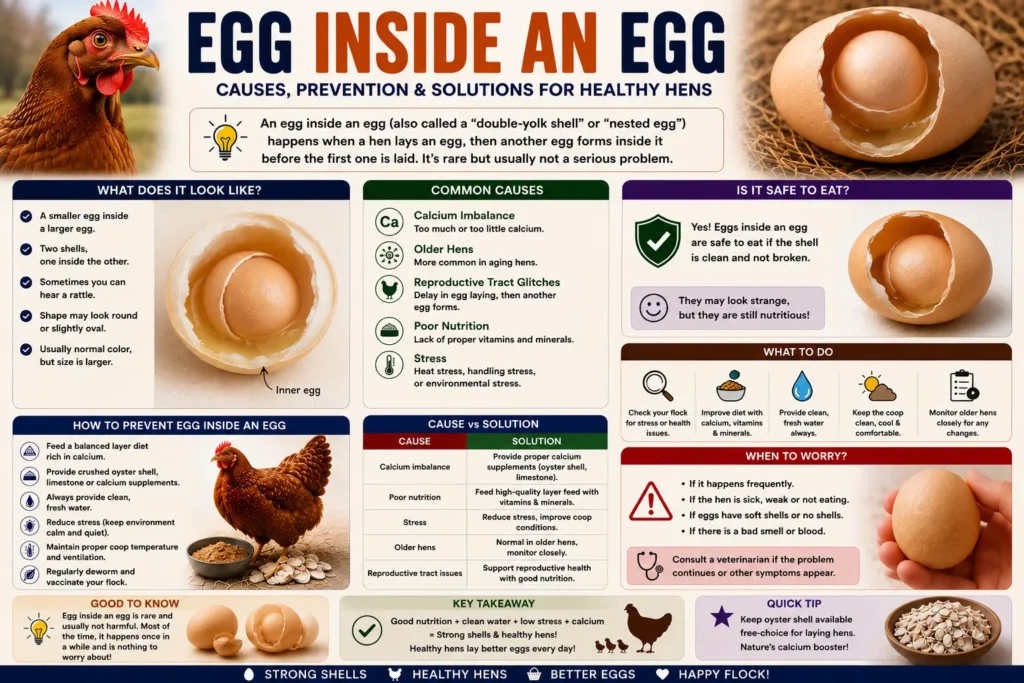
An egg inside an egg is one of the strangest things a flock owner can crack open — a fully formed, smaller egg encased inside a normal-sized shell. It looks impossible, but it has a well-documented biological explanation. This guide covers exactly why an egg inside an egg happens, how rare it really is, whether it signals a health problem, and what to do if you find one in your nest box.
Table of Contents
Quick Answer
An egg inside an egg happens when a fully formed egg gets pushed backward in the oviduct and picked up by a second egg forming behind it, becoming encased inside a new shell. It’s rare, generally harmless, and doesn’t usually indicate disease unless it happens repeatedly in the same hen.
What Does “Egg Inside an Egg” Mean?
The phrase describes exactly what it sounds like: crack open one egg and find a second, smaller, fully shelled egg inside it. Sometimes the inner egg has its own yolk and white; other times it’s just a small shell fragment. This is sometimes called an “egg within an egg” or counter-peristalsis egg, referencing the reverse muscle movement believed to cause it.
Key facts about egg inside an egg cases:
- Extremely rare — most poultry keepers will never see one in a lifetime of flock ownership
- Documented in chickens, and occasionally reported in other egg-laying birds
- The inner egg is usually smaller and sometimes lacks a proper air cell
- The outer egg is typically normal-sized or slightly larger than usual
Read More: https://lashegg.com/corrugated-eggs-causes-and-fixes/
How Rare Is an Egg Inside an Egg?
There’s no large-scale statistic tracking exact frequency, but veterinary and poultry science sources consistently describe it as one of the rarest egg abnormalities documented, far less common than double-yolked eggs or soft-shelled eggs. Most flock owners who keep hens for years never encounter one.
Why Does an Egg Inside an Egg Happen?
Counter-Peristalsis (Reverse Movement)
The leading explanation involves counter-peristalsis, a reverse muscular contraction in the oviduct. Normally, the oviduct moves an egg forward in one direction, from the ovary toward the vent, over roughly 24–26 hours. Occasionally, a contraction pushes a nearly finished egg backward instead of forward.
When that reversed egg meets a new egg forming behind it, the reproductive tract sometimes wraps a fresh layer of albumen and shell around both, encasing the first egg entirely inside the second. The result, once laid, is an egg inside an egg.
Timing and the Ovulation Cycle
This phenomenon depends on timing. The hen’s reproductive system releases yolks roughly once every 24–26 hours, and shell formation takes up the bulk of that window. An egg inside an egg requires the near-final egg and a new one to meet at almost exactly the same point in the tract, which is part of why it’s so uncommon.
Expert Tip
If you find an egg inside an egg, note whether it was an isolated event or if the same hen has laid unusual eggs before. A one-time occurrence needs no action. A repeated pattern from one specific hen is more worth watching.
Table: Egg Inside an Egg vs. Other Rare Egg Abnormalities
| Abnormality | What It Is | Relative Rarity |
| Egg inside an egg | A fully formed egg encased inside another shell | Extremely rare |
| Double-yolked egg | Two yolks in one shell from close ovulations | Uncommon but well documented |
| Wind egg (yolkless) | Small egg with no yolk, common in young or old hens | Fairly common |
| Soft shell egg | Egg with little to no hard shell | Occasional, often diet-related |
| Lash egg | Mass of tissue, pus, and egg material from oviduct inflammation | Rare, often disease-linked |
Is an Egg Inside an Egg a Health Concern?
For most hens, a single egg inside an egg is a one-time reproductive quirk rather than a sign of illness. The reproductive tract is a complex, muscular system, and occasional misfires happen even in healthy birds. However, context matters, and a few situations call for closer attention.
When It Might Signal a Problem
Repeated abnormal eggs from the same hen — including egg inside an egg cases, lash eggs, or consistent misshapen eggs — can point toward chronic oviduct inflammation or a reproductive tract disorder. According to general poultry veterinary references including the Merck Veterinary Manual, chronic salpingitis (oviduct inflammation) is associated with a range of abnormal egg presentations, though egg inside an egg specifically is described as a rare, largely mechanical event rather than a disease symptom on its own.
When to Call a Vet
Contact a poultry veterinarian if a hen repeatedly lays egg inside an egg cases, shows signs of straining or discomfort while laying, has a swollen abdomen, or stops laying altogether alongside these abnormal eggs. A single isolated case in an otherwise healthy, actively laying hen typically doesn’t need veterinary intervention.
What to Do If You Find an Egg Inside an Egg
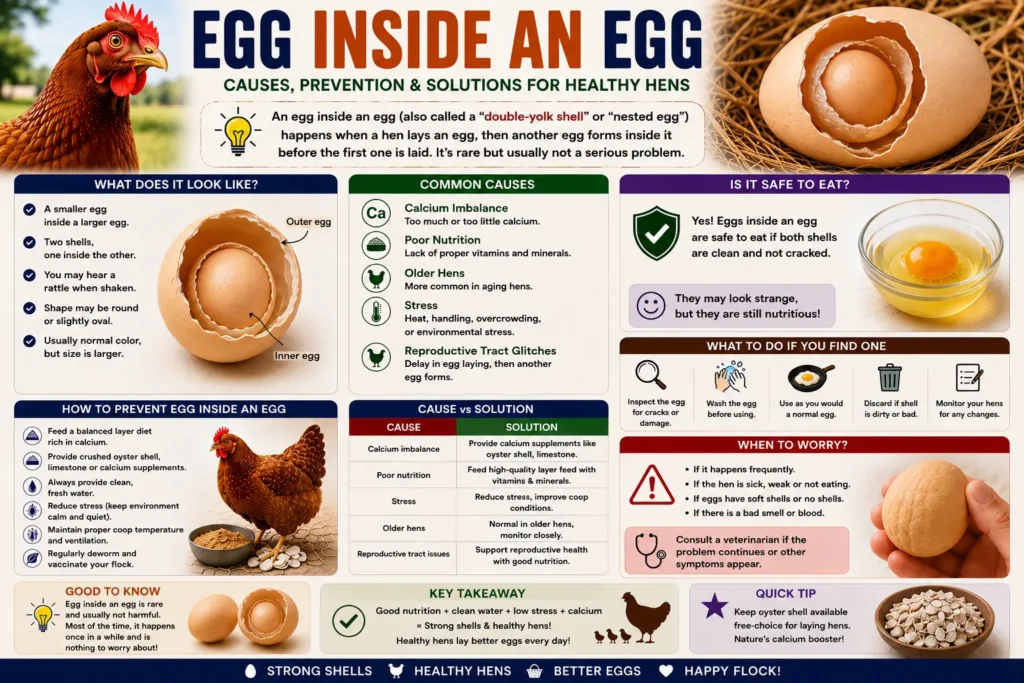
- Confirm what you’re seeing — crack the outer egg carefully over a bowl to check the inner egg fully.
- Check the hen’s recent health — look for any signs of stress, illness, or changes in behavior.
- Note the date and hen — if you can identify which hen laid it, track future eggs from her.
- Continue normal care — no special treatment is needed for a one-time occurrence.
- Watch for repeats — a second or third occurrence from the same hen is the signal to consult a vet.
- Keep the flock’s routine stable — reducing stress can lower the odds of reproductive tract irregularities in general.
Common Mistakes
- Assuming an egg inside an egg always means serious illness
- Ignoring a repeated pattern from the same hen because the first case seemed harmless
- Confusing an egg inside an egg with a double-yolked egg, which is a different and more common phenomenon
- Discarding the eggs without checking whether the hen shows any other symptoms
Did You Know?
Reports of an egg inside an egg date back over a century in poultry literature, making it one of the oldest documented reproductive oddities in domestic hens, long before modern veterinary imaging could explain exactly how it happens.
Can You Eat an Egg Inside an Egg?
Both the outer and inner egg are generally safe to eat if they were freshly laid, properly refrigerated, and show no signs of spoilage, following the same food safety standards as any other egg from your flock. As with any unusual egg, use normal judgment: check for odd smells, discoloration, or any sign of contamination before use, and when in doubt, discard it. The USDA’s general egg safety guidance applies regardless of how unusual an egg looks on the outside.
Egg Inside an Egg vs. Lash Eggs: Don’t Confuse Them
These two are often mixed up online, but they’re very different. An egg inside an egg is a mechanical formation event involving actual egg material — yolk, albumen, and shell. A lash egg is not a true egg at all; it’s a mass of pus, tissue debris, and inflammatory material caused by infection or inflammation of the oviduct, most commonly linked to infectious bronchitis or E. coli salpingitis. Lash eggs are a genuine disease sign and warrant veterinary attention, while a single egg inside an egg usually does not.
Warning
If what you’re seeing resembles a lumpy, cheese-like, or foul-smelling mass rather than a clean, fully formed inner egg, you may be dealing with a lash egg rather than an egg inside an egg. This distinction matters because lash eggs point toward an active infection needing treatment.
Prevention: Can You Stop an Egg Inside an Egg From Happening?
There’s no proven way to prevent an egg inside an egg specifically, since it stems from a spontaneous reverse muscle contraction rather than diet or environment. That said, general reproductive health support can lower the odds of egg abnormalities overall:
- Feed a complete, balanced layer ration
- Minimize stress and sudden disruptions
- Maintain a stable, predictable daily routine
- Keep the flock at a healthy weight, since obesity can affect reproductive function
- Schedule a vet check if abnormal eggs become a repeated pattern
Conclusion
An egg inside an egg is a genuinely rare event, caused by a reverse contraction in the oviduct that traps one egg inside another as it forms. Most hens that lay one go on to have completely normal reproductive health afterward, and a single occurrence rarely needs veterinary action. Keep an eye on the hen involved, watch for repeats, and reach out to a vet if unusual eggs become a pattern rather than a one-time surprise.