Yolkless Egg: Why Hens Lay Eggs Without a Yolk

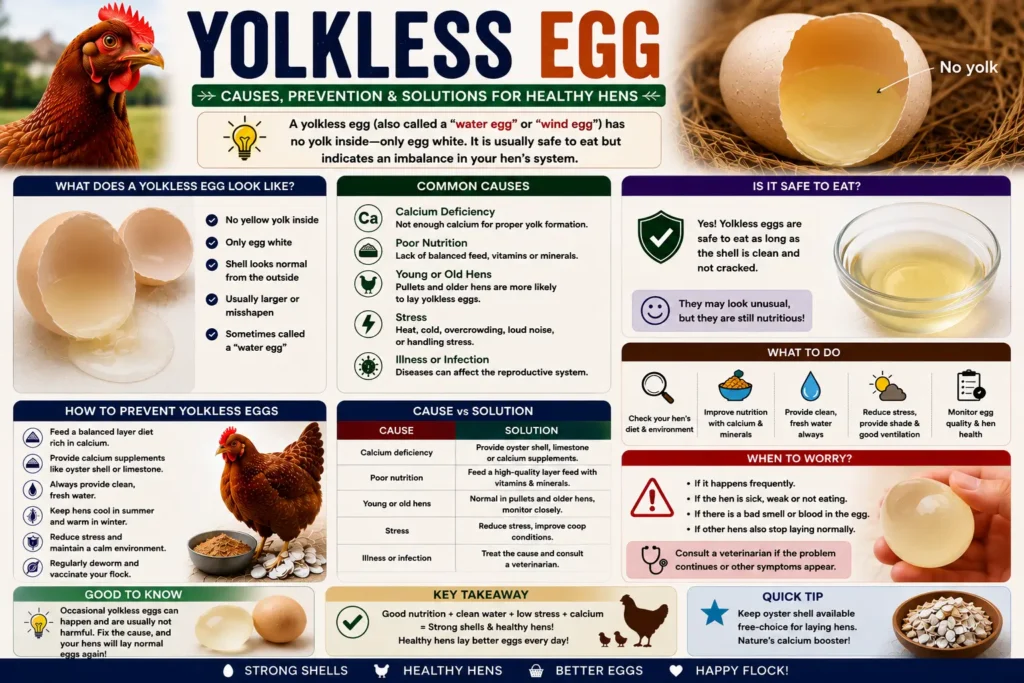
A yolkless egg catches most flock owners off guard the first time they crack one open. It’s small, round, and completely empty of yolk, sometimes described as a “wind egg” or “fart egg” in older poultry-keeping language. The good news is that a yolkless egg almost always has a simple, harmless explanation. This guide covers exactly why it happens, who’s most likely to lay one, and the rare cases where it’s worth a second look.
Table of Contents
Quick Answer
A yolkless egg forms when a piece of tissue, blood clot, or other irritant enters the oviduct and gets coated in egg white and shell, with no yolk involved at all. It’s most common in young pullets just starting to lay and older hens near the end of their laying cycle, and it’s rarely a health concern.
What Is a Yolkless Egg?
A yolkless egg is exactly what it sounds like: a small, fully shelled egg with no yolk inside, just egg white or sometimes a small amount of thickened albumen. It’s also called a wind egg, dwarf egg, or fart egg in traditional poultry terminology, though none of those names describe the actual biology accurately.
Read More: https://lashegg.com/egg-inside-an-egg-explained/
Typical characteristics of a yolkless egg:
- Noticeably smaller than a hen’s normal eggs
- Round rather than oval-shaped
- Little to no yolk when cracked open
- A fully formed, normal-looking shell on the outside
How a Yolkless Egg Forms
Unlike a normal egg, which starts with a yolk released from the ovary, a yolkless egg usually starts with something else entering the oviduct — a bit of tissue debris, a small blood clot, or in some cases nothing identifiable at all. The reproductive tract treats this foreign material the same way it would treat a yolk, wrapping it in albumen, membranes, and a shell as it moves through the system.
Who Lays a Yolkless Egg Most Often?
Young Pullets Just Starting to Lay
The most common source of a yolkless egg is a pullet in her first few weeks of laying. Her reproductive system is still calibrating, and it’s common for the shell gland and oviduct to produce one or two of these before settling into a normal rhythm.
Older Hens Near the End of Laying
On the other end of the spectrum, older hens whose reproductive systems are slowing down can also produce an occasional yolkless egg as ovulation becomes less consistent.
Any Hen, Occasionally
Even hens in their prime laying years can lay a yolkless egg once in a while. A single occurrence in an otherwise healthy, regularly laying hen is considered normal variation rather than a red flag.
Expert Tip
If a young pullet lays a yolkless egg during her first month of laying, there’s usually no need to do anything differently. Keep her on a balanced grower-to-layer transition feed and give her system time to settle.
Table: Common Causes of a Yolkless Egg
| Cause | Who It Affects Most | Action Needed |
| Point of lay (new pullet) | Young hens in first weeks of laying | None — resolves naturally |
| End of laying cycle | Older hens with declining ovulation | Monitor; expected with age |
| Occasional reproductive quirk | Any hen, any age | None if isolated |
| Stress-related ovulation disruption | Any hen during a stressful period | Reduce stress triggers |
| Reproductive tract irritation | Hens with recurring yolkless eggs | Veterinary evaluation if repeated |
Is a Yolkless Egg a Sign of a Health Problem?
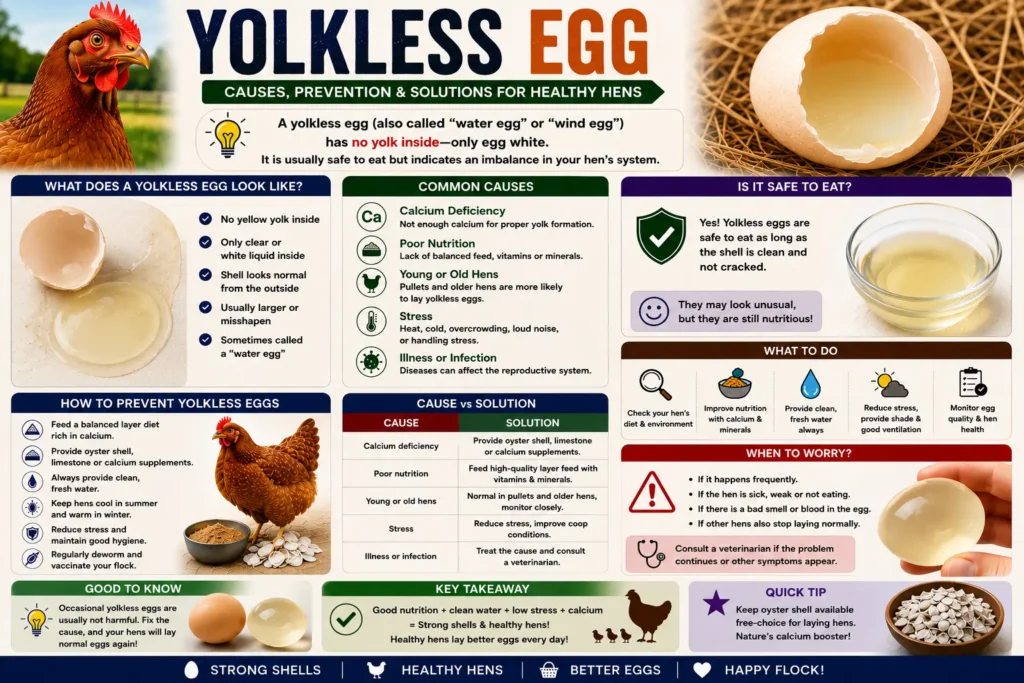
For the vast majority of hens, a yolkless egg is not a disease symptom. It’s a normal, if uncommon, quirk of the reproductive system, especially in young or aging birds. The situation changes only when yolkles become a repeated pattern from the same hen, rather than an occasional one-off.
When It Might Point to Something More
Frequent yolkless from a mature, mid-cycle hen — especially alongside reduced appetite, lethargy, or abdominal swelling — can occasionally indicate reproductive tract inflammation, such as salpingitis. General poultry veterinary references, including the Merck Veterinary Manual, describe oviduct inflammation as a cause of a range of abnormal egg presentations, though an occasional yolkless on its own is not typically treated as a disease sign.
When to Call a Vet
Reach out to a poultry veterinarian if a hen lays multiple yolkless in a short period while otherwise healthy and mid-cycle, or if yolkless eggs appear alongside straining, abdominal swelling, lethargy, or a stop in normal laying. A single yolkless egg from a new layer or an older hen rarely needs medical attention.
Yolkless Egg vs. Other Unusual Egg Types
| Egg Type | Key Feature | Most Likely Cause |
| Yolkless egg | Small, round, no yolk inside | Point of lay, older hens, occasional quirk |
| Double-yolked egg | Oversized, two yolks | Two ovulations released close together |
| Soft shell egg | Rubbery, little to no hard shell | Calcium deficiency, reproductive disorder |
| Egg inside an egg | A full egg encased inside another shell | Reverse muscle contraction in the oviduct |
| Thin shell egg | Normal size, fragile shell | Calcium or vitamin D3 deficiency, heat stress |
Warning
Don’t confuse an occasional yolkless egg with a pattern of shrinking egg size and declining production across the whole flock, which can point to nutritional deficiencies, disease, or a lighting problem affecting multiple hens rather than one individual quirk.
Can Roosters or Diet Cause a Yolkless Egg?
Rooster Presence
A yolkless egg has nothing to do with whether a rooster is present in the flock. Hens lay eggs on their own laying cycle regardless of fertilization, and a yolkless egg forms from a tissue or debris issue in the oviduct, unrelated to mating.
Diet and Nutrition
Diet doesn’t directly cause a yolkless egg the way it can cause thin shells or soft shells. A complete, balanced layer feed supports healthy ovulation overall, but a single yolkless egg isn’t a sign to overhaul the feeding program.
What to Do If You Find a Yolkless Egg
- Note which hen laid it, if you can tell, especially in a small flock.
- Check her age and laying history — new layers and older hens are the most common source.
- Watch for a pattern — one yolkless egg is normal; several in a row from the same hen is worth tracking.
- Rule out stress — recent changes, predator scares, or coop disruptions can occasionally play a role.
- Continue normal care — no diet or environment change is needed for an isolated case.
- Consult a vet only if repeated — especially in a mature hen showing other symptoms.
Common Mistakes
- Assuming a yolkless egg always means illness
- Changing the whole flock’s diet over a single yolkless egg from one hen
- Blaming the rooster or lack of one for a yolkless egg
- Ignoring repeated yolkless eggs from the same hen when other symptoms are present
Did You Know?
A yolkless egg was traditionally called a “cock egg” or “witch egg” in old folklore, often surrounded by superstition, even though the actual cause is a straightforward reproductive process with nothing mysterious about it.
Can You Eat a Yolkless Egg?
Yes, a yolkless egg is safe to eat as long as it was freshly laid and properly stored, following the same food safety standards as any other egg from your flock. It won’t have the nutritional profile of a full egg since it’s mostly albumen, but there’s nothing about a yolkless egg that makes it unsafe on its own.
Prevention: Can You Stop Yolkless Eggs From Happening?
Since a yolkless egg is largely tied to a hen’s age and natural reproductive timing, there’s no guaranteed way to prevent it. General flock health support can reduce how often reproductive irregularities happen overall:
- Provide a complete, age-appropriate feed (starter, grower, then layer)
- Minimize stress during the pullet-to-layer transition
- Keep lighting and routines stable and predictable
- Support older hens with adequate calcium as their laying slows
- Monitor egg patterns over time rather than reacting to a single unusual egg
Conclusion
A yolkless egg is one of the more harmless-looking oddities a flock owner will find, and in almost every case, that’s exactly what it is: harmless. Young pullets and older hens are the most likely to lay one, and a single occurrence needs no special action. Keep an eye on the hen involved, and if yolkless eggs turn into a repeated pattern alongside other symptoms, a veterinary check will help rule out anything beyond normal reproductive variation.
5. FAQ
What causes a yolkless egg? A yolkless egg forms when tissue debris or another irritant enters the oviduct and gets coated in egg white and shell, without a yolk from the ovary involved at all.
Is a yolkless egg fertilized? No. A yolkless egg has no yolk, and fertilization requires a yolk, so these eggs can never be fertilized or hatch.
Do young hens lay more yolkless eggs? Yes. Pullets just starting to lay are one of the most common sources of a yolkless egg, along with older hens nearing the end of their laying cycle.
Can you eat a yolkless egg? Yes, a yolkless egg is safe to eat if freshly laid and properly stored, following standard USDA egg safety guidance.
Is a yolkless egg a sign of illness? Usually not. A single yolkless egg is normal reproductive variation. Repeated yolkless eggs from a mature hen, especially with other symptoms, are worth a veterinary check.
What’s another name for a yolkless egg? A yolkless egg is also called a wind egg, dwarf egg, or in older folklore, a witch egg or cock egg.