
White Egg Spots: What the Marks on Your Eggshell Mean


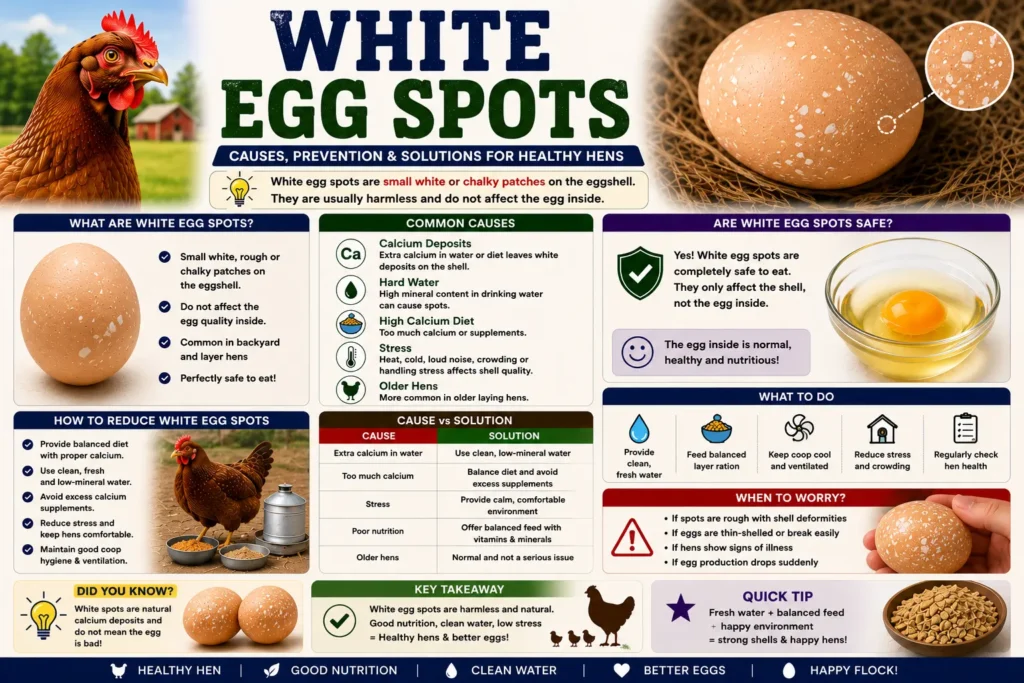
White egg spots show up on all kinds of eggs, from smooth pale bumps to fine chalky speckles scattered across the shell. Most flock owners notice them and wonder if something’s wrong with their hens. In the vast majority of cases, white egg spots are a completely normal, harmless part of shell formation. This guide covers exactly why they happen, how to tell a normal spot from a genuine warning sign, and what to do either way.
Table of Contents
Quick Answer
White egg spots are almost always calcium deposits added unevenly during the final stage of shell formation. They don’t affect the egg’s safety or quality inside. Spots become worth watching only if they’re paired with a rough, cracked texture or a sudden flock-wide shift in shell appearance.
What Causes White Egg Spots?
An egg picks up its final layer, called the cuticle, right before it’s laid, and calcium carbonate deposits happen throughout the roughly 20 hours the egg spends in the shell gland. When calcium is applied a little unevenly during this process, it shows up as raised, chalky, or pale white egg spots on the finished shell.
Read More:https://lashegg.com/iant-chicken-egg-causes-explained/
What white egg spots typically look like:
- Small, raised, chalky bumps scattered across the shell
- Larger pale patches with a slightly different texture than the rest of the shell
- Fine white speckling that’s easy to miss unless the egg is held up to light
- Spots that don’t affect shell strength or the egg underneath
Are White Egg Spots the Same as Shell Color?
No. White egg spots are a texture and deposit issue, not a pigment issue. Even brown eggs can show white egg spots, since brown shell color comes from a pigment applied in a separate layer, while the calcium deposits that cause spotting sit underneath or alongside that pigment.
Why Do Some Eggs Have More White Egg Spots Than Others?
Individual Hen Variation
Some hens simply deposit calcium a little less evenly than others, producing white egg spots consistently on their eggs while flock-mates lay smooth shells. This is normal individual variation, similar to how people have naturally different skin or hair texture.
Calcium Intake Timing
Hens that get a large calcium supplement dose all at once, rather than grazing on it steadily throughout the day, can sometimes show more visible white egg spots as that calcium gets deposited in an uneven rush during shell formation.
Age of the Hen
Younger hens still calibrating their reproductive system, and older hens with a less efficient shell gland, both tend to show slightly more white egg spots than hens in the middle of a stable laying cycle.
Genetics and Breed
Certain breeds and even certain family lines within a breed show a natural tendency toward more visible white egg spots, independent of diet or health status.
Expert Tip
If white egg spots show up consistently on eggs from the same hen and her shells are otherwise strong and normal-shaped, there’s usually no need to change anything. This is simply how her shell gland deposits calcium.
Table: Common Causes of White Egg Spots
| Cause | Appearance | Action Needed |
| Normal calcium deposit variation | Scattered chalky bumps or patches | None — normal shell variation |
| Uneven calcium supplement timing | Clustered white egg spots | Offer calcium free-choice throughout the day |
| Young hen (point of lay) | Fine speckling, sometimes with other irregularities | None — resolves with age |
| Older hen shell gland decline | More frequent, larger spots over time | Monitor; expected with age |
| Breed or individual tendency | Consistent from the same hen | None — normal trait |
| Early-stage shell gland irritation | Spots combined with rough or ridged texture | Monitor for other symptoms; consult vet if pattern grows |
Are White Egg Spots Safe? Can You Eat Spotted Eggs?
Yes. White egg spots are a shell surface feature only. They don’t affect the egg white, yolk, or nutritional content inside, and they aren’t linked to bacteria or contamination on their own. An egg with white egg spots is safe to eat under the same food safety standards as any other egg, according to general USDA egg-handling guidance: keep it clean, refrigerated, and used within a normal timeframe.
Do White Egg Spots Mean the Shell Is Weaker?
Not necessarily. A shell with scattered white egg spots can be just as strong as a smooth one, since the spots reflect where calcium clustered rather than where it was missing. The exception is when spotting is combined with a shell that also feels notably thin or fragile, which points toward a calcium or vitamin D3 supply issue rather than simple deposit variation.
When White Egg Spots Might Signal Something More
Occasional white egg spots on their own are not a disease symptom. But a few patterns are worth paying closer attention to, especially when they show up alongside other shell or flock changes.
Combined with Rough or Ridged Texture
White egg spots paired with a rough, gritty, or ridged shell surface can point toward the same shell gland disruptions that cause corrugated eggs, sometimes linked to stress or infectious bronchitis moving through the flock.
A Sudden Flock-Wide Increase
Occasional white egg spots from individual hens is normal. A sudden jump in spotting across many hens at once is a different situation, and it’s worth reviewing recent changes in feed, calcium supplementation, or flock health.
When to Call a Vet
Contact a poultry veterinarian if white egg spots appear alongside coughing, nasal discharge, a drop in egg production, or other shell abnormalities like thin or misshapen eggs across multiple hens. Isolated white egg spots on otherwise normal, strong shells don’t require veterinary attention.
White Egg Spots vs. Other Shell Surface Issues
| Shell Feature | Appearance | Most Likely Cause |
| White egg spots | Chalky, raised, or pale patches | Normal calcium deposit variation |
| Rough/sandpaper shell | Gritty, uneven texture overall | Excess calcium buildup, mild irritation |
| Corrugated (ridged) eggs | Raised wavy lines or bands | Stress, infectious bronchitis, shell gland irritation |
| Blood or meat spots (inside egg) | Small spots in yolk or white, not on shell | Minor blood vessel rupture during formation, unrelated to shell |
| Shell staining | Discoloration from environment, not raised | Dirty nest box, not a shell formation issue |
Warning
Don’t confuse white egg spots on the shell surface with blood spots or meat spots found inside the egg after cracking it. These are unrelated issues — shell spots are calcium deposits, while spots inside the egg come from a minor blood vessel rupture during yolk release and are also generally harmless.
How to Reduce White Egg Spots (If You Want To)
White egg spots don’t need to be “fixed” for the hen’s health, but a few adjustments can smooth out shell appearance if it matters for selling or showing eggs:
- Offer calcium free-choice rather than mixing large doses into feed all at once.
- Keep feed consistent — avoid switching layer feed brands frequently.
- Reduce flock stress — stable routines support more even shell formation overall.
- Support older hens with accessible calcium as their shell gland efficiency declines.
- Accept some natural variation — a certain amount of white egg spots is normal even in a perfectly healthy flock.
Common Mistakes
- Assuming white egg spots mean the egg is unsafe or lower quality
- Confusing shell-surface white egg spots with blood spots found inside the egg
- Over-supplementing calcium trying to eliminate spotting, which doesn’t address the actual cause
- Ignoring a genuine flock-wide shift in shell texture because “it’s probably just spots”
Did You Know?
The same calcium carbonate that forms the bulk of an eggshell is chemically similar to chalk and limestone, which is exactly why white egg spots often have that same slightly chalky, matte appearance under close inspection.
Prevention Checklist for Fewer White Egg Spots
- Offer free-choice oyster shell or calcium supplement, not just mixed into feed
- Keep a stable, consistent layer feed rather than switching often
- Reduce sudden stress and disruption near the coop
- Support aging hens with easy calcium access as their shell gland changes
- Monitor for any accompanying texture or health changes rather than the spots alone
Conclusion
White egg spots are one of the least concerning shell irregularities a flock owner will come across, usually reflecting nothing more than normal, slightly uneven calcium deposits during shell formation. They don’t affect the egg’s safety or what’s inside, and most hens show at least a few over their laying life. Keep an eye out for white egg spots that come paired with a rough or ridged texture, or a sudden change across the whole flock, and check in with a veterinarian if those broader patterns show up alongside other health signs.
5. FAQ
What causes white egg spots on eggshells? White egg spots are caused by uneven calcium carbonate deposits added during the final stage of shell formation. They’re a normal part of how some hens build their eggshells.
Are eggs with white egg spots safe to eat? Yes, eggs with white egg spots are safe to eat. The spots are a shell surface feature and don’t affect the egg white or yolk inside, following standard USDA egg safety guidance.
Do white egg spots mean the shell is weak? Not usually. Spotting reflects where calcium clustered, not where it’s missing, so a spotted shell can be just as strong as a smooth one.
Are white egg spots the same as blood spots inside an egg? No. White egg spots are on the shell surface and come from calcium deposits. Blood spots are inside the egg and come from a minor blood vessel rupture during yolk release.
Can diet cause white egg spots? Diet can influence how calcium is deposited, especially if supplements are given in large, infrequent doses rather than steadily throughout the day, but white egg spots are usually more about individual hen variation than diet alone.
Should I worry about white egg spots on my hen’s eggs? Usually not. Occasional white egg spots on strong, normally shaped eggs are harmless. A sudden increase across multiple hens or spots combined with rough texture are what deserve a closer look.