Sour Crop Treatment: A Full Protocol From First Aid to Recovery

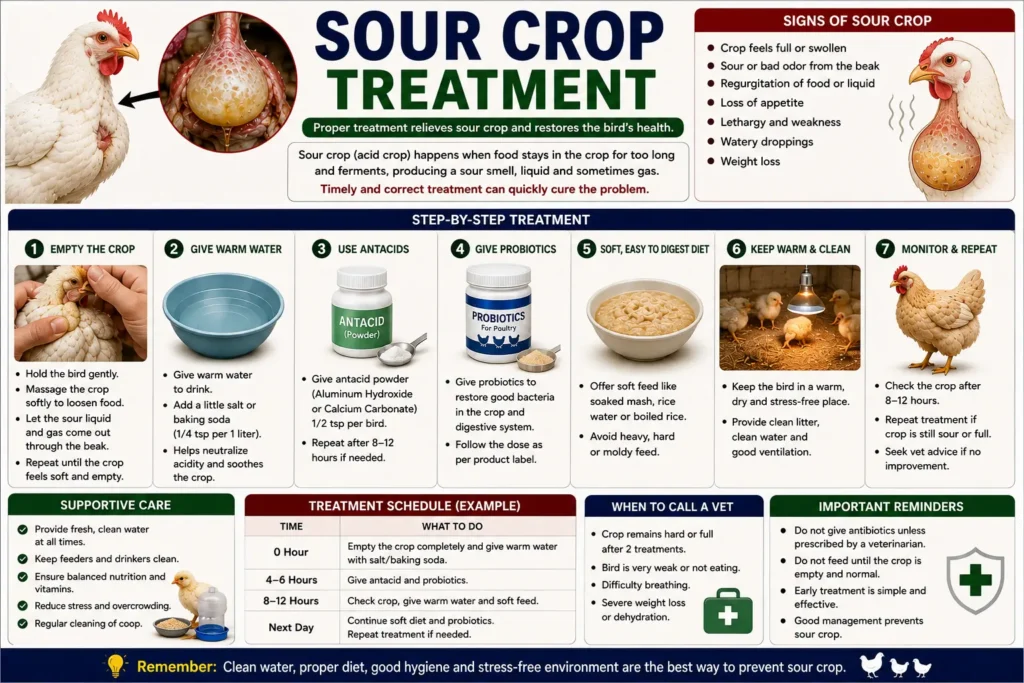
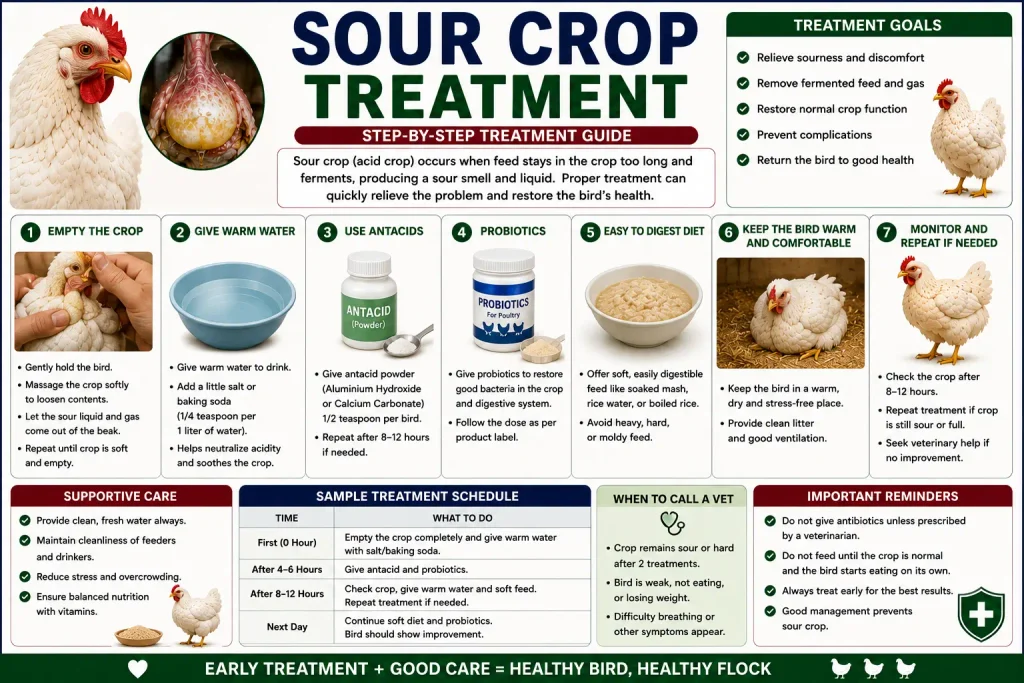
Effective sour crop treatment starts the moment you notice a squishy, swollen crop and sour breath in your hen: withhold food for 12 to 24 hours, massage the crop gently to help it empty, and support her gut with probiotics and diluted apple cider vinegar as she recovers. Most mild cases respond well to this approach within a day or two, though more stubborn cases sometimes need veterinary-prescribed antifungal medication to fully clear.
This guide goes step by step through the entire treatment process, from the first at-home actions through what happens when home care isn’t enough, including how vets approach medication and, in severe cases, surgery. You’ll also find a decision-making table to help you judge how your hen’s case is progressing and answers to the most common questions keepers have about treating this condition.
Table of Contents
Quick Answer: Sour crop treatment begins with isolating the hen and withholding food for 12 to 24 hours while keeping water available, followed by gentle crop massage several times a day to help break up and move the fermented contents. Diluted apple cider vinegar and probiotics support recovery once she resumes eating. Cases that don’t improve within a day or two, or that involve a firm, non-squishy crop, often need a veterinarian, who may prescribe an antifungal medication such as Nystatin or, in severe impaction cases, perform a minor surgical procedure.
Confirm What You’re Treating First
Before starting sour crop treatment, feel the crop to confirm it’s actually soft and squishy rather than firm and hard. A soft, fluid-filled crop points to sour crop (yeast fermentation), while a firm, unmoving crop points to impacted crop (a physical blockage), which needs a different first step. The two conditions often overlap, but starting with the wrong approach wastes valuable time.
Read More: https://lashegg.com/vent-gleet-causes/
Phase 1: Immediate At-Home Sour Crop Treatment
Step-by-Step First Aid
- Isolate the hen. Move her to a quiet, separate space where you can control her food access and monitor her closely.
- Withhold food for 12 to 24 hours. This is the single most important early step, since it gives the crop a chance to empty rather than continuing to add material to an already overloaded system. Keep fresh water available the entire time.
- Gently massage the crop. Several times a day, use light, circular pressure with your fingers to help break up the fermented contents. Work in short sessions of a minute or two rather than one long, forceful massage.
- Angle her body to help drainage. Some keepers gently tip the hen forward, head down, over a towel during massage to help fluid and gas move out rather than settling.
- Offer diluted apple cider vinegar in her water, about one tablespoon per gallon, once the fasting period begins. This is a traditional supportive measure that may help make the crop environment less hospitable to yeast, though it works best paired with the other steps rather than used alone.
- Watch for regurgitation during massage. A small amount of fluid or gas escaping is normal and often a sign the treatment is working, but position her so this doesn’t lead to aspiration.
Warning: Never force-feed a hen with an actively fermenting, squishy crop, and never attempt aggressive massage that could cause her discomfort or risk aspiration. Gentle and consistent works better than forceful and rushed.
Phase 2: Reintroducing Food and Supporting Recovery
Once the crop feels noticeably softer and smaller, and ideally close to flat after an overnight fast, you can begin reintroducing food carefully.
- Offer small, easily digestible meals first, such as a watery mash, rather than her full normal ration.
- Introduce probiotics to help rebuild a healthy population of gut bacteria after the fasting period and yeast overgrowth.
- Continue diluted apple cider vinegar in her water for several more days as ongoing support.
- Monitor crop emptying each morning. A properly recovering crop should be flat or only slightly full before her first meal of the day.
- Gradually return to a normal diet over two to three days rather than switching back all at once.
- Keep her isolated for observation until you’ve confirmed several consecutive days of normal crop emptying and behavior.
When to Escalate: Sour Crop Treatment That Needs a Vet
| Situation | What It Suggests | Next Step |
| Crop is soft but doesn’t improve after 24–48 hours of fasting and massage | Yeast overgrowth may be more established than home care can resolve | Veterinary exam, possible antifungal prescription |
| Crop feels firm or hard, not squishy | Likely impacted crop rather than sour crop | Veterinary evaluation, possible manual or surgical intervention |
| White plaques visible in the mouth | Advanced candidiasis | Veterinary diagnosis and antifungal treatment |
| Hen shows breathing difficulty | Possible aspiration of crop fluid | Veterinary care immediately |
| Crop is very large, described as “softball-sized,” or extremely distended | Severe impaction or fermentation | Veterinary care, surgery may be needed |
| Repeated sour crop episodes in the same hen | Possible chronic slow crop or underlying digestive issue | Veterinary workup to identify root cause |
Veterinary Sour Crop Treatment Options
When home care isn’t enough, a veterinarian has additional tools available.
Antifungal Medication
Veterinarians most commonly reach for prescription antifungal medications when candidiasis is confirmed or strongly suspected. Nystatin is the most frequently used option, though other antifungals are sometimes chosen for more resistant cases. Dosing depends on the bird’s exact weight and the specific product, which is exactly why this step requires a vet’s involvement rather than home guesswork.
Warning: Antifungal medications like Nystatin are prescription products, and correct dosing depends on your hen’s precise weight and the concentration of the specific product you have. Never estimate a dose yourself; have your vet calculate and prescribe it, and follow their instructions on frequency and treatment duration exactly.
Manual Crop Emptying
For crops that are severely distended or not responding to fasting and massage, a vet can manually express or flush the crop to relieve pressure and remove fermented material directly, under controlled, sterile conditions.
Surgical Intervention
In cases involving a large, long-standing impaction, or a crop that has stretched significantly, surgery may be the only way to fully resolve the blockage. Vets generally reserve this option for cases where the crop feels extremely firm, very large, or has failed to respond to less invasive treatment over several days.
Recovery Timeline for Sour Crop Treatment
| Stage | Typical Timeframe | What to Expect |
| Initial fasting phase | 12–24 hours | Crop begins to soften and reduce in size |
| Early improvement | 1–3 days | Crop feels smaller, breath odor improves, appetite may return |
| Full home recovery | 3–7 days | Normal crop emptying overnight, resumed regular diet |
| Veterinary antifungal course | 5–14 days, per prescription | Gradual resolution of underlying yeast infection |
| Post-surgical recovery | Timeline set by vet | Close monitoring, restricted diet during healing |
Did You Know? A hen recovering from sour crop treatment can look and act completely normal within days, but the underlying gut imbalance that allowed the yeast to overgrow in the first place can take longer to fully correct. That’s part of why probiotics and dietary support matter even after the visible crop symptoms resolve.
Common Mistakes During Sour Crop Treatment
- Skipping the fasting period. Continuing to feed a hen with an already-overloaded crop only adds to the fermentation problem.
- Massaging too aggressively or too long. Gentle, brief, frequent sessions are more effective and less stressful than one forceful attempt.
- Assuming apple cider vinegar alone will resolve it. It’s a helpful supportive addition, not a substitute for fasting, massage, and, when needed, veterinary antifungal treatment.
- Guessing at antifungal medication dosing. Prescription antifungals need to be dosed to the bird’s exact weight; incorrect dosing can be ineffective or harmful.
- Returning to a full diet too quickly. Reintroducing food gradually gives the crop time to confirm it’s actually emptying normally again.
- Waiting too long before involving a vet. A crop that isn’t improving after a day or two of consistent home care, or that feels hard rather than soft, needs professional evaluation rather than continued home attempts.
Preventing a Repeat Episode After Treatment
Once your hen has recovered, a few ongoing habits reduce the chance of sour crop returning:
- Keep feeders and waterers clean to limit yeast and bacterial exposure
- Provide grit to support normal crop and digestive function
- Avoid excess long grass or fibrous treats that can slow crop emptying
- Continue occasional probiotic support, especially after any future antibiotic treatment
- Check her crop each morning as part of routine flock health monitoring
When to Call a Vet
Reach out to a poultry-experienced veterinarian if:
- The crop hasn’t visibly improved after 24 to 48 hours of fasting and massage
- The crop feels firm or hard rather than soft and squishy
- White plaques appear in the mouth, suggesting advanced candidiasis
- Your hen shows breathing difficulty, severe lethargy, or stops eating and drinking entirely
- Sour crop keeps recurring despite consistent home care and good coop hygiene
Final Thoughts
Sour crop treatment comes down to a clear sequence: fast the crop to let it empty, massage gently and consistently, support gut health as she recovers, and reintroduce food gradually. Most mild cases improve noticeably within a day or two of this approach. When home care stalls, or the crop feels hard rather than soft, a vet can step in with properly dosed antifungal medication or, in more serious cases, manual or surgical intervention. Keep monitoring your hen’s crop each morning going forward, since catching a repeat episode early is always easier than treating an advanced one egg .
5. FAQ
Q: What is the first step in sour crop treatment? A: The first step is withholding food for 12 to 24 hours while keeping water available, which gives the crop a chance to empty before you begin gentle massage and supportive care.
Q: How often should I massage the crop during treatment? A: Several short sessions a day, each lasting only a minute or two, tend to work better and cause less stress than one long, forceful massage attempt.
Q: Does apple cider vinegar work as a sour crop treatment on its own? A: Not typically. It’s a helpful supportive addition to the water during treatment, but fasting, crop massage, and probiotics are the core steps that address the fermentation directly.
Q: When does sour crop treatment require antifungal medication? A: When home care, fasting, massage, and supportive measures haven’t resolved symptoms within a day or two, or when a vet confirms candidiasis, a prescription antifungal like Nystatin may be recommended, dosed specifically for your hen’s weight.
Q: Can I give my chicken Nystatin without a vet? A: Nystatin is a prescription medication, and proper dosing depends on your hen’s exact weight and the product concentration. It should only be given under veterinary guidance rather than estimated at home.
Q: How long does full recovery from sour crop treatment take? A: Mild cases often show clear improvement within one to three days and full recovery within about a week. Cases needing a veterinary antifungal course can take one to two weeks to fully resolve.
Q: Is surgery ever needed for sour crop? A: Surgery is generally reserved for severe or long-standing impaction that hasn’t responded to fasting, massage, or medication, rather than being a first-line sour crop treatment.
Q: How do I know if sour crop treatment is working? A: You should see the crop gradually soften and shrink, breath odor improve, and appetite return over the first few days. A crop that isn’t emptying normally by morning after a day or two of treatment is a sign to involve a vet.