Why Are Young Chickens Not Laying Eggs Yet?

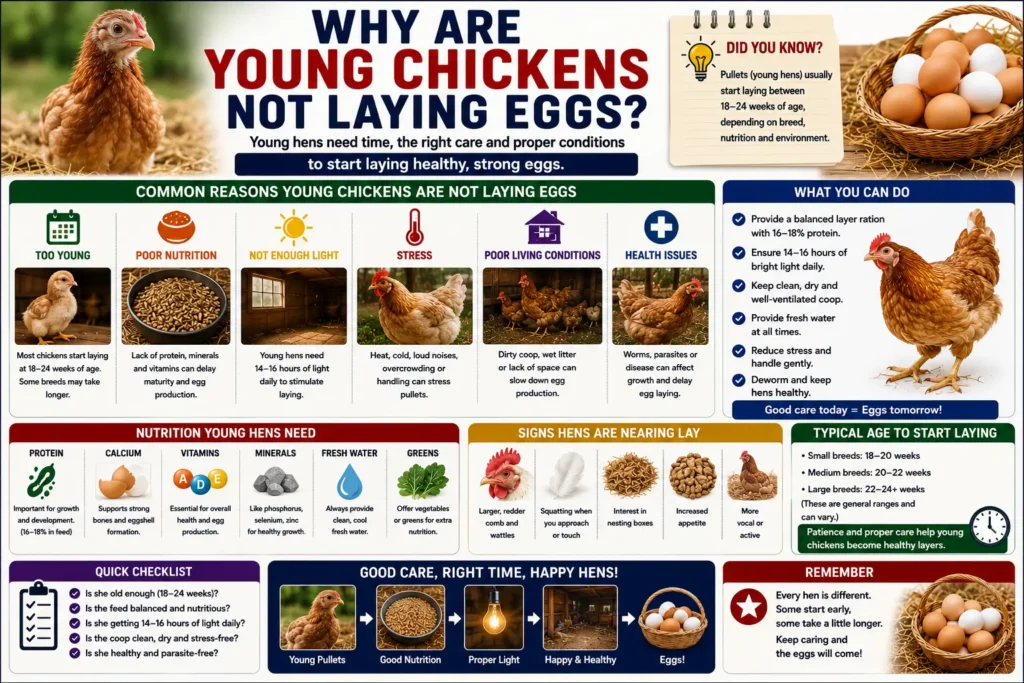
Why are young chickens not laying eggs is a completely different question from asking why an established hen has slowed down, and it deserves its own answer. A pullet who hasn’t started laying is often just running behind an internal timeline shaped by breed, season, and body development, not dealing with any kind of problem.
This guide covers exactly when chickens start laying, the realistic range of normal timing, and the specific factors that can delay a young flock’s first eggs. It also explains when a pullet not laying eggs on the expected schedule is worth a closer look.
Quick Answer: Most chickens start laying between 18 and 24 weeks old, though this varies by breed, season, and body weight. A pullet not laying eggs by 20 weeks isn’t unusual, especially for slower-maturing or heritage breeds. Delays past 30 weeks, combined with poor body condition or illness, are the point where it’s worth investigating further.
Table of Contents
When Chickens Start Laying: The Real Timeline
Typical Age Ranges by Breed Type
When chickens start laying depends heavily on breed. Production hybrids like Golden Comets or ISA Browns often begin around 18 to 20 weeks, while many heritage breeds take closer to 24 to 28 weeks, and some larger, slower-growing breeds can take even longer.
| Breed Type | Typical Age at First Egg |
| Production hybrids (Golden Comet, ISA Brown) | 18–20 weeks |
| Standard dual-purpose (Plymouth Rock, Wyandotte) | 20–24 weeks |
| Heritage breeds (Orpington, Brahma) | 24–28 weeks |
| Bantam breeds | 20–24 weeks, varies widely |
Why This Timeline Exists
A pullet’s body needs to reach a certain level of physical maturity, including skeletal development and hormone readiness, before her reproductive system activates. Rushing this process through excessive light or feed manipulation can cause problems later, including a higher risk of complications like egg binding.
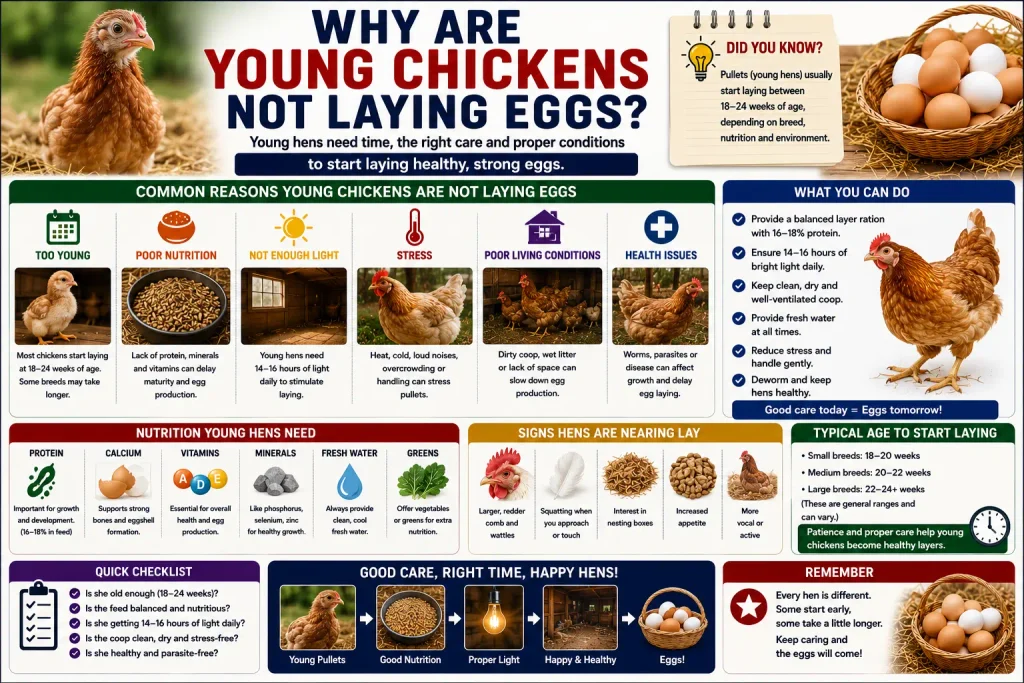
Factors That Delay When Young Chickens Start Laying
1. Season and Daylight
Pullets reaching maturity during shortening fall or winter daylight often delay laying until daylight naturally increases in spring, even if they’ve technically reached the right age.
2. Body Weight and Condition
A pullet who is underweight, due to poor nutrition or illness, typically delays laying until her body reaches an adequate condition to support egg production. Overweight pullets can also see delays, since excess fat can disrupt normal hormone signaling.
3. Breed and Genetics
As covered above, genetics play a major role, with production breeds bred specifically for early, frequent laying compared to heritage breeds selected historically for other traits like meat production or hardiness.
4. Stress or Environmental Disruption
A recent move, a new flock introduction, or predator stress can delay the onset of laying in a pullet who was otherwise on track, similar to how stress can pause laying in an established hen.
5. Nutrition
A diet lacking proper protein or calcium during the growing phase can slow overall development, which in turn delays sexual maturity and the start of laying.
Did You Know? A pullet’s first eggs are often smaller than normal and may lack a fully formed shape or shell strength while her reproductive system calibrates. This is a normal part of the process and typically resolves within the first few weeks of laying.
Read More: https://lashegg.com/chicken-not-laying-eggs-in-summer/
Pullet Not Laying Eggs: Normal vs. Worth Investigating
| Situation | Normal? | Suggested Action |
| Pullet at 18–20 weeks, no eggs yet | Yes, very common | Continue normal care, monitor |
| Pullet at 22–26 weeks, heritage breed | Yes, still within range | Continue normal care |
| Pullet past 30 weeks, no eggs, healthy | Possibly delayed by season/weight | Review light, diet, body condition |
| Pullet past 30 weeks, poor body condition | Investigate further | Check diet, rule out illness |
| Pullet showing lethargy or illness signs | Not normal | Veterinary evaluation |
Signs a Pullet Is Getting Close to Laying
Physical Signs
- Comb and wattles turning brighter red and growing larger
- Squatting when approached or touched on the back, a natural mating stance
- Increased interest in the nesting box, even without laying yet
- A noticeable widening of the pelvic bones near the vent
Behavioral Signs
Pullets nearing their first egg often become more vocal, sometimes producing a distinct “egg song” even before laying begins, and may spend more time investigating nesting areas around the coop.
Supporting Young Chickens Toward Their First Eggs
Step-by-Step: Preparing for Laying
- Switch to a layer feed at the right time. Most keepers transition from grower feed to layer feed around 16 to 18 weeks, or when the first signs of laying readiness appear.
- Provide free-choice calcium separately. Offering crushed oyster shell on the side, rather than mixing it into grower feed too early, lets pullets take what they need as their bodies prepare.
- Set up nesting boxes early. Having clean, private nesting boxes ready before pullets start laying helps prevent floor-laying habits from forming.
- Avoid rushing with excessive light. Adding significant supplemental light to force early laying in very young pullets can strain a body that isn’t fully ready.
- Reduce stress during this window. Avoid major flock changes or moves right as pullets approach laying age, if possible.
- Be patient with breed-appropriate timelines. Comparing a heritage breed’s pace to a production hybrid’s pace sets unrealistic expectations.
Expert Tip
Track each pullet’s individual age alongside her breed’s typical timeline rather than judging the whole flock by a single average date. Mixed-breed flocks especially can show a wide spread in when chickens start laying, and that spread is completely normal.
Common Mistakes to Avoid
- Assuming a pullet not laying eggs at 18 weeks is behind schedule without checking her specific breed
- Forcing early laying with aggressive light supplementation before proper physical maturity
- Overfeeding calcium too early, which can strain kidneys in birds not yet laying
- Confusing a young pullet’s first small, odd-shaped eggs with a health problem
- Ignoring true delay past 30 weeks when body condition or health also looks off
Warning
A pullet who reaches well past the expected age range for her breed and also shows poor body condition, lethargy, or other illness signs should not be assumed to simply be “a late bloomer.” These combinations deserve a closer look rather than continued waiting.
When to Call a Vet
Contact a poultry veterinarian if a pullet significantly exceeds the expected age range for her breed, especially past 30 weeks, and shows poor growth, lethargy, or other signs of illness alongside the delay. Reproductive abnormalities, though uncommon in young birds, can also prevent normal laying onset and are best evaluated by a professional if development otherwise seems off track.
People Also Ask
Why are young chickens not laying eggs at the age I expected? Breed differences, the season a pullet reaches maturity in, and her overall body condition all affect timing, so a slight delay past the average age is usually still within the normal range.
When do chickens start laying their first eggs? Most chickens start laying between 18 and 24 weeks old, though heritage and slower-maturing breeds can take until 26 to 28 weeks or slightly longer.
Is it normal for a pullet not laying eggs to still act completely healthy? Yes, a healthy pullet who simply hasn’t reached full maturity yet will act normal in every other way, which is a good sign the delay is developmental rather than health-related.
Can diet speed up when chickens start laying? Proper nutrition during the growing phase supports timely development, but overfeeding calcium or protein too early won’t meaningfully speed up laying and can cause other issues.
Does daylight affect when young chickens start laying? Yes, pullets maturing during shorter fall or winter days often delay their first egg until daylight naturally increases, similar to how daylight affects established laying hens.
Final Thoughts
Why are young chickens not laying eggs almost always comes down to timing rather than a problem to fix. Breed, season, body condition, and individual development all shape exactly when a pullet produces her first egg, and the normal range is wider than many new keepers expect.
Keep tracking each pullet’s age against her breed’s typical timeline, and reach out to a poultry veterinarian if a pullet not laying eggs significantly exceeds that range while also showing signs of poor health, rather than assuming patience alone will solve every delay.
5. FAQ
Q: Why are young chickens not laying eggs by 20 weeks old? A: This is still within the normal range for many breeds, especially heritage or dual-purpose types, so 20 weeks without an egg usually isn’t a cause for concern yet.
Q: What’s considered too late for a pullet not laying eggs? A: Past 30 weeks without an egg, particularly alongside poor body condition or other health signs, is generally the point where it’s worth investigating further.
Q: Does breed really matter for when chickens start laying? A: Yes, production hybrids often start several weeks earlier than heritage breeds, so comparing timelines across different breeds can create unnecessary worry.
Q: Can stress delay when a young chicken starts laying? A: Yes, a major flock change, move, or predator scare around the time a pullet is approaching maturity can push back the onset of laying by days to weeks.
Q: Should I worry if my pullet’s first eggs look strange? A: No, small, oddly shaped, or thin-shelled first eggs are common as a pullet’s reproductive system calibrates, and this typically improves within the first few weeks.