Chicken Heat Stress: The Reference Guide

Chicken heat stress is a physiological response, not just discomfort, triggered when a bird’s cooling mechanisms can’t keep pace with rising body temperature. This page works as a quick reference: what’s actually happening inside a heat-stressed bird and which individual chickens face the highest risk.
For the practical side, daily cooling techniques and emergency heatstroke response, the companion guide on keeping chickens cool in summer covers that ground thoroughly. This page focuses specifically on the condition itself and who’s most vulnerable.
Quick Answer: Chicken heat stress occurs when a bird’s body temperature rises faster than panting and other cooling behaviors can manage. Signs of heat stress progress from panting and wing-spreading to more severe symptoms like stumbling or collapse. Heavier breeds, overweight birds, very young or old chickens, and those with existing health conditions face the highest risk.
Table of Contents
What’s Physiologically Happening During Heat Stress
Why Chickens Struggle to Cool Down
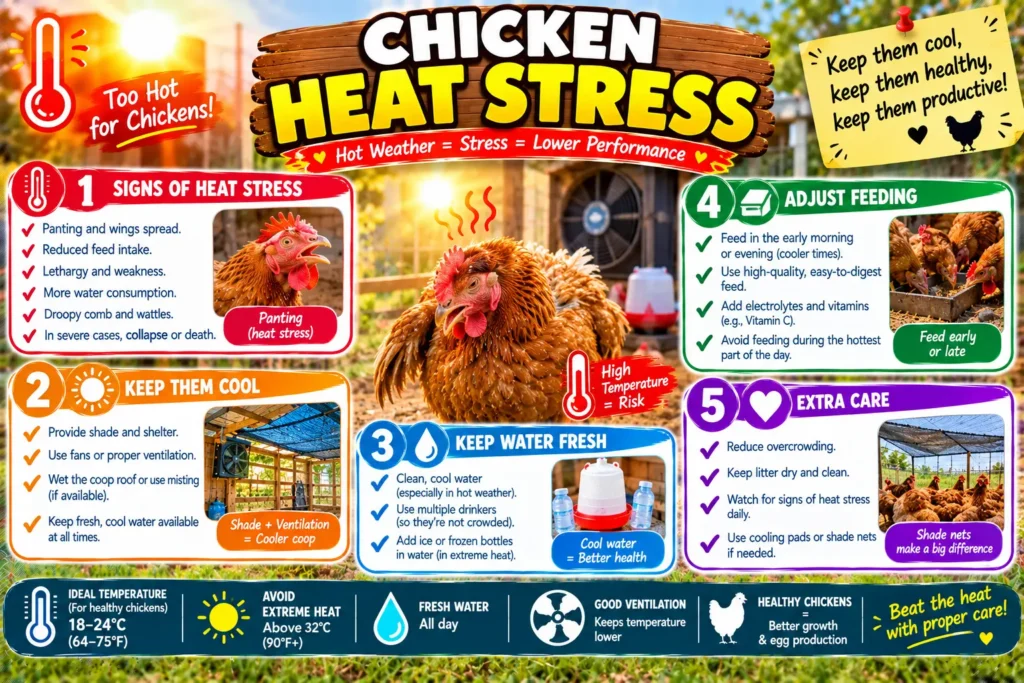
Chickens lack sweat glands, relying instead on panting, wing-spreading, and behavioral changes like seeking shade to release excess heat. When ambient temperature and humidity overwhelm these mechanisms, body temperature climbs beyond the normal 105–107°F range.
The Cascading Effect
As body temperature rises, blood flow redirects toward the skin and extremities for cooling, away from digestive and reproductive functions, which is part of why reduced feed intake and egg production both commonly accompany heat stress.
| Physiological Response | Purpose | Trade-off |
| Panting | Evaporative cooling via respiration | Uses energy, can cause respiratory alkalosis if prolonged |
| Wing-spreading | Increases surface area for heat loss | Limited effectiveness alone |
| Blood flow redirection | Cools skin/extremities | Reduces digestive/reproductive function |
| Reduced activity | Conserves energy, reduces heat generation | Reduces feed intake |
Did You Know? Prolonged, severe panting can lead to respiratory alkalosis, a blood pH imbalance from excessive carbon dioxide loss, which is part of why extreme, extended heat stress carries risks beyond simple overheating alone.
Read More: https://lashegg.com/how-to-keep-chickens-cool-in-summer/
Who’s Most at Risk for Chicken Heat Stress
Breed-Related Risk Factors
Heavier-bodied, densely feathered breeds generate and retain more heat than lighter, less feathered breeds, making breed selection a genuine risk factor independent of management quality.
| Risk Factor | Higher Risk | Lower Risk |
| Body size | Larger, heavier breeds | Smaller, lighter breeds |
| Feather density | Heavily feathered | Lighter feathering |
| Comb size | Smaller combs (less heat dissipation) | Larger combs (more heat dissipation) |
| Body condition | Overweight birds | Healthy weight birds |
Age-Related Risk Factors
Very young chicks and older hens both handle temperature regulation less effectively than healthy adult birds in their prime, making age an important factor in overall heat stress vulnerability.
Health-Related Risk Factors
Birds with existing respiratory conditions, obesity, or other underlying health issues face compounded risk during heat events, since their baseline physiological reserve is already reduced.
| Age/Health Factor | Why It Increases Risk |
| Very young chicks | Immature temperature regulation |
| Older hens | Reduced physiological reserve |
| Existing respiratory issues | Compromised cooling via panting |
| Obesity | Increased insulation, reduced heat dissipation |
Recognizing the Stages of Heat Stress
Early to Emergency Progression
Heat stress in chickens moves along a spectrum rather than switching on suddenly, which is exactly why early recognition matters for preventing progression to a genuine emergency.
| Stage | Key Signs |
| Early | Panting, wings held from body, seeking shade |
| Moderate | Reduced activity, decreased feed intake, pale comb |
| Severe/Emergency | Labored breathing, stumbling, collapse |
For the full step-by-step response to each stage, including emergency first aid, the companion cooling guide covers exactly what to do at each point.
Common Mistakes in Understanding Heat Stress Risk
- Assuming all breeds face equal heat stress risk regardless of body type or feathering
- Overlooking body condition (overweight birds) as a significant risk factor
- Focusing only on temperature while ignoring humidity’s compounding effect
- Assuming young, healthy adult birds face the same risk level as chicks or older hens
- Treating heat stress as an all-or-nothing state rather than a progressive spectrum
Warning
Humidity significantly compounds heat stress risk beyond what temperature alone suggests, since high humidity limits the effectiveness of panting as a cooling mechanism. A “feels like” heat index is often more relevant than the raw thermometer reading when assessing chicken heat stress risk.
When to Call a Vet
Contact a poultry veterinarian if a bird shows signs progressing toward the severe end of the heat stress spectrum, or if a high-risk individual (very young, old, overweight, or with existing health conditions) shows even moderate signs during a heat event, since these birds have less physiological reserve to recover without intervention.
People Also Ask
What causes chicken heat stress most commonly? High ambient temperature combined with high humidity is the most common trigger, since humidity limits the effectiveness of panting, a chicken’s primary cooling mechanism.
What are the very first signs of heat stress to watch for? Panting with an open beak and wings held away from the body are typically the earliest visible signs, appearing before more serious symptoms develop.
Are some chicken breeds more resistant to heat stress? Yes, lighter-bodied breeds with larger combs and less dense feathering, like Leghorns, generally handle heat better than heavier, densely feathered breeds.
Does chicken heat stress affect young and old birds differently? Yes, both very young chicks and older hens have less effective temperature regulation than healthy adult birds, putting them at higher risk during heat events.
Can chicken heat stress happen even with adequate shade and water? Yes, particularly during extreme heat waves or high humidity, basic shade and water may not be sufficient for high-risk individuals, making closer monitoring important during genuine extremes.
Final Thoughts
Chicken heat stress reflects a real physiological struggle to keep pace with rising body temperature, with risk varying significantly by breed, age, body condition, and existing health status. Understanding these risk factors helps identify which specific birds in a flock need the closest attention during hot weather.
For the practical response, daily prevention and emergency first aid, the companion guide on keeping chickens cool in summer covers that ground in full detail, and a poultry veterinarian should be involved promptly for any bird showing signs progressing toward the severe end of the spectrum.
5. FAQ
Q: What is chicken heat stress exactly? A: It’s a physiological state where a bird’s cooling mechanisms, mainly panting and behavioral changes, can’t keep pace with rising body temperature, leading to a spectrum of signs from mild to severe.
Q: Which chickens are most vulnerable to signs of heat stress? A: Heavier, densely feathered breeds, overweight birds, very young chicks, older hens, and birds with existing health conditions all face elevated risk compared to healthy adult birds of a heat-tolerant breed.
Q: Can chicken heat stress cause long-term health effects? A: Mild to moderate heat stress typically resolves without lasting effects once conditions improve, though severe, repeated, or prolonged heat stress can contribute to lasting health decline in vulnerable individuals.
Q: How does humidity affect chicken heat stress risk? A: High humidity significantly worsens heat stress by limiting how effectively a chicken can cool through panting, making humid heat considerably more dangerous than dry heat at the same temperature.
Q: Is chicken heat stress the same as heatstroke? A: No, heat stress describes the broader physiological response across a spectrum, while heatstroke refers specifically to the severe, emergency end of that spectrum requiring immediate intervention.