Egg Binding Causes: Looking Past the Basic List

Ask why a hen becomes egg bound and most answers stop at “low calcium” or “she’s overweight.” Those are real egg binding causes, but they’re only part of the picture. The muscles, hormones, and physical structures involved in laying an egg all have to work together, and a problem in any one of them can lead to a stuck egg.
This guide goes deeper than a basic cause list. It explains the mechanism behind each risk factor, how multiple causes often combine, and includes a practical checklist to assess your own flock’s risk level.
Table of Contents
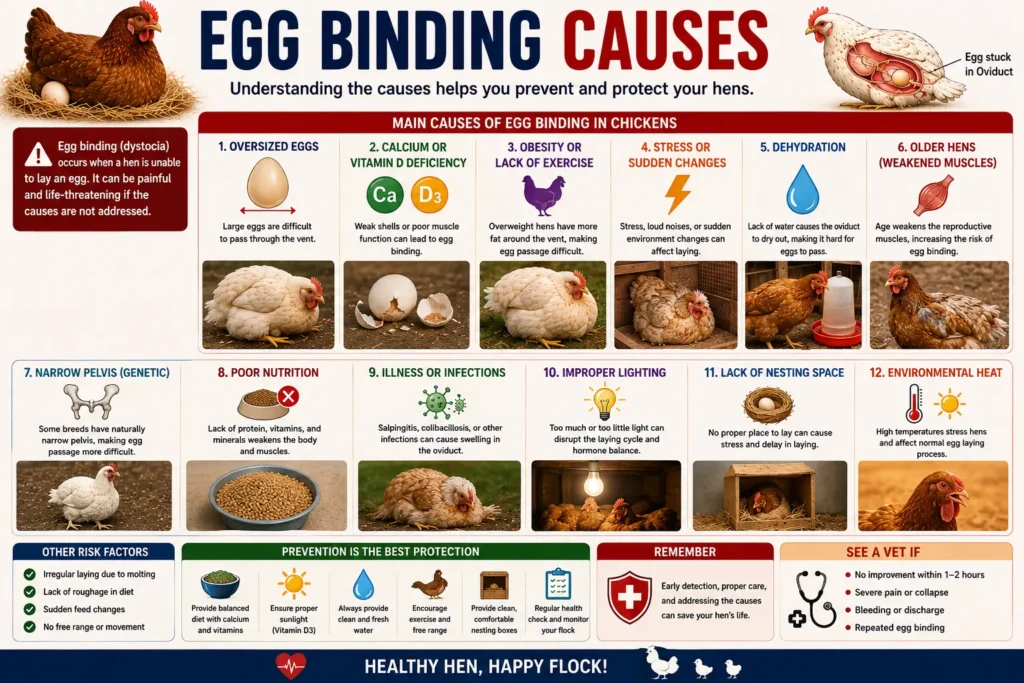
Quick Answer: Egg binding causes fall into four groups: muscular and nutritional (calcium, hydration), physical (egg size, obesity, anatomy), age-related (first-time layers, older hens), and situational (stress, illness, environment). Most cases involve more than one factor at once.
Understanding the mechanism behind each cause is what turns a generic prevention checklist into decisions that actually fit your specific flock.
The Biology Behind Every Case of Egg Binding
Before covering individual causes, it helps to understand what has to go right for an egg to pass normally. The uterus (shell gland) and vagina rely on coordinated smooth muscle contractions, supported by calcium-dependent muscle function, to move a finished egg out through the vent.
Anything that weakens those contractions, physically obstructs the passage, or disrupts the hormonal signals coordinating the process can result in egg binding. This is why so many seemingly different risk factors — diet, weight, age, stress — all lead to the same outcome.
Read More: https://lashegg.com/egg-binding-treatment/
Muscular and Nutritional Egg Binding Causes
These causes affect the reproductive tract’s ability to contract with enough strength to move the egg along normally.
Calcium Deficiency
Calcium is directly involved in muscle contraction at a cellular level. Without enough circulating calcium, the uterine and vaginal muscles can’t generate the force needed to push an egg through, especially late in the laying cycle when a hen’s calcium reserves are already being heavily used for shell formation.
Dehydration
Water plays a role in maintaining tissue elasticity and general muscle function. A dehydrated hen has less physiological reserve to manage the mechanical demands of passing an egg, and dehydration often compounds other risk factors rather than acting alone.
Vitamin D3 Deficiency
Since vitamin D3 governs how efficiently a hen absorbs and uses calcium, a deficiency here can create a functional calcium shortage even when dietary calcium levels look adequate on paper.
General Nutritional Imbalance
A layer diet lacking overall balance, not just calcium, can leave a hen’s muscles and connective tissue under-supported for the physical demands of laying, particularly during high-production periods.
Table 1: Muscular and Nutritional Causes
| Factor | Mechanism | Contributing Condition |
| Calcium deficiency | Weak muscle contraction | Poor diet, high-production laying |
| Dehydration | Reduced tissue and muscle function | Hot weather, inadequate water access |
| Vitamin D3 deficiency | Impaired calcium absorption | Low sunlight, incomplete feed |
| General nutrient imbalance | Reduced muscle/tissue support | Unbalanced or low-quality diet |
Physical Egg Binding Causes
These causes create a mechanical obstacle, regardless of how strong the hen’s muscle contractions are.
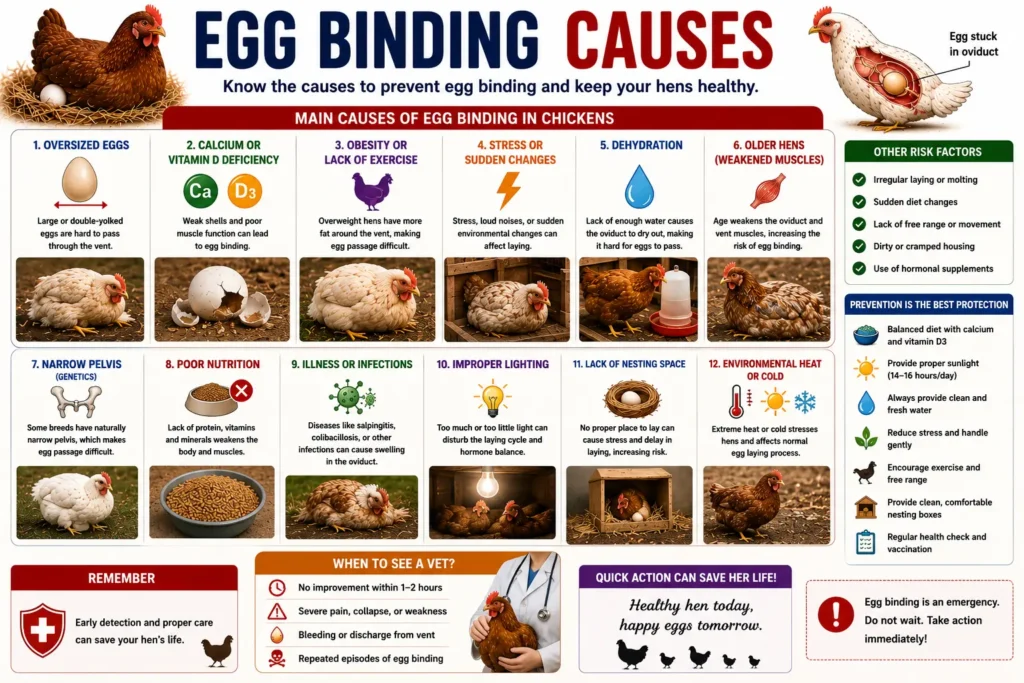
Oversized or Double-Yolked Eggs
An egg significantly larger than a hen’s typical size, often a double yolk, can be genuinely too large to pass through the oviduct smoothly, even in a hen with normal muscle function.
Misshapen Eggs
An egg with an irregular shape, sometimes caused by two eggs meeting in the oviduct, can catch or stall partway through the tract.
Obesity
Excess internal fat physically compresses the reproductive tract from the outside, narrowing the effective space an egg has to move through.
Reproductive Tract Scarring or Abnormality
A prior infection, previous egg-binding episode, or a structural abnormality present from development can leave scar tissue or a narrowed passage that raises the risk of a repeat obstruction.
Table 2: Physical Causes and Their Effect
| Factor | Effect on Passage |
| Oversized/double-yolk egg | Egg too large for the tract to accommodate easily |
| Misshapen egg | Irregular shape catches partway through |
| Obesity | External compression narrows the tract |
| Scarring/abnormality | Structural narrowing or obstruction |
Age-Related Egg Binding Causes
First-Time Layers
A pullet’s reproductive tract hasn’t fully matured or stretched to accommodate a full-sized egg during her very first laying cycles, making early egg binding more common in young hens than many owners expect.
Older Hens
As hens age, muscle tone throughout the body, including the reproductive tract, gradually declines. Combined with a lifetime of laying-related wear, this makes egg binding somewhat more common again later in a hen’s life.
Did You Know? Egg binding risk follows something close to a U-shaped curve across a hen’s lifespan: higher in her first laying weeks, lower during her prime laying years, and rising again as she gets older.
Situational and Environmental Egg Binding Causes
Acute Stress
A sudden stressor, like a predator scare or an abrupt environmental change, can disrupt the hormonal signaling that coordinates normal muscle contractions during egg passage.
Concurrent Illness
A hen fighting an unrelated infection or illness may have less physiological reserve for the muscular demands of laying, making egg binding more likely during that period.
Overcrowding
Beyond general stress, overcrowded conditions can disrupt normal laying routines and increase the odds of interrupted or incomplete muscle contractions during shell gland activity.
Expert Tip: When you’re trying to identify why chickens become egg bound in your specific flock, look for overlap. A hen who is a first-time layer AND slightly overweight AND laying in hot weather carries combined risk that’s higher than any single factor alone would suggest.
How Multiple Causes Combine
Egg binding causes rarely act in isolation. In practice, most cases involve two or more overlapping risk factors working together. A hen with mild calcium deficiency might lay normally most of the time, but combine that with dehydration during a heat wave, and her risk rises sharply. This is why prevention efforts that address multiple factors at once tend to work better than focusing on a single cause.
Egg Binding Risk Checklist for Your Flock
Use this checklist to identify which egg binding causes are most relevant to your own birds:
- [ ] Are your hens on a complete, balanced layer feed with adequate calcium?
- [ ] Is free-choice calcium (like oyster shell) available at all times?
- [ ] Do your hens have constant access to fresh water?
- [ ] Are any of your hens noticeably overweight?
- [ ] Do you have pullets in their first few weeks of laying?
- [ ] Do you have hens laying eggs unusually large for their breed?
- [ ] Has your flock experienced recent stress (predator activity, new birds, environment changes)?
- [ ] Has any hen had a prior episode of egg binding?
Checking several boxes doesn’t guarantee an issue, but it does mean paying closer attention to those specific hens.
Common Mistakes When Identifying Egg Binding Causes
Common Mistakes:
- Assuming there’s always one clear cause instead of a combination
- Overlooking dehydration as a contributing factor alongside calcium
- Not considering age-related risk in very young or older hens
- Ignoring the compounding effect of stress on other existing risk factors
- Focusing only on diet while overlooking body condition or anatomy
When Causes Point Toward a Vet Visit
When to Call a Vet:
- Egg binding has happened more than once in the same hen
- You suspect a structural or anatomical cause rather than diet or weight
- Nutritional and environmental corrections haven’t reduced recurrence
- A hen shows signs of egg binding alongside unrelated illness symptoms
- You’re unsure which underlying cause applies and need a professional assessment
A veterinarian can help pinpoint less obvious causes, including reproductive tract abnormalities that aren’t visible or predictable from home observation alone, and can guide longer-term management for hens with recurring risk factors.
Addressing Egg Binding Causes to Reduce Future Risk
- Correct calcium and vitamin D3 intake with a complete layer feed and free-choice oyster shell.
- Prioritize hydration, especially during hot weather or illness recovery.
- Manage body condition through balanced feeding rather than excess treats.
- Watch first-time layers and older hens more closely, given their elevated baseline risk.
- Reduce environmental stress through consistent routines and predator-proofing.
- Track recurring hens, since a prior episode is one of the strongest predictors of a future one.
University extension services and poultry health researchers consistently point to this combined approach, addressing nutrition, body condition, and stress together, as more effective than targeting any single egg binding cause in isolation.
5. FAQ
Q: What is the single most common cause of egg binding? A: Calcium deficiency is generally considered the most common underlying egg binding cause, since it directly weakens the muscle contractions needed to pass an egg.
Q: What causes egg binding in young, first-time-laying hens? A: What causes egg binding in first-time layers is usually a reproductive tract that hasn’t fully matured or stretched yet, making her very first eggs harder to pass than eggs later in her laying life.
Q: Why do chickens become egg bound even with a good diet? A: Why chickens become egg bound despite good nutrition often comes down to physical factors like an oversized or double-yolked egg, obesity, or a structural abnormality, rather than diet alone.
Q: Can stress really be one of the causes of egg binding? A: Yes. Acute stress can disrupt the hormonal signaling that coordinates normal muscle contractions during egg passage, making it a real, if often overlooked, contributing cause.
Q: Are older hens more likely to experience egg binding? A: Yes, somewhat. Declining muscle tone with age, combined with a lifetime of laying-related wear, makes egg binding modestly more common again in older hens compared to hens in their prime laying years.
Q: Is egg binding usually caused by one single factor? A: Not usually. Most cases involve two or more overlapping causes, such as mild calcium deficiency combined with dehydration or heat stress, working together rather than a single isolated factor.
Q: Can a hen’s anatomy be an underlying egg binding cause? A: Yes. Scarring from a prior infection or episode, or a structural abnormality present from development, can create a physical obstruction that raises egg binding risk independent of diet or weight.