What Causes Soft Shell Eggs? A Closer Look at Every Reason

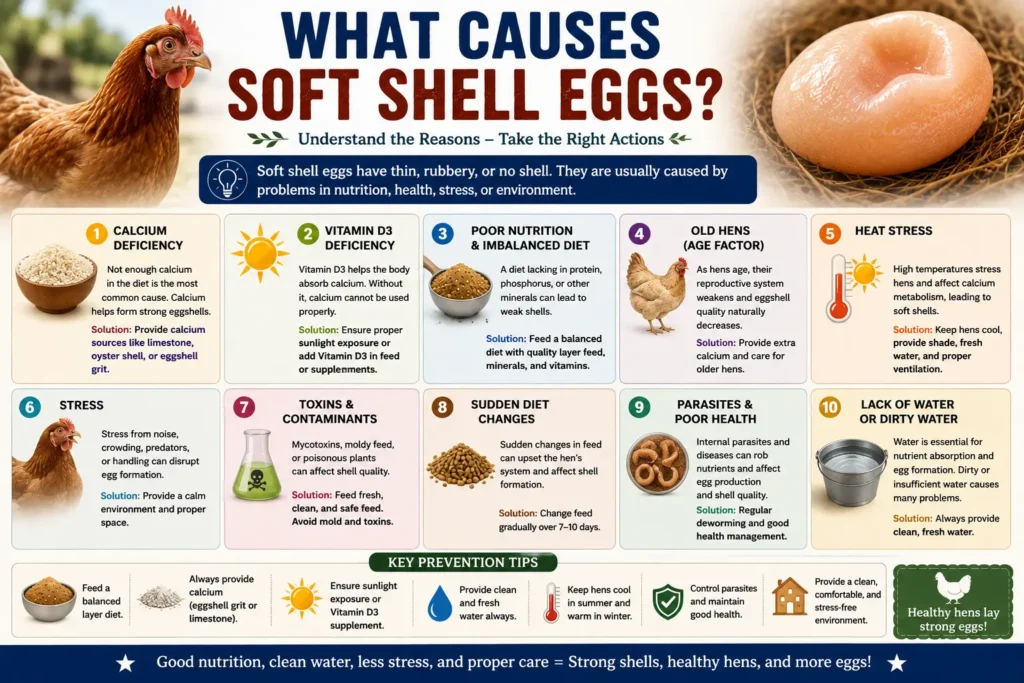
A hen lays an egg that bends instead of cracks, and the obvious question follows immediately: what causes soft shell eggs to happen in the first place? The short answer is almost always tied to calcium, but the full picture involves several overlapping factors that determine why, and how often, it happens.
This article breaks down the causes of soft shell eggs one by one — from nutritional gaps to age, heat, stress, and disease — so you can identify which factor is likely affecting your flock rather than guessing. If you already know what a soft shell egg looks like, this guide goes deeper into the biological “why” behind it.
Quick Answer: The most common causes of soft shell eggs are calcium deficiency, a young pullet’s still-calibrating shell gland, heat stress, general flock stress, and normal reproductive aging. Less commonly, underlying illness such as infectious bronchitis can disrupt shell formation directly.
Table of Contents
How a Normal Shell Forms, and Where It Goes Wrong
To understand what causes soft shell eggs, it helps to know how a normal shell is built. After the yolk and albumen form, the egg spends roughly 20 hours in the shell gland (uterus), where calcium carbonate is deposited layer by layer to build a hard, protective shell.
A soft shell egg happens whenever that 20-hour deposition process is interrupted, shortened, or under-supplied. The egg still moves through the rest of the reproductive tract normally — it’s specifically the calcium-laying stage that falls short.
Read More: https://lashegg.com/soft-shell-egg-causes-and-fixes/
Cause #1: Calcium Deficiency
This is the single most common and most documented cause of soft shell eggs. A hen needs a steady calcium supply to keep building strong shells day after day, and even a temporary shortfall shows up in her next egg.
- Insufficient dietary calcium: Non-layer feed, scratch-heavy diets, or feed not formulated for laying hens often fall short of the calcium a laying hen needs
- Poor calcium absorption: Even with enough calcium in the diet, inadequate vitamin D3 can limit how well a hen absorbs it
- Reduced feed intake: A hen eating less than usual, for any reason, takes in less calcium even on an otherwise adequate diet
Expert Tip: Offer crushed oyster shell or eggshell separately from the main feed rather than mixed in. Hens instinctively self-regulate calcium intake when it’s offered free-choice, which helps prevent both deficiency and over-supplementation.
Cause #2: Age-Related Factors
Age affects the causes of soft shell eggs at both ends of a hen’s laying life, though for different reasons.
Young pullets just starting to lay often produce one or more soft or thin-shelled eggs while their reproductive system, including the shell gland, calibrates a consistent process. This is considered a normal, temporary phase.
Older hens can show a gradual decline in shell gland efficiency as part of typical reproductive aging, sometimes alongside reduced overall egg production.
| Age Group | Why Soft Shells Happen | How Long It Typically Lasts |
| New pullet, first weeks | Shell gland still calibrating | Days to a few weeks |
| Mature hen, otherwise healthy | Usually diet or environmental, not age | Resolves with correction |
| Older hen, declining production | Natural reproductive aging | Ongoing, gradual |
Cause #3: Heat Stress
Heat is one of the most seasonal, predictable causes of soft shell eggs. When temperatures climb, hens pant to cool down, and panting lowers blood carbon dioxide levels in a way that reduces the bicarbonate available for calcium carbonate shell formation.
This explains why soft shell eggs often spike during summer heat waves even in flocks on a properly balanced, calcium-adequate diet. The cause here isn’t a lack of calcium in the feed — it’s a temporary disruption in how the body processes it during extreme heat.
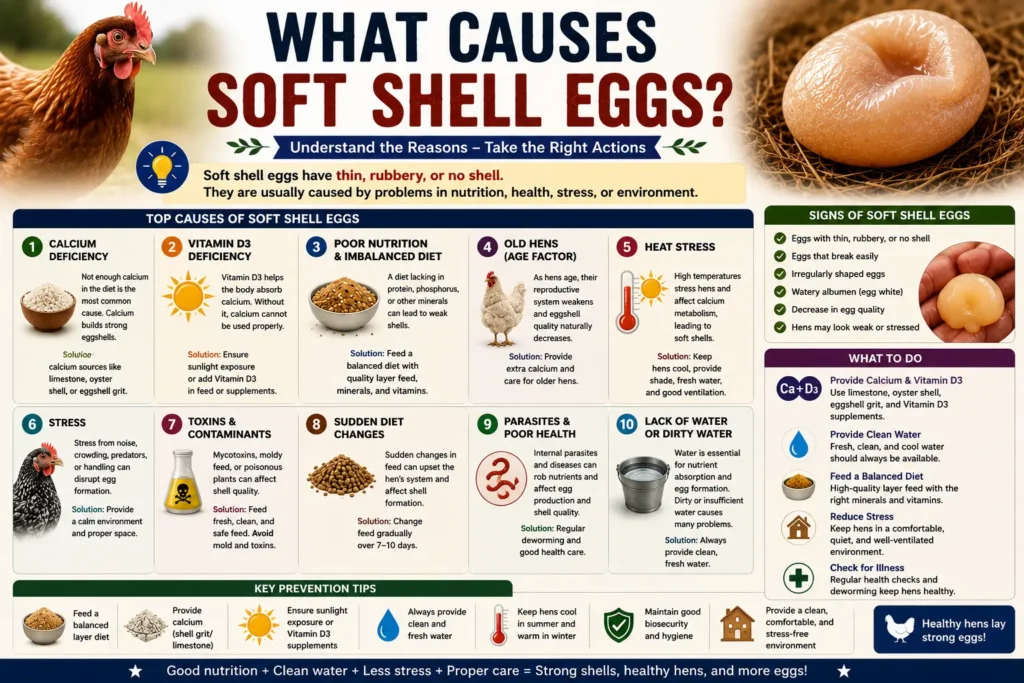
Cause #4: General Stress
Beyond heat specifically, a range of stressors can disrupt the shell-forming process:
- Overcrowding or sudden changes in flock size
- Predator scares or perceived threats
- Introducing new birds to an established flock
- Loud, sudden changes in routine or environment
- Transport or relocation
Stress-related soft shell eggs are typically temporary and resolve once the stressor is removed or the flock adjusts.
Cause #5: Underlying Illness
Less common, but important to rule out when other causes don’t explain a persistent pattern. Certain illnesses affect the shell gland directly or disrupt the reproductive system enough to cause ongoing shell quality problems.
- Infectious bronchitis, a respiratory virus, is documented to affect shell quality directly in some strains
- Egg drop syndrome, more common in commercial settings, can cause a sudden flock-wide pattern of soft or shell-less eggs
- Reproductive tract disorders, including inflammation of the oviduct, can disrupt normal shell formation
Did You Know? Sources referencing the Merck Veterinary Manual document that certain respiratory viruses affecting laying hens are known to cause persistent eggshell quality issues that don’t resolve with diet changes alone, which is why illness-related causes shouldn’t be ruled out too quickly in a persistent case.
Comparing the Causes of Soft Shell Eggs
| Cause | Onset | Resolves With Diet Fix Alone? | Needs Vet Involvement? |
| Calcium deficiency | Gradual | Yes, usually | No, unless persistent |
| New pullet calibrating | Early in laying life | Resolves on its own | No |
| Heat stress | Seasonal, sudden | Partially, with cooling measures | No |
| General stress | Sudden, tied to event | Yes, once resolved | No |
| Older hen aging | Gradual | Partially, supportive only | No |
| Illness (bronchitis, etc.) | Can be sudden, flock-wide | No | Yes |
This comparison helps narrow down which cause fits your situation. A single soft shell egg from a young pullet points to a very different explanation than a sudden pattern across multiple hens in the flock.
How to Identify Which Cause Applies to Your Flock
- Check your hen’s age and laying history. New layers and aging hens fit two of the most common causes right away.
- Review the weather. A recent heat wave points strongly toward heat stress as the cause.
- Look at your feed. Confirm you’re using a complete layer feed with free-choice calcium available separately.
- Consider recent flock changes. New birds, predator scares, or routine disruptions point to general stress.
- Watch for other symptoms. Respiratory signs, lethargy, or a flock-wide pattern point toward illness as a possible cause.
- Track how many hens are affected. One hen suggests an individual cause; multiple hens at once suggests a shared environmental or disease-related cause.
Warning: If soft shell eggs appear suddenly across several hens at once, especially alongside respiratory symptoms, treat this as a potential flock-wide illness rather than an individual dietary issue, and contact a veterinarian.
What Doesn’t Cause Soft Shell Eggs
It helps to rule out a few things people sometimes assume are causes but aren’t well documented:
- Rooster presence or absence has no documented connection to shell hardness
- Egg color (brown vs. white shelled breeds) doesn’t affect susceptibility to soft shells
- A single skipped day of calcium supplement rarely causes an immediate soft shell egg, since the body draws on stored calcium reserves first
When to Call a Vet
When to Call a Vet: Contact a veterinarian if soft shell eggs continue for more than two to three weeks despite a proper layer diet and free-choice calcium, if multiple hens are affected at once, or if soft shell eggs appear alongside respiratory symptoms, lethargy, or reduced appetite.
Common Mistakes When Diagnosing the Cause
Common Mistakes
- Assuming illness immediately instead of first checking diet, age, and recent heat exposure
- Overlooking a recent heat wave as the explanation for a sudden pattern
- Mixing calcium supplement into feed instead of offering it free-choice, which can mask whether hens are actually consuming enough
- Not tracking how many hens are affected, which is key to telling an individual cause from a flock-wide one
- Waiting too long to consider illness when a persistent pattern doesn’t respond to diet fixes
People Also Ask
What is the number one cause of soft shell eggs? Calcium deficiency is the most commonly documented cause, whether from insufficient dietary calcium, poor absorption, or reduced feed intake.
Can heat alone cause a soft shell egg without a calcium problem? Yes. Heat stress reduces the bicarbonate available for shell formation through panting, independent of how much calcium is in the diet.
Do soft shell eggs run in certain breeds? There isn’t strong documented evidence pointing to specific breeds as more prone to soft shell eggs overall, though individual hens vary in shell gland efficiency.
Can a vitamin deficiency cause soft shell eggs even with enough calcium in the diet? Yes. Inadequate vitamin D3 can limit calcium absorption even when dietary calcium levels are otherwise sufficient.
How do I know if illness is the cause instead of diet? Illness-related causes typically don’t improve after two to three weeks of proper diet and calcium supplementation, and often appear alongside other symptoms like respiratory signs or a sudden flock-wide pattern.
Final Thoughts
Understanding what causes soft shell eggs comes down to ruling factors in and out systematically — starting with the most common and fixable causes like calcium and heat, then considering age and stress, and only turning to illness when the pattern doesn’t resolve with those fixes. Most cases trace back to something correctable within your control.
Keep watching the pattern rather than reacting to a single egg. If the cause behind repeated soft shell eggs doesn’t respond to diet and environmental fixes within a few weeks, that’s the point to bring in a veterinarian rather than continuing to guess.
FAQ
What causes soft shell eggs most commonly? Calcium deficiency is the leading cause, though heat stress, general stress, age, and occasionally underlying illness are also documented causes of soft shell eggs.
What are the causes of soft shell eggs in young hens specifically? In pullets, the most common cause is a reproductive system, including the shell gland, still calibrating a consistent shell-forming process during the first weeks of laying.
Can stress be one of the causes of soft shell eggs even with a good diet? Yes. Even hens on an adequate, calcium-rich diet can produce a soft shell egg during a period of acute stress, since stress disrupts the shell-forming process independent of nutrition.
Is illness a common cause of soft shell eggs? No, it’s one of the less common causes, but it’s important to rule out when soft shell eggs persist despite proper diet, especially if multiple hens are affected or other symptoms appear.
Do soft shell eggs have more than one cause at the same time? Yes, often. A hen dealing with heat stress and a slightly low calcium intake, for example, may show a more pronounced soft shell pattern than either factor alone would cause.
How quickly can fixing the cause resolve soft shell eggs? Diet and environmental causes typically resolve within days to two weeks once corrected. Illness-related causes require veterinary treatment and won’t resolve with diet changes alone.