Lighting and Chicken Egg Production: The Practical Setup Guide

Lighting and chicken egg production are connected through one of the most reliable relationships in backyard poultry keeping, yet most keepers only think about it once winter output has already dropped. Understanding daylight and laying well enough to set up lighting proactively, rather than reactively, makes a real difference in year-round consistency.
This guide moves past the basic “hens need light” explanation and into the practical details: exactly how much light, what kind, what schedule, and how to set up supplemental lighting for hens safely and effectively.
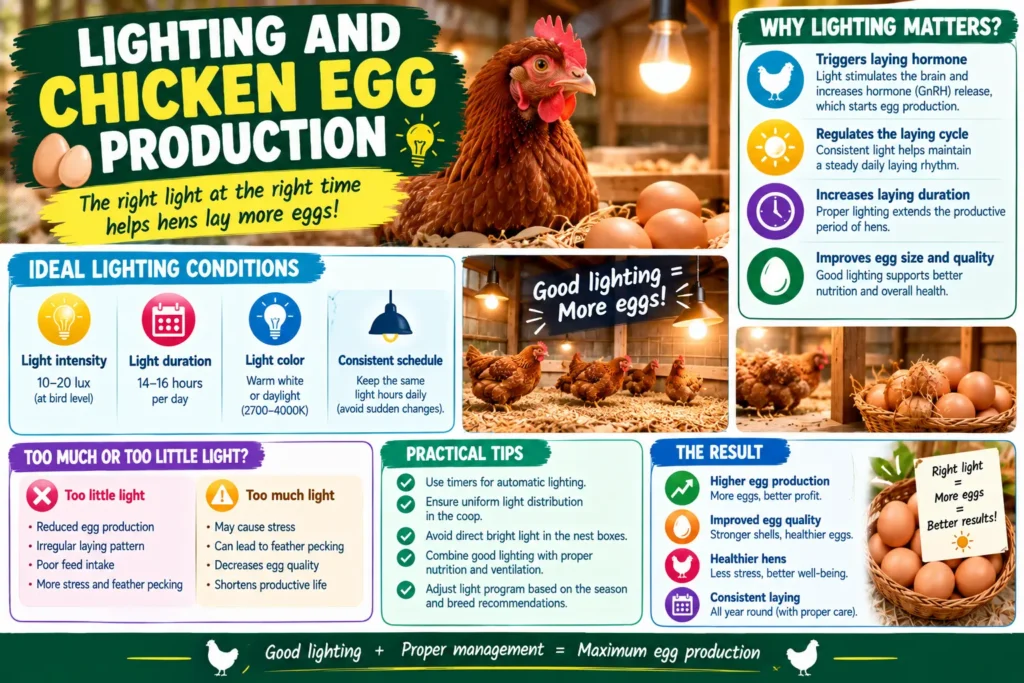
Quick Answer: Chickens need roughly 14 to 16 hours of light daily to maintain consistent egg production. When natural daylight falls short, especially in fall and winter, supplemental lighting on a timer can maintain or restore laying. Extending light in the early morning rather than the evening, using a warm-toned bulb, and increasing gradually all support a smoother transition than an abrupt lighting change.
Table of Contents
Why Lighting and Chicken Egg Production Are So Closely Linked
The Hormonal Trigger
Light entering a hen’s eye stimulates the hypothalamus and pituitary gland, triggering the hormonal chain that leads to ovulation and egg formation. Without adequate light exposure, this trigger doesn’t fire consistently, directly reducing or stopping egg production.
Why 14 to 16 Hours Specifically
This range approximates the daylight hens would experience during their most naturally productive months, generally corresponding to late spring through summer in most temperate regions. Falling meaningfully short of this range, particularly during fall and winter, is the primary driver behind seasonal laying declines.
| Daylight Hours | Effect on Laying |
| 14–16 hours | Supports consistent, strong production |
| 10–13 hours | Noticeable decline likely |
| Under 10 hours | Significant decline or full stop common |
Did You Know? This same light-driven hormonal mechanism is why commercial egg operations rely so heavily on controlled lighting systems, often achieving remarkably consistent year-round production regardless of the actual season outside.
Read More: https://lashegg.com/can-stress-stop-chickens-from-laying-eggs/
Calculating Your Current Daylight Situation
Step-by-Step: Figuring Out What You Need
- Check your local sunrise and sunset times. Numerous free tools and apps provide this by location and date.
- Calculate current total daylight hours. Subtract sunrise time from sunset time for your specific location.
- Compare against the 14–16 hour target. This tells you exactly how many additional hours of light your flock needs.
- Decide whether to add light in the morning, evening, or both. Morning extension is generally recommended, covered in detail below.
Regional Variation Matters
Keepers in far northern or southern latitudes deal with far more dramatic seasonal daylight swings than those closer to the equator, meaning lighting needs vary significantly by region even at the same time of year.
Setting Up Supplemental Lighting for Hens
Choosing the Right Light
| Light Type | Recommended? | Notes |
| Warm white LED | Yes | Energy efficient, gentle light quality |
| Incandescent | Acceptable | Less efficient, generates more heat |
| Harsh white/blue-toned LED | Not ideal | Can increase stress in some flocks |
| Red heat lamps | Not for lighting purposes | Intended for heat, not daylight extension |
Timer Setup
A basic mechanical or digital timer is essential for consistent supplemental lighting. Manually turning lights on and off introduces inconsistency that can disrupt the hormonal cycle more than simply providing no supplemental light at all.
Step-by-Step: Installing a Lighting Setup
- Choose a fixture rated for coop conditions. Look for moisture resistance given typical coop humidity and dust.
- Position the light safely away from bedding and flammable material. Fire risk is a genuine concern with any coop lighting setup.
- Connect the light to a reliable timer. Set it according to your calculated daylight gap.
- Test the schedule for a few days before finalizing. Confirm the timer functions correctly and the light reaches the intended area.
- Adjust gradually as natural daylight shifts. Revisit your calculation every few weeks as seasonal daylight changes throughout fall and winter.
Morning vs. Evening Lighting: Which Is Better?
Why Morning Extension Is Generally Preferred
Extending light in the early morning allows hens to settle onto the roost naturally as it gets dark in the evening, following their instinctive behavior. Evening-only extension followed by sudden darkness can leave hens caught off the roost, unable to see well enough to settle safely.
When Evening Extension Might Make Sense
Some keepers use a combination approach, or evening-focused lighting, when their daily schedule makes morning lighting logistically difficult to manage or monitor consistently.
| Approach | Pros | Cons |
| Morning extension | Natural evening roosting behavior preserved | Requires timer set for pre-dawn hours |
| Evening extension only | Simpler for some schedules | Risk of hens caught off roost at sudden lights-out |
| Combination (both ends) | Flexible, gradual transitions | Slightly more complex timer setup |
How Gradually Should You Introduce Supplemental Light?
Avoiding an Abrupt Change
Jumping from natural short winter daylight straight to a full 14–16 hour schedule overnight can be more disruptive than helpful. A gradual increase of 15 to 30 minutes every few days allows the flock’s hormonal cycle to adjust more smoothly.
Expert Tip
Keep a simple written log of your lighting schedule changes alongside your flock’s egg count. This makes it much easier to see whether adjustments are actually producing the intended effect, rather than relying on general impressions over a busy season.
Should You Use Supplemental Lighting At All?
The Case For It
Keepers wanting consistent egg availability through fall and winter, particularly those depending on their flock for regular household egg supply, often find supplemental lighting a practical, low-cost solution.
The Case Against It
Some keepers prefer to let hens follow their natural seasonal rhythm, allowing a genuine winter rest period. This approach may support longer-term reproductive health and overall laying lifespan, since continuous year-round production places ongoing physical demands on a hen’s body.
| Approach | Best For |
| Supplemental lighting | Keepers prioritizing consistent egg supply |
| Natural seasonal rest | Keepers prioritizing hen longevity and natural rhythms |
Common Mistakes to Avoid
- Using an inconsistent, non-timer-based lighting schedule
- Adding light abruptly rather than gradually increasing exposure
- Choosing harsh, high-intensity lighting instead of warm-toned, moderate options
- Overlooking fire safety when installing coop lighting
- Assuming lighting alone will fix a production issue actually caused by nutrition, stress, or health
Warning
Coop fires are a genuine and serious risk with improperly installed lighting, particularly heat lamps or fixtures placed too close to dry bedding. Always use fixtures rated for the environment, secure them well away from flammable material, and consider a fixture with a protective cage or guard.
When to Call a Vet
Contact a poultry veterinarian if egg production stays low despite properly implemented supplemental lighting, especially when paired with other symptoms like lethargy, weight loss, or poor shell quality. A persistent lack of response to appropriate lighting and chicken egg production changes may point toward an underlying nutritional or health issue instead.
People Also Ask
How many hours of light do chickens need to lay eggs? Chickens generally need 14 to 16 hours of light daily to support consistent egg production, whether from natural daylight, supplemental lighting, or a combination of both.
Does daylight and laying really matter that much, or is it overstated? It’s a genuinely significant factor; light directly triggers the hormonal chain responsible for ovulation, making it one of the most impactful single factors in seasonal production changes.
What’s the best time to turn on supplemental lighting for hens? Extending light in the early morning hours is generally preferred over evening-only lighting, since it preserves hens’ natural instinct to settle onto the roost as it gets dark.
Can too much light hurt chickens? Extending light meaningfully beyond the 14–16 hour range offers little additional production benefit and may increase stress or reduce needed rest, so more isn’t necessarily better.
Is it bad to stop supplemental lighting once I’ve started? Stopping abruptly can cause a noticeable production dip as natural seasonal daylight reasserts itself, so a gradual reduction is generally smoother than an immediate stop.
Final Thoughts
Lighting and chicken egg production are connected through a direct, hormone-driven mechanism that makes this one of the more controllable factors in seasonal laying patterns. A properly calculated, gradually introduced, timer-based lighting setup can meaningfully support consistent production for keepers who want it.
Weigh the benefits of consistent output against the case for natural seasonal rest, and reach out to a poultry veterinarian if production stays low despite a properly implemented lighting plan, since that pattern may point toward a different underlying cause.
5. FAQ
Q: How does lighting and chicken egg production connect to molting? A: Both are tied to seasonal daylight changes, and molting often coincides with shortening days, meaning supplemental lighting doesn’t override a molt already in progress.
Q: Can I use daylight and laying data to predict when my flock will slow down? A: Yes, tracking your local daylight hours against the 14–16 hour target gives a reasonably reliable prediction of when natural seasonal decline is likely to begin.
Q: What wattage light is best for supplemental lighting for hens? A: A moderate-intensity bulb, often in the range typically used for a single small room, is usually sufficient; overly bright, high-wattage lighting isn’t necessary and can increase stress.
Q: Do all chicken breeds respond the same way to supplemental lighting? A: Most breeds respond to the same basic light-hormone mechanism, though production hybrids often show a more pronounced response than heritage breeds with more independent seasonal patterns.
Q: Is natural sunlight enough, or do I need artificial lighting and chicken egg production support? A: In regions with naturally long summer days, sunlight alone is often sufficient for parts of the year, with artificial lighting becoming more relevant specifically during shorter fall and winter days.