Can Stress Stop Chickens From Laying Eggs? Short Answer: Yes

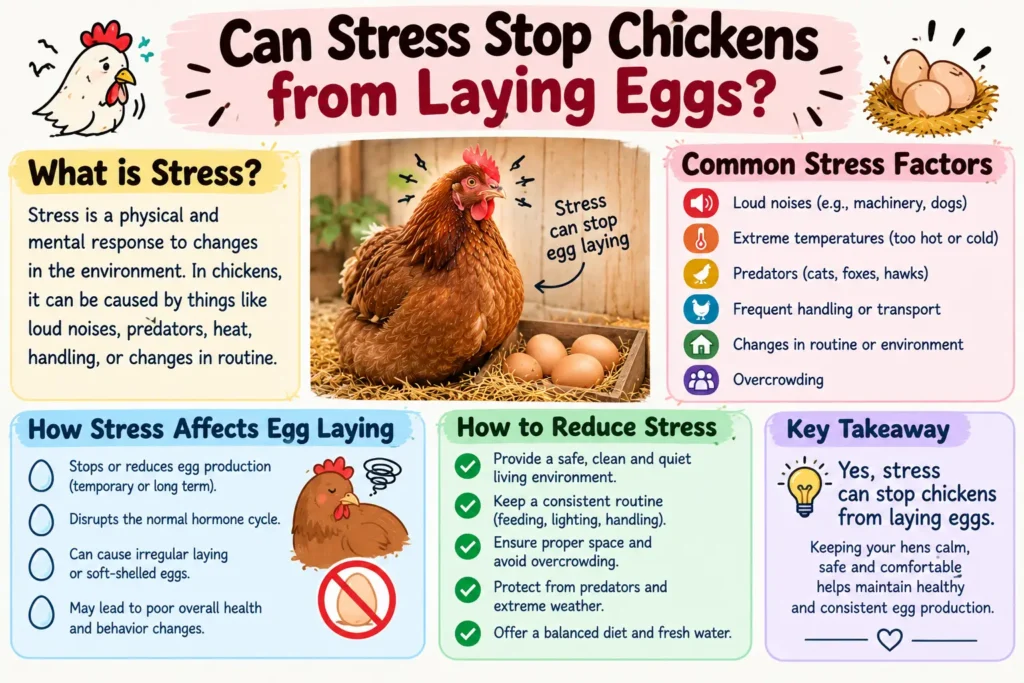
Can stress stop chickens from laying eggs is a question most keepers ask right after something dramatic happens near the coop, a hawk swooping low, a dog getting loose, a sudden thunderstorm. The direct answer is yes, and often faster than people expect: a genuinely stressed hen can stop laying within a day or two of the event.
This piece answers the question directly, in plain terms, without repeating the full biology lesson. For the deeper explanation of exactly why this happens and every specific stressor involved, the companion guide on stress and egg production covers that ground thoroughly; this page is here to give you a quick, confident answer and next steps.
Quick Answer: Yes, stress can and does stop chickens from laying eggs. A single frightening event or ongoing tension in the flock both work through the same basic mechanism: stress hormones interfere with the signals that trigger egg formation. Most hens resume laying within one to two weeks once the stressful situation is resolved.
Table of Contents
“My Hen Stopped Laying Right After [X] Happened” — Is That Stress?
Scenarios That Commonly Line Up With Stress
- A predator got into the run, or came close enough to cause a scare
- A new bird or several new birds were just added to the flock
- The coop was moved, rebuilt, or significantly changed
- A loud, unfamiliar noise or disruption happened nearby (construction, fireworks, a new dog)
- A hen was recently transported, sold, or rehomed
If a laying pause started within a day or two of one of these events, stress is a very reasonable explanation, and a stressed hen not laying for this reason usually isn’t a cause for serious worry.
Scenarios That Suggest Something Else
| What You’re Seeing | Stress Likely? | Consider Instead |
| Sudden stop right after a scary event | Yes | N/A |
| Gradual decline over weeks, no clear trigger | Less likely | Age, season, molting |
| Stop with lethargy, pale comb, or discharge | Less likely alone | Illness or reproductive issue |
| Only one hen affected, ongoing for weeks | Possible if bullying | Individual health issue |
How Fast Does Stress Actually Stop Egg Laying?
The Quick Timeline
A single significant stressful event can measurably affect hormone levels within minutes and visibly affect laying within one to two days. This is why keepers often notice a very clean before-and-after pattern tied to one specific incident.
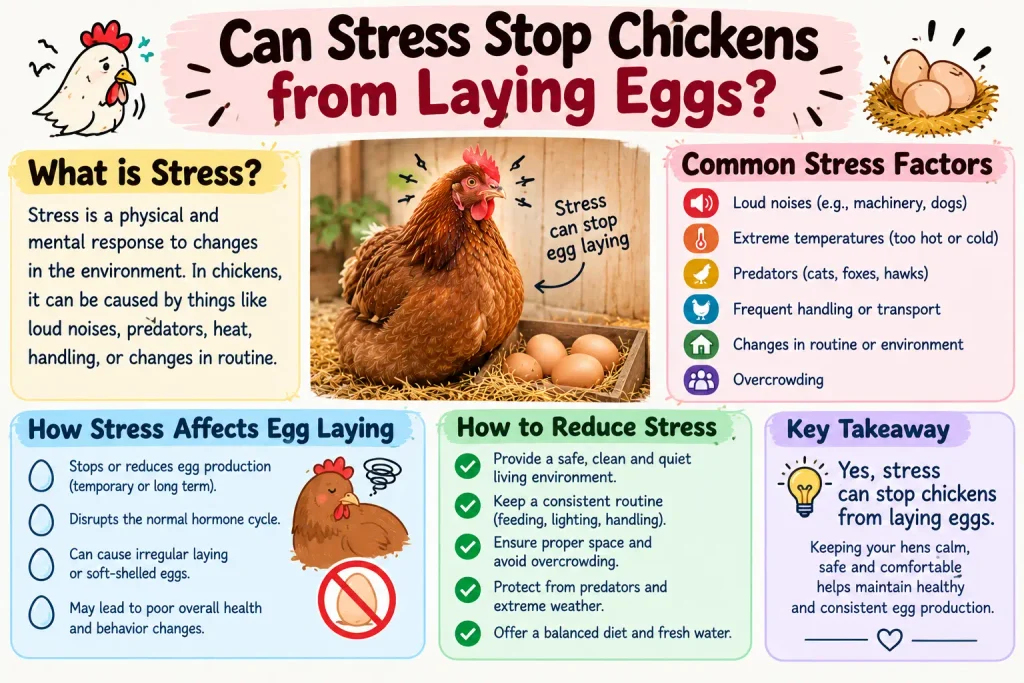
| Stage | Timing |
| Stressful event occurs | Day 0 |
| Hormonal changes begin | Minutes to hours |
| Laying pause becomes noticeable | 1–2 days |
| Recovery begins (if stressor resolved) | Within 1–2 weeks |
Did You Know? Even hens who didn’t directly experience a predator attack, but simply heard the alarm calls and commotion from flock mates who did, can show a stress-related laying pause. Chickens communicate danger to each other very effectively.
Read More: https://lashegg.com/stress-and-egg-production-in-chickens/
What to Do for a Stressed Hen Not Laying
Step-by-Step: The Practical Response
- Confirm the likely trigger. Match the timing of the laying stop to a specific recent event if you can identify one.
- Remove or fix the source if possible. Secure a predator entry point, separate a bullying hen, or simply let a recent change settle without adding more disruption.
- Keep everything else calm and consistent. Avoid introducing new stressors while the flock recovers from the first one.
- Give it one to two weeks. Most stress-related laying pauses resolve within this window once the underlying cause is addressed.
- Reassess if nothing improves. A pause lasting well beyond two weeks, without a clear ongoing stressor, is worth a closer look at health instead.
Expert Tip
Resist the urge to “fix” a stressed flock by immediately changing feed, adding supplements, or making other changes all at once. Since the answer to whether stress can stop chickens from laying eggs is almost always yes, the simplest and most effective response is usually just removing the stressor and giving the flock time, rather than layering on additional changes.
Common Mistakes to Avoid
- Assuming a laying pause after a scary event must mean illness instead of stress
- Adding new stress, like introducing more birds, right after an existing stressful event
- Expecting laying to resume the very next day once a stressor is removed
- Overlooking ongoing, low-level stress like overcrowding as a ongoing cause
- Ignoring a pattern where only one specific hen is consistently affected, which often points to bullying
Warning
While stress explains many sudden laying pauses, don’t use it as an automatic explanation if other symptoms are present. A stressed hen not laying should still be otherwise active and eating normally; lethargy, poor appetite, or physical symptoms alongside the laying stop deserve investigation beyond assuming stress alone.
When to Call a Vet
Contact a poultry veterinarian if a laying pause continues well beyond two to three weeks after the stressor has been identified and resolved, or if the stressed-looking hen also shows lethargy, poor appetite, or other physical symptoms. These signs suggest something beyond a typical stress response that’s worth a professional look.
People Also Ask
Can stress stop chickens from laying eggs even without an obvious scary event? Yes, chronic, lower-level stress like overcrowding or ongoing flock tension can suppress laying just as effectively as a single dramatic incident, just often less obviously tied to one moment.
How do I know if my stressed hen not laying will start again on her own? If the stressor has genuinely been resolved and she’s otherwise acting healthy, most hens resume laying within one to two weeks without any additional intervention needed.
Does every hen in the flock stop laying from the same stressful event? Often yes for flock-wide events like a predator scare, though individual sensitivity varies, and some hens may be affected more or longer than others.
Can I speed up recovery for a stressed hen not laying? Removing the stressor and keeping the environment calm and consistent afterward is the most effective approach; there’s no reliable way to force a faster hormonal recovery beyond that.
Is it normal for stress and egg production issues to resolve completely on their own? Yes, in the vast majority of cases, once the underlying stressor is gone, laying returns to normal without needing any medical treatment.
Final Thoughts
Can stress stop chickens from laying eggs? Yes, clearly and often quickly, through a real hormonal mechanism rather than just general unhappiness. Matching the timing of a laying pause to a specific recent event usually confirms stress as the cause, and removing that stressor typically brings laying back within one to two weeks.
Keep an eye out for symptoms beyond just the laying pause itself, and reach out to a poultry veterinarian if a stressed hen not laying doesn’t recover within a reasonable time or shows other signs that point toward illness instead.
5. FAQ
Q: Can stress stop chickens from laying eggs permanently? A: No, in nearly all cases the effect is temporary, and laying resumes once the stressor is resolved and the flock has time to recover.
Q: What counts as stress and egg production triggers for backyard flocks specifically? A: Predator scares, new bird introductions, coop moves, loud disruptions, and overcrowding are among the most common real-world triggers keepers encounter.
Q: How long should I wait before worrying about a stressed hen not laying? A: Give it one to two weeks after the stressor is resolved; a pause extending well beyond that without other explanation is worth a closer look.
Q: Can mild, everyday stress affect laying, or does it need to be dramatic? A: Even mild but ongoing stress, like chronic overcrowding, can suppress laying over time, so the stressor doesn’t need to be a single dramatic event.
Q: Should I separate a stressed hen from the rest of the flock? A: Only if the stress is coming from another flock member specifically, such as bullying; for general environmental stress, keeping the flock together in a calm routine is usually better.