Home Remedies for Lash Egg: Separating Helpful From Hopeful

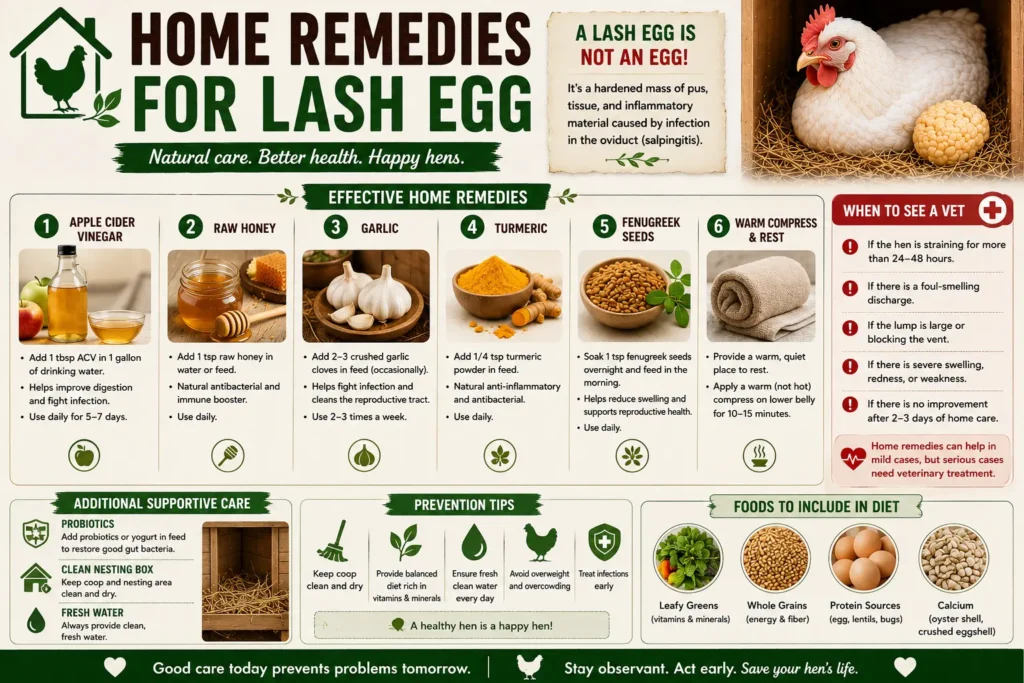
Searching for home remedies for lash egg usually means you’re trying to help your hen without rushing straight to medication, and that instinct makes sense. Some natural approaches genuinely support recovery. Others just sound good online without much backing. This guide breaks down what home remedies for lash egg can realistically do, what they can’t, and where natural remedies for chickens fit into a real treatment plan.
Table of Contents
Quick Answer
Home remedies for lash egg — like probiotics, hydration support, and stress reduction — can support a hen’s immune system and comfort during recovery. They cannot reliably cure the bacterial infection (salpingitis) behind most lash eggs. Veterinary diagnosis and antibiotics remain the primary treatment when infection is confirmed.
What’s Really Happening Inside a Lash Egg
A lash egg isn’t a deformed egg. It’s a mass of hardened pus, casein (a cheese-like protein), and tissue debris, expelled from the oviduct because of salpingitis — inflammation or infection in the reproductive tract.
This matters for remedy selection. Home remedies for lash egg work best as supportive care around an infection, not as a direct substitute for treating the infection itself.
Read More: https://lashegg.com/lash-egg-treatment-at-home/
Home Remedies for Lash Egg: Popular Options at a Glance
| Remedy | Claimed Purpose | Evidence Level |
| Probiotics / fermented feed | Supports gut and immune health | Some poultry research support for general gut health |
| Diluted apple cider vinegar | General flock wellness, water acidity | Mostly anecdotal in backyard settings |
| Garlic in feed | Believed immune or antibacterial support | Limited, mixed evidence in poultry |
| Oregano or oregano oil | Anecdotal antimicrobial properties | Some lab studies, limited real-world poultry data |
| Reduced light exposure | Slows egg production, rests oviduct | Reasonably supported physiological mechanism |
| Warm compress on vent area | Comfort, gentle cleaning | Supportive only, not curative |
| Turmeric in feed | Anti-inflammatory folk use | Very limited poultry-specific evidence |
| Epsom salt soak | General comfort, hygiene | No specific evidence for salpingitis |
Expert Tip
Treat this table as a starting point for conversation with your vet, not a shopping list. Ask specifically whether any remedy you’re considering could interact with prescribed medication before combining them.
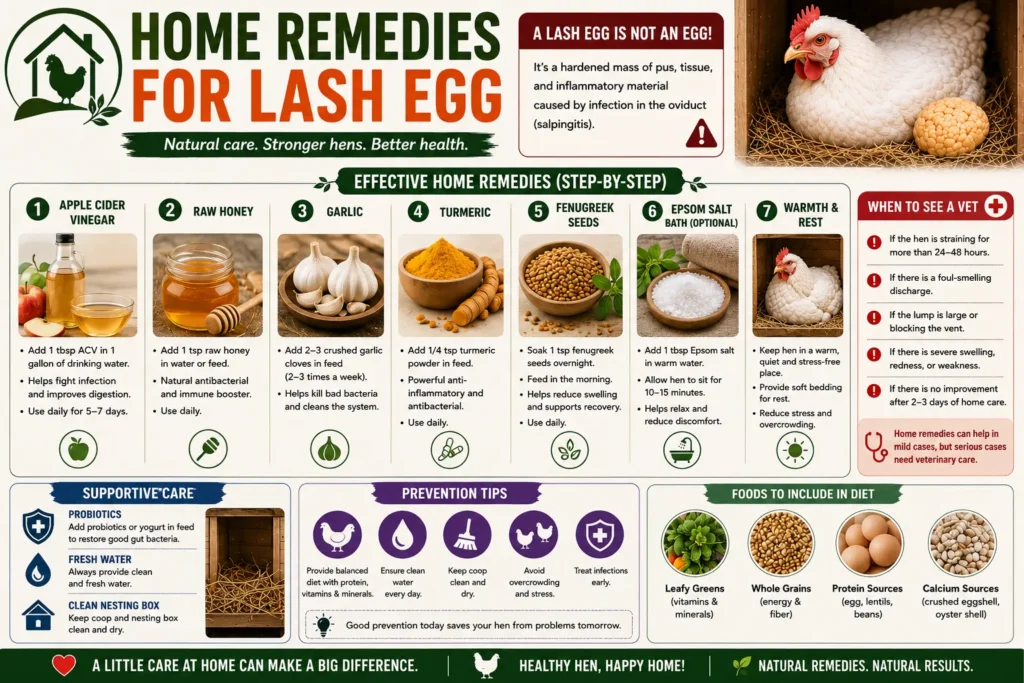
Do Home Remedies for Lash Egg Actually Work?
The honest answer sits in the middle. Supportive remedies can genuinely help a hen feel more comfortable, stay hydrated, and maintain gut health during recovery. What they generally can’t do is eliminate an established bacterial infection on their own.
Salpingitis is most often driven by bacteria like E. coli. Bacterial infections typically need targeted antibiotics to fully resolve, especially once symptoms extend beyond a single mild episode. Relying only on home remedies for lash egg in a hen with worsening symptoms risks letting the infection progress.
Warning
Never use home remedies for lash egg as a reason to delay a vet visit once your hen shows lethargy, appetite loss, abdominal swelling, or a second lash egg. Salpingitis can progress to egg yolk peritonitis, which is far harder to treat once established.
Natural Remedies for Chickens: The Bigger Picture
Home remedies for lash egg often overlap with general natural remedies for chickens used for overall flock wellness. Understanding this broader context helps you use them sensibly.
- Fermented feed and probiotics support gut bacteria balance, which plays a role in overall immune function
- Apple cider vinegar in water (diluted, roughly 1 tablespoon per gallon) is a common wellness habit, though effects are more anecdotal than proven
- Herbs like oregano, thyme, and garlic appear often in natural poultry care discussions, with some laboratory-level antimicrobial research but limited large-scale poultry trials
- Diatomaceous earth is used by some keepers for external parasite control, unrelated to internal infections like salpingitis
- Calming herbs like chamomile are sometimes used for stress reduction during illness, though stress reduction itself matters more than the specific herb
None of these replace diagnosis. They function as wellness support, similar to how a balanced diet supports human health without treating a bacterial infection.
Building a Sensible Home Remedy Routine
- Start with the basics first. Hydration, warmth, and isolation matter more than any specific remedy.
- Add one supportive remedy at a time, such as probiotics, so you can track what helps.
- Avoid combining multiple untested remedies at once, since this makes it hard to know what’s working.
- Keep a symptom log so you can report specifics to a vet if things don’t improve.
- Set a decision point, such as 48–72 hours, to reassess and escalate to veterinary care if needed.
Did You Know?
Stress reduction is one of the more evidence-backed “natural” interventions in poultry care. Elevated stress hormones can suppress immune response, so a calm, low-stress environment genuinely supports recovery, even though it’s rarely marketed the same way as a specific remedy.
What Home Remedies for Lash Egg Cannot Replace
| Need | Why Remedies Fall Short |
| Diagnosing the exact cause | Requires a physical exam, and sometimes imaging or bloodwork |
| Treating confirmed bacterial infection | Needs targeted antibiotics matched to the bacteria involved |
| Addressing internal laying | May require veterinary intervention or surgery |
| Managing egg yolk peritonitis | A serious complication requiring prompt professional treatment |
| Pain management | Appropriate anti-inflammatory medication is vet-directed |
When to Call a Vet
Move past home remedies for lash egg and involve a vet if you see:
- A second lash egg within a few weeks
- Ongoing lethargy or appetite loss
- Abdominal swelling or a firm belly
- Persistent foul odor from the vent
- No improvement after 48–72 hours of supportive care
Natural Remedies for Chickens: What to Avoid
Some substances marketed as “natural” are actually harmful to chickens. Being cautious here matters as much as choosing helpful remedies.
- Excess garlic or onion in large amounts can affect red blood cells over time
- Essential oils used undiluted can irritate a hen’s respiratory system
- Unregulated herbal supplements may carry unknown dosing risks for birds
- Human medications of any kind should never be given without specific veterinary guidance
Common Mistakes With Home Remedies for Lash Egg
- Treating remedies as a full alternative to veterinary care
- Adding several new remedies at once, making it impossible to track effects
- Continuing home-only care past the point symptoms clearly worsen
- Assuming “natural” automatically means “safe” for chickens
Recovery Expectations With Supportive Natural Care
| Stage | What to Expect |
| Days 1–3 | Hydration and comfort measures should keep the hen stable, not necessarily improving yet |
| Days 3–7 | If infection is mild or already resolving, gradual improvement may appear |
| Beyond 7 days without improvement | Time to prioritize veterinary treatment over continued home remedies |
| After vet-directed treatment | Natural supportive care can continue alongside prescribed medication, with vet approval |
Preventing the Need for Repeated Home Remedies
- Keep coop hygiene consistent to reduce bacterial exposure
- Support gut health year-round with probiotics or fermented feed, not just during illness
- Manage flock stress through adequate space and enrichment
- Maintain a balanced layer diet with proper calcium and protein
- Monitor older or high-production hens more closely for early signs
Conclusion
Home remedies for lash egg have a real, supportive role, especially for hydration, comfort, and general wellness during recovery. What they can’t do is reliably cure the bacterial infection that usually causes a lash egg in the first place. Use natural remedies for chickens as one part of a bigger plan, not the whole plan, and watch your hen closely for any signs that point toward a vet visit. Acting on those signs early gives her the best chance at a full recovery.
5. FAQ
What are the best home remedies for lash egg? Supportive options like probiotics, hydration with electrolytes, warmth, and stress reduction are the most commonly used home remedies for lash egg. They support recovery but don’t replace veterinary treatment for infection.
Can natural remedies for chickens cure a lash egg? Natural remedies can support a hen’s overall health and comfort, but they generally cannot cure the bacterial infection behind most lash eggs on their own.
Is apple cider vinegar good for lash egg treatment? Diluted apple cider vinegar is a common general wellness habit in backyard flocks, though its direct effect on salpingitis specifically isn’t well documented.
Are essential oils safe as a lash egg home remedy? Undiluted essential oils can irritate a chicken’s respiratory system, so they’re generally not recommended without specific, vet-approved guidance.
How long should I try home remedies before seeing a vet? Most keepers set a 48–72 hour window. If there’s no improvement, or symptoms worsen, veterinary care should take priority over continued home remedies.
Can probiotics help with lash egg recovery? Probiotics support gut and immune health, which can help a hen’s overall resilience during recovery, though they don’t directly treat the infection causing salpingitis.
Is garlic a safe natural remedy for chickens? Small amounts in feed are commonly used, but large or excessive amounts may affect red blood cells over time, so moderation matters.
Do I still need a vet if I’m using home remedies for lash egg? Yes, especially if symptoms are more than mild or a second lash egg appears. Remedies work best alongside, not instead of, professional diagnosis.