Are Lash Eggs Dangerous to Humans? The Short Answer

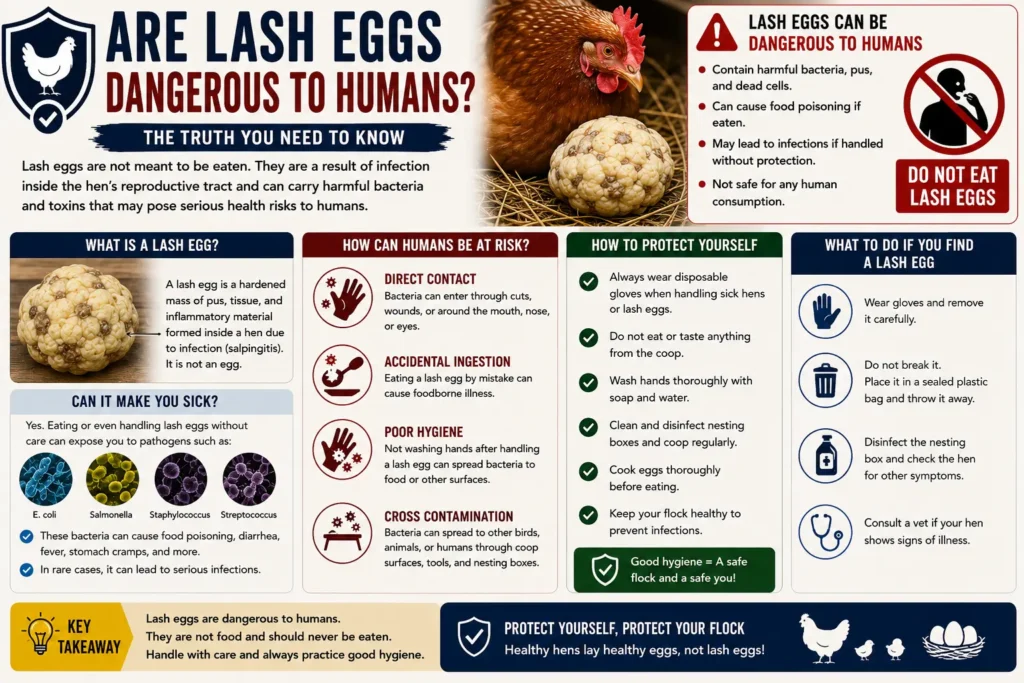
If you just found a strange, rubbery mass in your nesting box and started searching are lash eggs dangerous to humans, here’s the direct answer: handled carelessly, yes, they can carry some risk, mainly through bacterial exposure. Handled with basic hygiene, that risk drops close to zero for most backyard keepers.
A lash egg isn’t a real egg. It’s a buildup of pus, dead tissue, and inflammatory material from a hen’s infected or inflamed oviduct, most often tied to a condition called salpingitis. The material inside can contain live bacteria, which is where the actual human health risks come from, not from some mysterious toxin.
Quick Answer: Lash eggs themselves are not highly dangerous to humans when handled with gloves and basic hygiene, but they can carry bacteria like E. coli or Salmonella, which pose real risk if touched with bare hands and then transferred to your mouth, face, or food. Never eat a lash egg, and always wash your hands thoroughly after handling one.
Table of Contents
Are Lash Eggs Dangerous to Humans? Breaking Down the Real Risk
The honest answer sits between “totally harmless” and “seriously toxic.” A lash egg isn’t radioactive or poisonous on contact, but it isn’t sanitary either. The risk comes almost entirely from the bacteria that caused the underlying infection in the first place.
What’s Actually Inside a Lash Egg
- Caseous pus — solidified white blood cells and bacterial material.
- Sloughed tissue — cells shed from the inflamed oviduct lining.
- Bacteria — commonly E. coli, sometimes other opportunistic bacteria.
- Occasionally yolk material — if internal laying contributed to its formation.
None of these components are inherently more dangerous than what you’d find in any other infected biological material, but they’re also not something your body is built to handle through the mouth, eyes, or open cuts.
Human Health Risks Tied to Bacterial Exposure
| Risk Factor | Why It Matters | How to Reduce It |
| Bare-hand contact | Bacteria can transfer to skin, then to face or food | Wear gloves when handling |
| Touching mouth or eyes afterward | Direct bacterial exposure route | Wash hands thoroughly, avoid touching face |
| Open cuts on hands | Bacteria can enter through broken skin | Use gloves, cover open wounds |
| Feeding it to pets | Risk of bacterial illness in the animal | Discard away from pets entirely |
| Composting near edible plants | Bacteria can persist in soil, especially without proper hot composting | Dispose separately or hot-compost properly |
Warning: E. coli and Salmonella, the bacteria most commonly linked to lash eggs and reproductive infections in hens, can cause gastrointestinal illness in humans if ingested, even in small amounts. This is exactly why lash eggs should never be eaten or handled carelessly around food prep areas.
Comparing Lash Egg Risk to Other Backyard Chicken Hazards
To put the human health risks in perspective, it helps to compare a lash egg to other common backyard chicken exposures.
| Source | Common Bacteria/Risk | Relative Human Risk |
| Lash egg | E. coli, inflammatory material | Moderate if mishandled, low with gloves and handwashing |
| Raw chicken droppings | Salmonella, Campylobacter | Moderate, well-documented risk without hygiene |
| Handling live, healthy chickens | Salmonella (from skin/feathers) | Low to moderate, standard precaution: wash hands after |
| Normal fresh eggs, properly handled | Minimal | Very low with standard food safety practices |
According to guidance echoed by the USDA and CDC-aligned public health messaging, handwashing after any poultry contact, not just lash egg handling, is the single most effective prevention step against bacterial illness from backyard flocks.
Read More: https://lashegg.com/can-you-eat-a-lash-egg/
Did You Know?
Did You Know? Public health guidance has long recommended washing hands after handling any live poultry or their environment, not because chickens are unusually dirty, but because Salmonella can live on healthy-looking birds without causing any visible illness in the bird itself.
Safe Handling Steps When You Find a Lash Egg
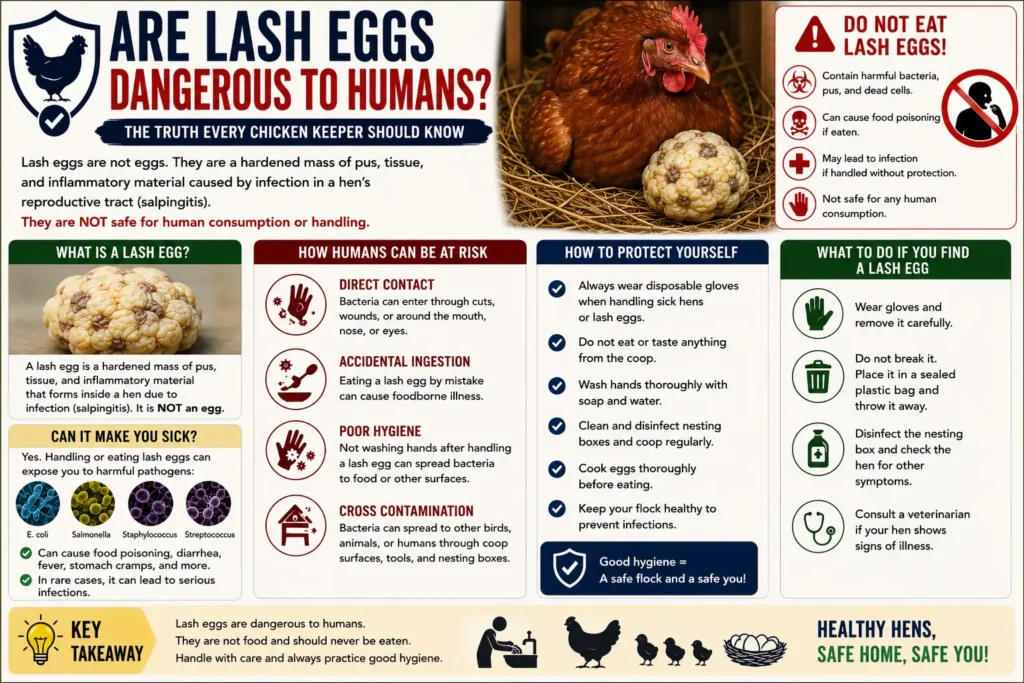
- Put on gloves before touching it. Disposable gloves work fine for a one-time cleanup.
- Place it directly into a bag or container. Avoid letting it touch other surfaces.
- Dispose of it away from pets and edible garden beds. Standard trash disposal is simplest for most households.
- Remove gloves carefully, inside out. This keeps contaminated surfaces away from your skin.
- Wash your hands thoroughly with soap and water. At least 20 seconds, covering all surfaces.
- Clean the nesting box area. Especially if the lash egg leaked or broke apart inside it.
Expert Tip: Keep a small “chicken chore kit” near the coop with disposable gloves, hand sanitizer, and a few sealable bags. It turns an unpleasant surprise into a quick, low-risk cleanup instead of a bare-handed scramble.
Common Mistakes That Increase Human Health Risks
Common Mistakes:
- Picking up a lash egg bare-handed out of curiosity before realizing what it is.
- Cracking one open to inspect it without gloves or handwashing planned afterward.
- Letting children or pets near a freshly discovered lash egg before it’s removed.
- Assuming a “cooked” or dried-out lash egg is automatically safe to touch or dispose of casually.
- Composting it directly into a garden bed without proper hot composting to reduce bacterial survival.
Why the Hen’s Health Matters Just as Much as Human Safety
A lash egg is really a symptom, not the main event. The underlying cause, most often salpingitis, is what actually needs attention, both for the hen’s wellbeing and for reducing ongoing bacterial load in your coop environment.
What Causes the Infection Behind a Lash Egg
- Bacterial infection of the oviduct, commonly E. coli.
- Internal laying, where a yolk doesn’t enter the oviduct properly.
- Prior respiratory illness that damaged reproductive tract tissue.
- Age and breed factors, with high-production hybrids showing higher rates over time.
Signs the Hen Needs Veterinary Attention
| Symptom | What It May Mean |
| One lash egg, hen otherwise normal | Possible mild, resolving inflammation |
| Repeated lash eggs | Chronic or ongoing infection |
| Lethargy or appetite loss | Systemic illness developing |
| Swollen abdomen | Possible fluid buildup, egg yolk peritonitis |
| Foul vent discharge | Active bacterial infection |
When to Call a Vet: Contact a poultry-experienced veterinarian if a hen produces more than one lash egg, shows abdominal swelling, stops eating, or seems lethargic. Beyond the human health risks of handling, repeated lash eggs signal a health problem in the hen that home care alone cannot resolve.
Reducing Ongoing Risk in Your Flock and Household
- Maintain clean nesting boxes and change bedding regularly to lower bacterial buildup.
- Keep a complete layer feed with proper calcium levels to support reproductive health.
- Wash hands after any coop chores, not just after finding a lash egg specifically.
- Separate sick or symptomatic hens promptly to limit bacterial spread within the flock.
- Avoid letting young children handle nesting box contents unsupervised.
People Also Ask
Can touching a lash egg make you sick? It’s possible if the material contains bacteria like E. coli and you touch your mouth, eyes, or food afterward without washing your hands. Gloves and thorough handwashing largely eliminate this risk.
Is it safe to let children near a lash egg? It’s best to keep children away from handling a lash egg directly, since young kids are less likely to follow proper hygiene steps and may be more vulnerable to bacterial illness.
Do lash eggs carry Salmonella specifically? Not always, but the bacteria most commonly associated with the underlying infection is E. coli, and Salmonella exposure risk from general poultry contact is a separate, well-documented concern regardless of lash eggs specifically.
Can dogs or cats get sick from eating a lash egg? Yes, potentially. Bacterial content in a lash egg can cause gastrointestinal illness in pets just as it can in humans, so it should be discarded away from animals entirely.
Is it more dangerous to touch a fresh lash egg versus an old, dried one? A fresh lash egg likely carries more active bacteria, but a dried one isn’t automatically safe either. Gloves and handwashing remain the right approach regardless of how old it appears.
Conclusion
Are lash eggs dangerous to humans? Mostly not, as long as you handle them the way you’d handle any potentially contaminated biological material: gloves, careful disposal, and thorough handwashing afterward. The real human health risks come from bacteria like E. coli, not from the lash egg itself being some unique hazard.
The bigger takeaway is what a lash egg tells you about your flock. It’s a signal that a hen may have an active or recent infection worth watching closely. If lash eggs keep appearing, or the hen shows lethargy, swelling, or discharge, a poultry-experienced veterinarian should evaluate her rather than relying on home observation alone.
5. FAQ
Are lash eggs dangerous to humans if handled without gloves? There’s some added risk, mainly from bacterial exposure like E. coli, if you touch your face or food afterward without washing your hands. Gloves and handwashing reduce that risk significantly.
What are the main human health risks tied to lash eggs? The primary human health risks come from bacterial contamination, potentially leading to gastrointestinal illness if the material is ingested or transferred to the mouth through unwashed hands.
Should I wear gloves every time I clean a nesting box, not just for lash eggs? It’s a reasonable precaution, especially if you have young children in the household or anyone with a weaker immune system, since general poultry contact carries some baseline bacterial risk.
Can a lash egg make an entire household sick? It’s unlikely with proper handling, but poor hygiene after contact could theoretically lead to isolated gastrointestinal illness in someone who touched it and didn’t wash their hands before eating or touching their face.
Do I need to disinfect the whole coop after finding one lash egg? A thorough cleaning of the immediate nesting box area is reasonable, but a single lash egg doesn’t necessarily require disinfecting the entire coop unless multiple hens show symptoms.