Lash Egg vs Egg Peritonitis: What’s the Real Difference?

If you found a strange, rubbery mass in your chicken’s nesting box, you’re probably searching for answers right now. The debate over lash egg vs egg peritonitis confuses even experienced backyard keepers, because both conditions come from the same broken system — the hen’s reproductive tract — but they are not the same thing, and they don’t need the same response.
A lash egg is a solid, often layered mass your hen passes from her vent. Egg peritonitis, on the other hand, is an internal infection where egg material leaks into the body cavity instead of leaving it. One you can see in the nesting box. The other you often can’t see at all until your hen is seriously ill.
This guide breaks down both conditions in plain language: what causes each one, how to tell them apart, what a vet will look for, and what happens if you wait too long to act.
Table of Contents
Quick Answer
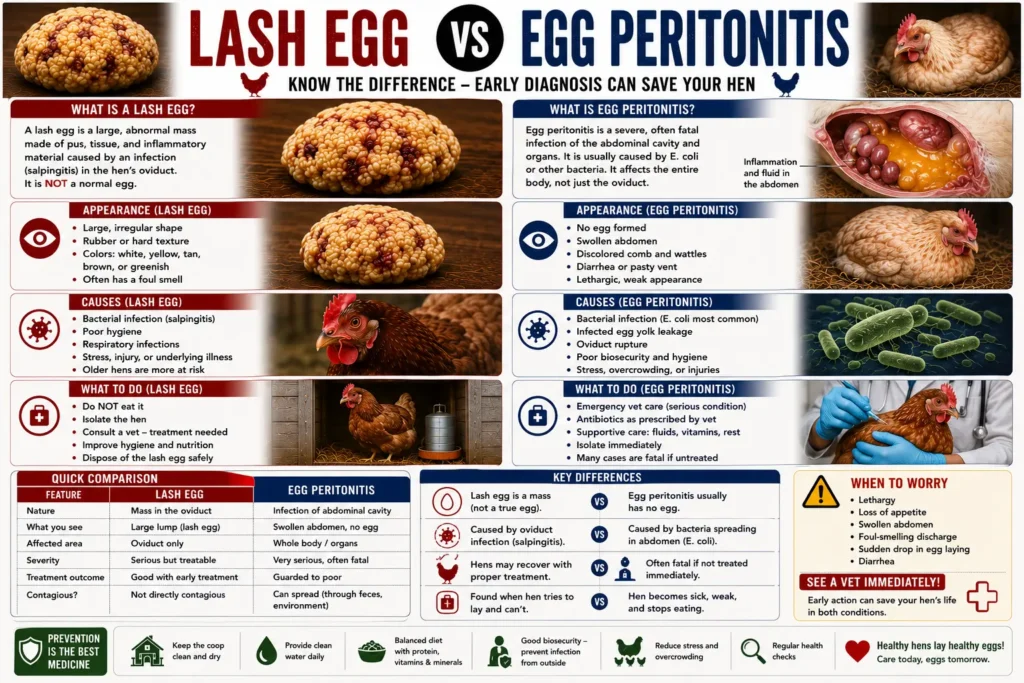
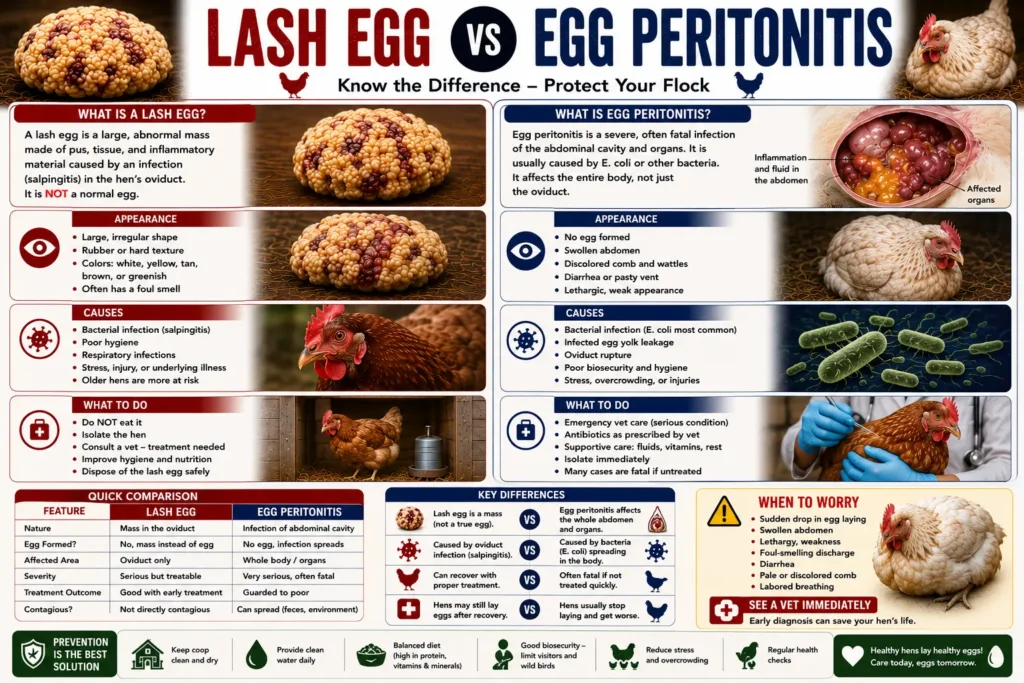
A lash egg is a caseous (cheese-like) mass of pus, tissue, and yolk material that a hen expels through her vent, usually caused by salpingitis (oviduct infection). Egg peritonitis is a more serious internal infection that happens when yolk or egg material enters the abdominal cavity and triggers inflammation or infection there. Lash eggs are a visible symptom of reproductive trouble. Peritonitis is often the next, more dangerous stage if that trouble goes untreated.
What Is a Lash Egg?
A lash egg isn’t actually an egg. It’s a mass made of coagulated pus, dead tissue, egg white, and sometimes yolk, all bound together and shaped roughly like an egg because it forms inside the oviduct — the same tube that normally shapes and coats a real egg.
Hens produce a lash egg when the oviduct becomes inflamed or infected, a condition vets call salpingitis. Bacteria, most often E. coli, work their way into the reproductive tract and the hen’s immune system responds by walling off the infection with layers of caseous material. Eventually, her body pushes that mass out the same way it would push out a normal egg.
Read More: https://lashegg.com/lash-egg-vs-salpingitis/
Common Lash Egg Symptoms
- A lumpy, rubbery, or layered mass in the nest box, often yellow, orange, or grey
- A foul smell coming from the mass or the hen’s vent
- Reduced or stopped egg laying
- Lethargy or fluffed-up feathers
- Straining or repeated visits to the nest box without producing an egg
- Loss of appetite in more advanced cases
What Causes a Lash Egg?
- Bacterial infection of the oviduct (salpingitis), usually ascending from the vent or cloaca
- Respiratory infections that spread bacteria into the reproductive tract
- Stress from overcrowding, predators, or sudden environmental change, which weakens immune defenses
- Poor nesting hygiene, which increases bacterial exposure
- Reproductive strain in hens bred for high egg production, since their tracts work harder and heal slower
What Is Egg Peritonitis?
Egg peritonitis (sometimes called egg yolk peritonitis, or vent gleet’s more serious cousin) happens when egg yolk, or fragments of an egg, end up in the abdominal cavity instead of continuing down the oviduct and out through the vent. Once yolk sits in the abdomen, it’s an ideal breeding ground for bacteria, and the surrounding tissue becomes inflamed and infected.
This can happen for two main reasons. First, ovulation sometimes misfires — the yolk drops into the body cavity instead of being caught by the infundibulum, the funnel-shaped opening of the oviduct. Vets call this internal laying. Second, an existing oviduct infection or rupture can let egg material leak backward into the abdomen.
Common Egg Peritonitis Symptoms
- A swollen, fluid-filled, “penguin-like” belly stance
- Sudden drop or complete stop in egg production
- Labored or open-mouth breathing, since the swollen abdomen presses on the air sacs
- Pale comb and wattles
- Depression, hunching, and reluctance to move
- Sitting low with tail down, sometimes described as sitting like a “broody” hen that isn’t broody
- Sudden death in severe or chronic cases, especially if fluid buildup goes unnoticed
What Causes Egg Peritonitis?
- Internal laying, where the yolk misses the oviduct opening during ovulation
- Oviduct rupture or infection that allows egg material to leak into the abdominal cavity
- Chronic salpingitis that was never treated and progressed further into the body
- Genetic and breed factors, since hybrid layers bred for high output are more prone to reproductive tract issues
- Age, as older hens with worn-out reproductive systems are statistically more likely to develop it
Lash Egg vs Egg Peritonitis: Side-by-Side Comparison
| Feature | Lash Egg | Egg Peritonitis |
| What it is | External mass of pus, tissue, and egg material | Internal infection from yolk/egg leaking into the abdomen |
| Where it shows up | Passed through the vent into the nest box | Stays inside the body cavity |
| Visibility | Visible, physical object | Hidden; only symptoms are visible |
| Underlying cause | Salpingitis (oviduct infection) | Internal laying or untreated salpingitis |
| Typical symptom | Rubbery mass, foul odor | Swollen abdomen, labored breathing |
| Urgency | Serious, needs monitoring and often vet care | Emergency; can be fatal without treatment |
| Can one lead to the other? | Yes — untreated salpingitis can progress into peritonitis | Often the downstream result of a lash egg’s cause |
Did You Know?
A hen can pass a lash egg and still develop peritonitis weeks or months later if the underlying oviduct infection was never fully treated. Passing one lash egg is not proof that the problem resolved itself.
How Are These Reproductive Disorders Diagnosed?
Diagnosing either condition starts with a physical exam. A vet will palpate the abdomen to check for fluid buildup or swelling, and they’ll ask about your hen’s laying history, diet, and any masses you’ve found in the nest box.
From there, diagnostic tools may include:
- Abdominal palpation to detect fluid or a distended coelomic cavity
- X-rays or ultrasound to visualize internal masses or fluid pockets
- Abdominocentesis (fluid aspiration) to check for pus, yolk material, or infection markers
- Blood work to assess white blood cell counts and general organ function
- Necropsy, in cases where the hen has already died, to confirm the diagnosis and rule out other causes
According to the Merck Veterinary Manual, reproductive tract disorders including salpingitis and egg yolk peritonitis are among the most common causes of death in laying hens, particularly in older or high-production birds.
Treatment Options
Treating a Lash Egg
- Antibiotics prescribed by a vet, targeted at the likely bacterial cause
- Anti-inflammatory support to reduce discomfort during recovery
- Rest and reduced stress, including separating the hen from an aggressive flock if needed
- Monitoring egg production closely for several weeks after the mass passes
- In recurring or severe cases, a vet may recommend spaying (salpingohysterectomy) or hormone implants to stop egg production altogether and prevent recurrence
Treating Egg Peritonitis
- Aggressive antibiotic therapy, often for weeks rather than days
- Fluid drainage if the abdomen is significantly distended
- Supportive care, including hydration and nutritional support, since affected hens often stop eating
- Surgical intervention in select cases, though prognosis depends heavily on how advanced the infection is
- Hormone therapy or surgical spaying to stop future ovulation and reduce the chance of another internal-laying episode
Warning
Egg peritonitis can progress quickly from mild symptoms to critical illness. A hen that seems only slightly off one day can be in respiratory distress within 48 hours. Don’t wait to see if she “gets better on her own.”
When to Call a Vet
Call an avian or poultry vet immediately if you notice:
- A swollen or fluid-filled abdomen
- Labored breathing or open-mouth panting at rest
- A pale comb combined with lethargy
- A lash egg mass, even if the hen otherwise seems fine
- A sudden, unexplained stop in egg laying paired with any of the above
Home care can manage mild discomfort and support recovery, but it cannot replace antibiotics, fluid drainage, or surgery when the reproductive tract is infected internally. A veterinary diagnosis is the only reliable way to tell how far the disease has progressed.
Common Mistakes Backyard Keepers Make
- Assuming a lash egg is a one-time fluke. It’s a symptom of an underlying infection that usually needs treatment.
- Waiting to see if symptoms improve instead of calling a vet when a hen shows a swollen abdomen.
- Confusing peritonitis with normal broodiness. A hen sitting low and puffed up could be broody — or she could be seriously ill. Check her breathing and abdomen to be sure.
- Skipping necropsy after an unexplained death. This is often the only way to confirm what actually happened and protect the rest of the flock.
- Not adjusting flock management after one case, even though the same risk factors (stress, genetics, age) affect other hens too.
Expert Tip
Keep a simple laying log for your flock. Sudden drops in egg production are often the earliest warning sign of both salpingitis and internal laying, showing up days or weeks before any visible mass or swelling appears.
Prevention Strategies
- Provide a balanced layer feed with adequate calcium and protein to support reproductive tract health
- Keep nesting boxes clean and dry to lower bacterial exposure
- Reduce flock stress through adequate space, predator-proofing, and stable routines
- Monitor older hens more closely, since reproductive tract issues become more common with age
- Consider genetic factors when choosing breeds, as hybrid layers selected for high egg output carry a higher lifetime risk of reproductive disorders, according to University Extension poultry health resources
- Avoid sudden feed or lighting changes that can disrupt the ovulation cycle
Can Lash Egg and Egg Peritonitis Happen at the Same Time?
Yes. Because both conditions often share the same root cause — an infected or malfunctioning oviduct — a hen can pass a lash egg while also developing internal inflammation that progresses toward peritonitis. This is one reason vets recommend following up after any lash egg with continued observation, not just a sigh of relief.
Recovery Outlook
Recovery depends heavily on how early the condition was caught. Hens treated for salpingitis before a lash egg forms often recover fully with antibiotics and rest. Hens diagnosed with early-stage peritonitis, before major fluid buildup, also have a reasonable chance of recovery with aggressive treatment. Once peritonitis becomes advanced, with heavy fluid accumulation and breathing difficulty, prognosis drops significantly, and some hens do not survive even with treatment.
Conclusion
Understanding lash egg vs egg peritonitis comes down to one key idea: a lash egg is something you can see, while peritonitis is something hiding inside your hen’s body. Both point to the same underlying weakness in the reproductive tract, and both deserve fast attention rather than a wait-and-see approach. Watch your flock’s laying patterns, check for swelling or breathing changes, and don’t hesitate to involve a vet the moment something looks off. Early monitoring is the difference between a hen that recovers fully and one that doesn’t get the chance.
FAQ
Is a lash egg the same as egg peritonitis? No. A lash egg is a physical mass passed through the vent, while egg peritonitis is an internal infection inside the abdominal cavity. They share similar causes but are different conditions with different treatments.
Can a hen survive egg peritonitis? Yes, especially if caught early. Hens treated with antibiotics, fluid drainage, and supportive care before the infection becomes advanced have a reasonable recovery rate. Advanced cases have a much lower survival rate.
What does a lash egg look like? A lash egg typically looks like a lumpy, rubbery, or layered mass, often yellow, orange, or grey, and it usually has a strong, unpleasant odor.
Can a hen lay eggs normally after passing a lash egg? Some hens return to normal laying after treatment, while others experience reduced production permanently, depending on how much scarring or damage occurred in the oviduct.
How do I know if my hen has internal laying? Internal laying is hard to detect without a vet exam. Watch for a swollen abdomen, stopped egg production, and labored breathing, then get an abdominal ultrasound or palpation exam for confirmation.
Is egg peritonitis contagious to other hens? Egg peritonitis itself is not directly contagious, since it’s usually caused by an individual hen’s reproductive malfunction. However, if a bacterial infection is the root cause, the same bacteria could affect other hens with similar risk factors.
What is the survival rate for egg yolk peritonitis in chickens? Survival rates vary widely based on how early treatment starts. Mild, early cases treated promptly have a better outlook, while advanced cases with significant fluid buildup carry a much poorer prognosis.