Early Signs of Salpingitis in Chickens: What Every Owner Should Know

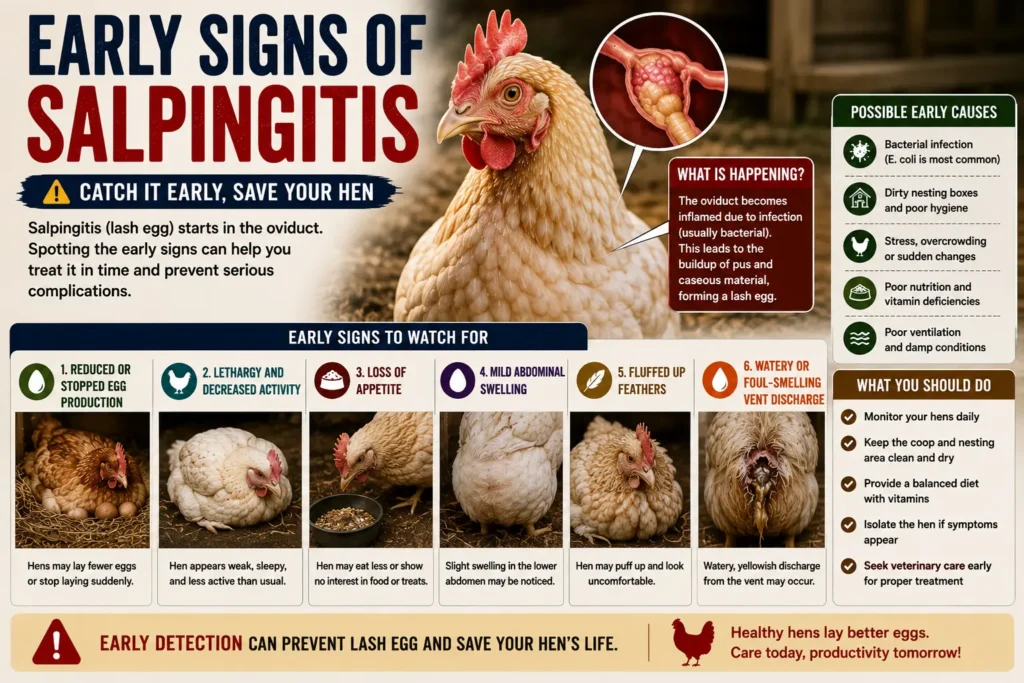
If your hen has stopped laying, sits puffed up in a corner, or has a swollen belly that wasn’t there last week, you need to know the early signs of salpingitis before the infection spreads. Salpingitis is inflammation of the oviduct, and catching it early can mean the difference between a hen that recovers and one that doesn’t. This guide breaks down exactly what to watch for, why it happens, and what to do next.
Salpingitis is one of the most common reproductive illnesses in backyard and commercial laying hens. It often develops quietly, which is why so many owners miss it until the bird is already seriously ill. Knowing the warning signs early gives you the best chance to act before the disease turns into something harder to treat, like egg peritonitis.
Table of Contents
Early Signs of Salpingitis in Chickens
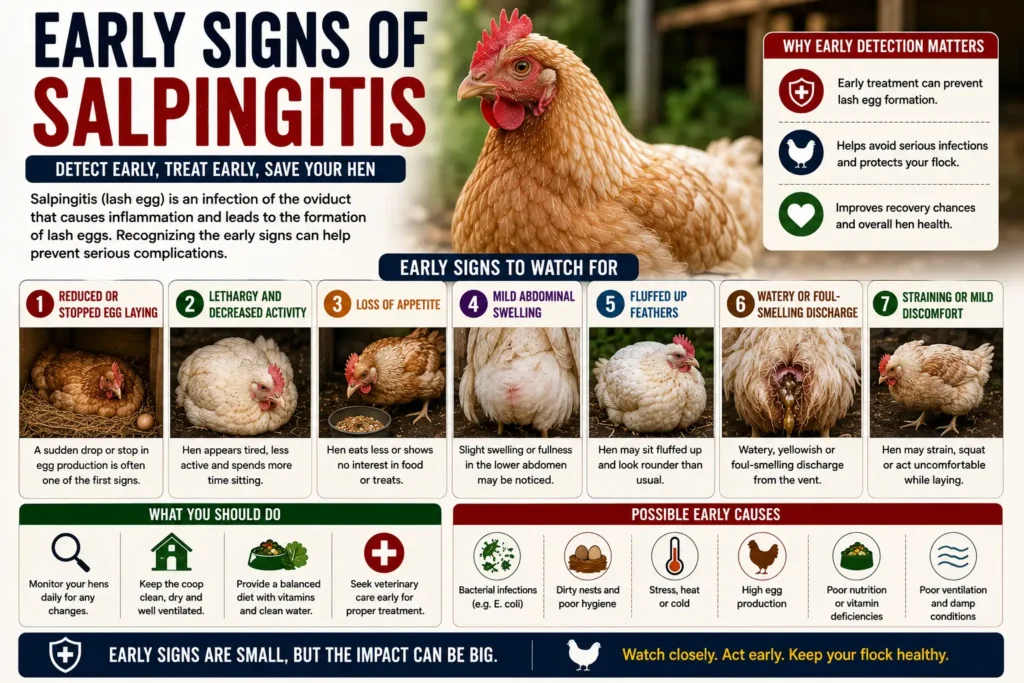
The early signs of salpingitis are usually subtle and easy to confuse with normal off days. A hen might just seem a little quieter than usual, or she might miss a day of laying. That’s exactly what makes this disease dangerous — it hides behind symptoms that look ordinary at first.
Here are the changes to watch for in the first days and weeks:
- A drop in egg production — she may lay less often, or stop laying altogether
- Abnormal eggs — soft-shelled, thin-shelled, or oddly shaped eggs
- A swollen or firm abdomen — feels tight or bloated when you gently palpate it
- Lethargy — standing apart from the flock, less interested in food or foraging
- A “penguin stance” — walking upright with her belly held out, like a penguin
- Loss of appetite — eating less than her usual amount over several days
- Pale or dull comb and wattles — a sign that something is off internally
- Straining near the vent — as if trying to pass an egg that won’t come
H3: Early Signs of Salpingitis vs. Normal Molting or Off-Lay Periods
One reason the early signs of salpingitis get missed is that they overlap with normal pauses in laying, like molting or short daylight hours in winter. The difference is that a healthy hen going through a natural lay break still acts alert, eats normally, and has a soft, flat abdomen. A hen with early salpingitis usually shows at least two or three of the signs above together, not just a lapse in egg-laying.
<div class=”callout quick-answer”> <strong>Quick Answer:</strong> The earliest signs of salpingitis are a drop in egg-laying, a swollen belly, lethargy, and a hunched or “penguin” posture. If you see two or more of these together, isolate the hen and monitor her closely for 24–48 hours. </div>
What Is Salpingitis in Chickens?
Salpingitis is inflammation or infection of the oviduct, the tube that carries a developing egg from the ovary to the vent. The oviduct is where the yolk gets its shell membrane, shell, and pigment before the egg is laid. When bacteria infect this tissue, the body responds by walling off the infection with a thick, cheese-like material called caseous exudate — the substance behind the so-called “lash egg.”
According to the Merck Veterinary Manual, salpingitis is one of the leading causes of death in commercial and backyard laying hens, often developing after a respiratory infection or reproductive tract injury allows bacteria to travel upward into the oviduct.
<div class=”callout did-you-know”> <strong>Did You Know?</strong> A “lash egg” is not actually an egg. It’s a solid mass of pus, tissue, and sometimes a yolk, shaped roughly like an egg because it travels through the same passage. </div>
Read More: https://lashegg.com/salpingitis-symptoms-in-chickens/
Causes of Salpingitis in Hens
Salpingitis rarely appears out of nowhere. It’s almost always the result of bacteria reaching the reproductive tract through one of a few common routes.
| Cause | How It Leads to Salpingitis |
| E. coli infection | The most common bacterial cause; often travels from the gut or vent into the oviduct |
| Respiratory infections | Bacteria from the trachea can migrate down to the reproductive tract |
| Internal laying | Yolk released into the abdomen instead of the oviduct triggers inflammation |
| Reproductive stress | Early or excessive egg production, especially in high-production breeds |
| Poor nutrition | Calcium or vitamin deficiencies weaken shell quality and oviduct health |
| Genetics | Some hybrid layers are bred for heavy production and are more prone to reproductive disease |
| Age | Hens over 2–3 years old, especially heavy layers, face higher risk |
Breeds known for very high egg output, such as production-line hybrids, tend to show early signs of salpingitis more often than slower-laying heritage breeds, simply because their reproductive systems work harder for longer.
How Salpingitis Progresses: From Early Signs to Advanced Disease
Understanding the stages helps you judge how urgent the situation is.
- Early stage — Mild drop in laying, occasional soft-shelled eggs, slightly quieter behavior. This is when the early signs of salpingitis are most treatable.
- Active infection — Abdomen becomes visibly swollen, appetite drops further, the hen may adopt the penguin stance.
- Advanced disease — Fluid or pus builds up in the abdomen (egg-related peritonitis), breathing may become labored, and the hen may collapse or die without warning.
<div class=”callout warning”> <strong>Warning:</strong> Once salpingitis progresses to egg peritonitis, survival rates drop sharply. Hens can appear stable one day and die suddenly the next. Don’t wait for advanced symptoms before seeking help. </div>
Diagnosing Salpingitis
There is no single at-home test for salpingitis. A veterinarian, ideally one with poultry or avian experience, typically diagnoses it using a combination of methods:
- Physical exam — palpating the abdomen for swelling, fluid, or firmness
- Weight and body condition check — comparing to the hen’s normal weight
- Ultrasound or X-ray — to look for fluid buildup or abnormal masses
- Bloodwork — elevated white blood cell counts can indicate infection
- Abdominal fluid sampling — checking for pus, bacteria, or yolk material
- History review — recent laying patterns, diet, and flock health
University extension poultry programs and the MSD Veterinary Manual both note that definitive diagnosis often only comes from surgery or post-mortem exam in advanced or fatal cases, which is another reason catching the early signs of salpingitis matters so much — early cases are far easier to manage than confirmed advanced ones.
Treatment Options for Salpingitis
Treatment depends heavily on how early the disease is caught.
| Stage Caught | Typical Treatment | Outlook |
| Early signs only | Antibiotics, supportive care, rest, monitoring | Good, if treated promptly |
| Active infection | Antibiotics, anti-inflammatories, possible fluid drainage | Fair, depends on response |
| Advanced/chronic | Surgery to remove the oviduct (salpingohysterectomy), or humane euthanasia if quality of life is poor | Guarded to poor |
<div class=”callout expert-tip”> <strong>Expert Tip:</strong> Antibiotics only work against bacterial salpingitis, and they need to be prescribed by a vet based on the specific bacteria involved. Over-the-counter treatments without a diagnosis often fail and can delay real treatment. </div>
H3: Can Salpingitis Be Cured?
Mild cases caught during the early signs of salpingitis phase can sometimes resolve with prompt veterinary antibiotics and supportive care. Chronic or advanced cases are harder to cure and may require surgical removal of the affected oviduct. Hens that recover from surgery typically stop laying eggs permanently but can otherwise live comfortably.
Home Care vs. Veterinary Treatment
<div class=”callout when-to-call-a-vet”> <strong>When to Call a Vet:</strong> Call immediately if your hen shows a swollen abdomen, labored breathing, sudden collapse, or has stopped eating for more than 24 hours. These signs mean the infection may already be advanced. </div>
| What You Can Do at Home | What Requires a Vet |
| Isolate the hen from the flock | Diagnosing the cause of swelling |
| Offer easy-to-digest, high-quality feed | Prescribing antibiotics |
| Keep her warm, quiet, and low-stress | Draining abdominal fluid |
| Monitor droppings, appetite, and weight daily | Surgery (salpingohysterectomy) |
| Track egg-laying changes in a log | Pain management and anti-inflammatories |
Home care can support a hen through recovery, but it cannot cure a bacterial infection on its own. Supportive care buys time; it isn’t a substitute for professional treatment.
<div class=”callout common-mistakes”> <strong>Common Mistakes:</strong> Waiting to see if the hen “gets better on her own,” treating with random antibiotics without a diagnosis, and assuming a swollen belly is just fat are the three most common mistakes owners make with early salpingitis. </div>
Prevention: Reducing the Risk of Salpingitis
While not every case is preventable, several flock management practices lower the risk significantly:
- Feed a balanced, complete layer diet with adequate calcium and protein
- Avoid inducing early or excessive laying in young pullets
- Keep housing clean and dry to reduce bacterial exposure
- Provide clean nesting boxes to reduce vent contamination
- Manage flock stress through proper space, lighting, and reduced overcrowding
- Treat respiratory infections promptly, since untreated illness can spread to the oviduct
- Choose slower-laying or dual-purpose breeds if reproductive disease is a recurring flock issue
The USDA and university poultry extension programs consistently point to biosecurity, clean housing, and balanced nutrition as the three biggest levers flock owners have over reproductive disease rates.
Recovery and Long-Term Outlook
Hens caught in the early signs of salpingitis stage and treated promptly often return to normal activity, though egg production may be reduced for a period. Hens with advanced disease, especially those needing surgery, usually stop laying permanently but can live a full, comfortable life afterward if the underlying infection is resolved. Regular monitoring after treatment — tracking appetite, droppings, and behavior — helps catch any relapse early.
Frequently Asked Questions
What are the very first early signs of salpingitis in a hen? The earliest changes are usually a drop in egg-laying, a soft or misshapen egg, and mild lethargy. These can appear days or even weeks before more obvious symptoms like abdominal swelling show up.
Is salpingitis contagious to other chickens? Salpingitis itself is not directly contagious between hens. However, the underlying bacterial infections, such as E. coli or certain respiratory pathogens, can spread through the flock, so isolating a sick hen is still a smart precaution.
Can a hen survive salpingitis without treatment? Some mild cases resolve with rest and improved conditions, but many progress to egg peritonitis without treatment, which is often fatal. Veterinary care greatly improves survival odds, especially when the early signs of salpingitis are caught quickly.
Does salpingitis hurt the hen? Yes. The swelling, pressure, and infection cause pain and discomfort, which is part of why affected hens become lethargic, stop eating normally, and adopt a hunched posture.
Will my hen lay eggs again after salpingitis treatment? It depends on the severity. Hens treated early may resume laying at a reduced rate. Hens that undergo surgical removal of the oviduct typically stop laying permanently but can still live comfortably as pets.
How can I tell the difference between salpingitis and egg binding? Egg binding usually involves visible straining and an egg stuck near the vent, often felt during a gentle exam. Salpingitis tends to cause more generalized abdominal swelling without a distinct egg mass, along with a longer history of reduced laying.
What does a lash egg look like? A lash egg is a firm, egg-shaped mass made of pus, tissue debris, and sometimes yolk material, rather than a true egg with a shell. Finding one in the nesting box is a strong signal of active or past salpingitis.