Is Salpingitis Contagious? The Short Answer

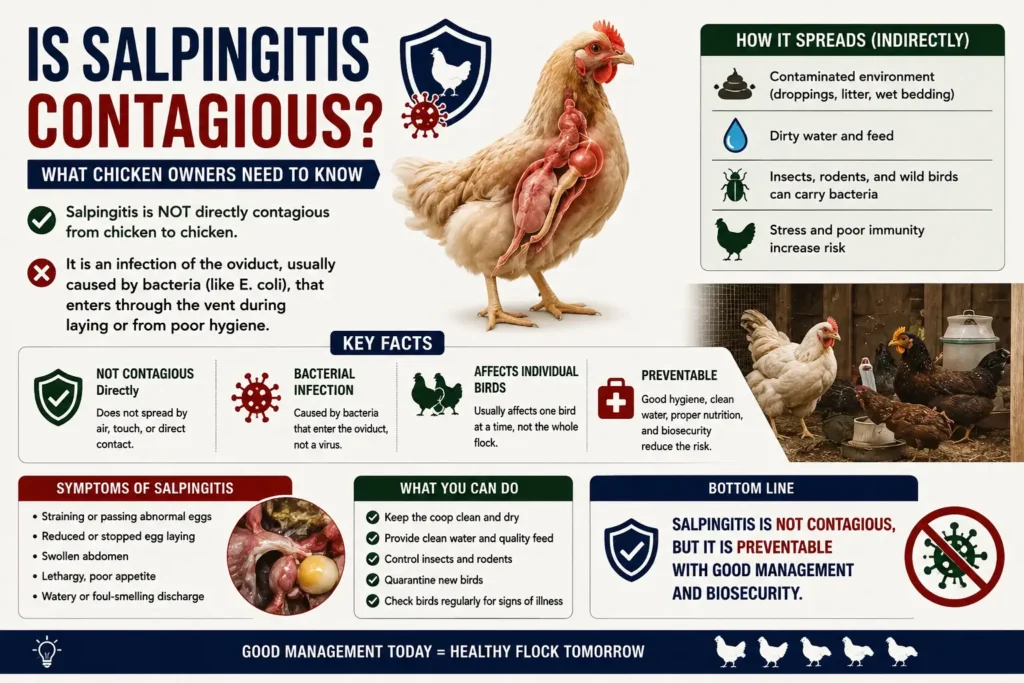
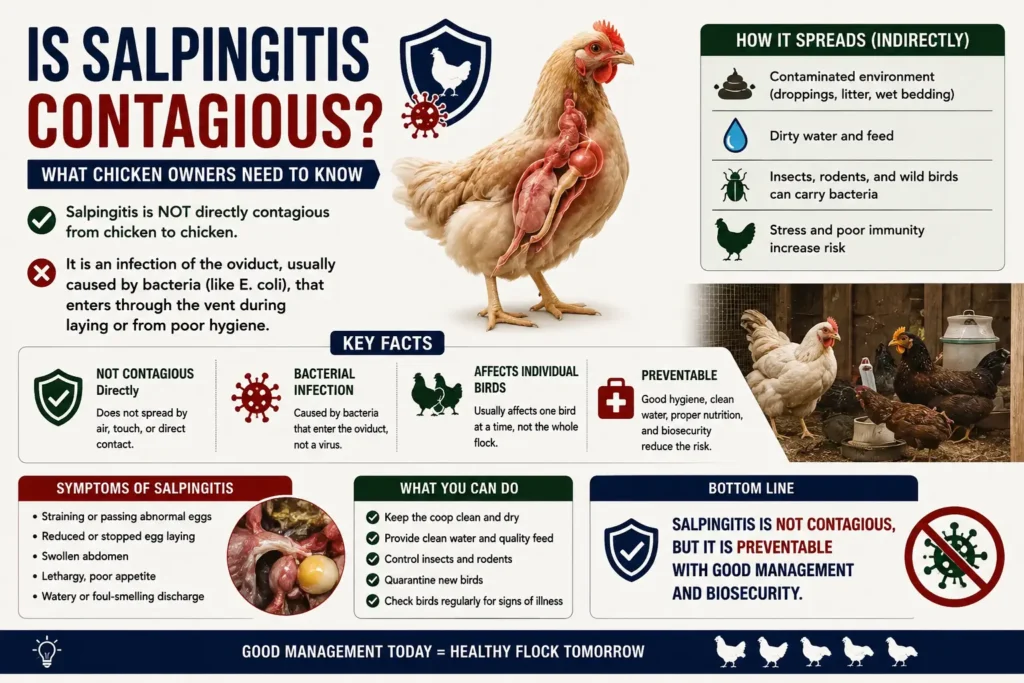
Is salpingitis contagious? In most cases, no. Salpingitis itself — inflammation of a hen’s oviduct — is not a disease that spreads directly from bird to bird the way a cold spreads between people. It’s usually the end result of an infection, not an infection that jumps on its own from one hen to the next.
But that answer comes with an important catch. If the underlying cause is a contagious pathogen, like infectious bronchitis virus or Mycoplasma gallisepticum, that original infection absolutely can spread through your flock. Salpingitis would then show up in multiple hens, not because they caught salpingitis from each other, but because they all caught the same root infection.
Quick Answer: Salpingitis is not directly contagious between hens. However, several bacteria and viruses that trigger salpingitis — such as infectious bronchitis, Newcastle disease, and Mycoplasma gallisepticum — are contagious and can spread through a flock, leading to salpingitis in more than one bird.
If you’ve found a strange, rubbery “lash egg” in the nest box and you’re wondering whether to quarantine your whole flock, this guide walks through exactly what’s going on, what to watch for, and when to call a vet.
Table of Contents
What Is Salpingitis in Chickens?
Salpingitis is inflammation of the oviduct — the tube that carries a developing egg from the ovary, through yolk and shell formation, and out through the vent. Bacteria such as E. coli, Salmonella species, Mycoplasma gallisepticum, Pasteurella multocida, and Gallibacterium anatis are the most frequently identified culprits<cite index=”8-1″>, with infection typically occurring when bacteria migrate from other parts of the body into the oviduct</cite>.
The oviduct connects the sterile inside of a hen’s body to the cloaca, an area that naturally hosts huge numbers of bacteria<cite index=”7-1″>. Anything that damages the lining of the oviduct or disrupts its normal muscle movement makes salpingitis more likely to develop</cite>. Under normal conditions, a layer of mucus and specialized cells sweep bacteria back out toward the cloaca before they can cause trouble. When that defense breaks down, infection can take hold.
Read More: https://lashegg.com/salpingitis-vs-prolapsed-vent/
Is Salpingitis Contagious Through Direct Contact?
No. A healthy hen standing next to an infected hen will not “catch” salpingitis simply through proximity. Salpingitis is a localized, internal inflammatory response, not a pathogen that hens shed and pass to flockmates directly. Most chicken-keeping veterinarians and poultry health resources describe salpingitis itself as a non-contagious condition, even though the bacteria involved are common, everyday organisms already present in most coops.
Why Salpingitis Sometimes Looks “Contagious” in a Flock
Backyard keepers sometimes see two or three hens develop lash eggs within weeks of each other and assume the disease is spreading bird to bird. There’s a more likely explanation: shared risk factors and shared exposure.
- A flock-wide viral infection. Infectious bronchitis virus and Newcastle disease are both contagious respiratory illnesses that can damage the reproductive tract as a secondary effect. If several hens caught the same virus, several hens may go on to develop salpingitis.
- Contaminated environment. Dirty nest boxes, damp bedding, and shared water sources let harmful bacteria build up and expose the whole flock at once.
- Similar physical risk factors. Hens of the same breed, age, and body condition, kept in the same coop, are exposed to the same stressors — heavy egg production, obesity, and vent picking — at the same time.
- Vent picking. Overweight or stressed hens are more prone to cloacal prolapse and vent picking from flockmates, which can introduce bacteria directly into the reproductive tract in more than one bird.
Which Underlying Infections Are Actually Contagious?
| Underlying Cause | Contagious? | How It Spreads |
| Infectious bronchitis virus | Yes | Airborne droplets, direct contact, contaminated equipment |
| Newcastle disease | Yes | Airborne, direct contact, contaminated feed/water |
| Mycoplasma gallisepticum | Yes | Direct contact, airborne, egg transmission, shared water |
| E. coli | Sometimes (opportunistic) | Fecal-oral, contaminated environment, not primarily bird-to-bird |
| Salmonella spp. | Sometimes (opportunistic) | Contaminated feed, water, droppings |
| Vent picking / trauma | No (behavioral) | Not infectious; a physical risk factor |
| Obesity / overproduction | No | Not infectious; a metabolic and management risk factor |
This is the key distinction to hold onto: salpingitis is the outcome, not the disease that spreads. Whether it’s contagious in your flock depends entirely on what triggered it in that specific hen.
What Causes Salpingitis?
Poultry health researchers generally split causes into two broad categories.
Bacterial Causes
Bacterial salpingitis is the more common form seen in backyard flocks<cite index=”4-1″>. The primary bacterial culprits include Salmonella, E. coli, Mycoplasma gallisepticum, and Pasteurella multocida</cite>. These bacteria are often already present in the coop environment or in a hen’s gut and only become a problem once they find a way into the oviduct.
Viral Causes
Viral salpingitis develops as a complication of a systemic viral infection<cite index=”4-1″>. Viral causes include bronchitis, Newcastle, and influenza, which are all contagious</cite>. In these cases, the virus itself spreads readily through a flock; the salpingitis is a downstream complication in individual birds whose reproductive tract was damaged by the illness.
Common Risk Factors
- High or forced egg production (commercial layer breeds are most affected)
- Advanced age
- Obesity
- Recent respiratory illness
- Vent picking or cloacal trauma
- Poor nest box hygiene
- Sudden changes in lighting or diet that disrupt the laying cycle
Signs and Symptoms of Salpingitis
Watch for these signs in your flock:
- Decreased or stopped egg production
- Visible abdominal swelling (“penguin stance” — standing more upright)
- Lethargy and reduced appetite
- Weight loss
- A firm, waxy, or cheese-like mass in place of a normal egg (a “lash egg”)
- Straining or difficulty passing an egg
- In advanced cases, fluid buildup in the abdomen
What Is a Lash Egg?
A lash egg isn’t a true egg at all. It’s a solid mass of pus, coagulated protein, tissue debris, and sometimes bits of actual egg material and shell, expelled through the vent as a byproduct of the infection. Finding one is one of the clearest visible signs of salpingitis and is often the moment keepers first realize something is wrong.
Did You Know? A lash egg can be almost any shape, size, or color, from a small rubbery pellet to a large, layered mass that resembles a misshapen egg. No two look exactly alike.
How Salpingitis Is Diagnosed
A veterinarian typically diagnoses salpingitis based on:
- History and clinical signs — egg production changes, lethargy, abdominal swelling
- Physical examination — palpating the abdomen for masses or fluid
- Imaging — radiographs or ultrasound to visualize the oviduct and any masses
- Necropsy findings — in birds that don’t survive, a necropsy can confirm the diagnosis and identify the causative organism
- Bacterial culture or PCR testing — to identify the specific pathogen involved, which matters most when a contagious cause is suspected
Expert Tip: If more than one hen in your flock develops symptoms around the same time, ask your vet about culture or PCR testing rather than assuming it’s “just salpingitis.” Identifying whether a contagious virus or bacterium is behind it changes how you manage the rest of the flock.
Treatment Options for Salpingitis
Treatment depends heavily on the cause, the stage of disease, and the individual bird’s condition.
Bacterial Salpingitis
- Veterinarian-prescribed antibiotics, chosen based on culture results when possible
- Supportive care: fluids, nutritional support, and a calm, low-stress environment
- In hens with large or persistent masses, surgical removal of the oviduct (salpingohysterectomy) may be recommended
- Hormonal implants to temporarily stop egg-laying and allow the reproductive tract to rest, used in some cases under veterinary guidance
Viral Salpingitis
There is no direct antiviral treatment. Care focuses on supportive treatment while the bird’s immune system fights the virus, along with managing secondary bacterial infections that often follow viral damage to the reproductive tract.
Warning: Never give leftover or unprescribed antibiotics to a hen with suspected salpingitis. Incorrect dosing can worsen antibiotic resistance in your flock and delay an accurate diagnosis.
When to Call a Vet
- Any hen producing a lash egg, even once
- Abdominal swelling that doesn’t resolve within a few days
- A hen that stops eating, drinking, or moving normally
- Multiple hens showing symptoms within a short window (possible contagious respiratory disease)
- Any sudden, unexplained flock deaths
Can Salpingitis Be Prevented?
Prevention focuses on reducing the risk factors that let bacteria reach the oviduct in the first place, and on keeping contagious respiratory diseases out of the flock.
- Keep nest boxes clean. Change bedding regularly and remove soiled material daily.
- Manage body weight. Avoid overfeeding treats, processed foods, or excess carbohydrates.
- Support the laying cycle. Provide balanced layer feed with adequate calcium and protein.
- Watch for vent picking. Separate hens that are being picked at, and address overcrowding or boredom, which drive the behavior.
- Practice biosecurity. Quarantine new birds for at least two to three weeks, disinfect shared equipment, and limit contact with wild birds.
- Vaccinate where appropriate. Vaccines against infectious bronchitis and Newcastle disease reduce the risk of viral salpingitis in areas where these diseases are common.
- Necropsy unexplained deaths. Any bird that dies unexpectedly should be examined to rule out a contagious disease that could threaten the rest of the flock.
Common Mistakes Keepers Make
- Assuming a lash egg means the whole flock is at risk and culling healthy birds unnecessarily
- Treating with random antibiotics instead of getting a proper diagnosis
- Ignoring the underlying cause and only treating the visible symptom
- Skipping quarantine for new flock additions
- Overfeeding treats, which contributes to the obesity that raises salpingitis risk
How Contagious Chicken Diseases Actually Spread
Understanding why salpingitis itself isn’t contagious is easier once you know how a truly contagious chicken disease moves through a flock. Pathogens that spread bird to bird generally use one or more of these routes:
- Direct contact. Beak-to-beak contact, mutual preening, and pecking at wounds or vent tissue can pass bacteria and viruses between birds.
- Airborne transmission. Respiratory viruses like infectious bronchitis and Newcastle disease travel in droplets released when an infected bird coughs, sneezes, or breathes.
- Fecal-oral spread. Bacteria such as Salmonella and E. coli can be picked up from droppings on the coop floor, in nest boxes, or in contaminated water.
- Shared equipment and surfaces. Feeders, waterers, and even a keeper’s boots and gloves can carry pathogens from one coop to another.
- Vertical transmission. Some organisms, including certain strains of Mycoplasma gallisepticum, can pass from a hen to her eggs, infecting chicks before they even hatch.
Salpingitis doesn’t fit any of these patterns on its own, because it isn’t an organism traveling between bodies. It’s an internal inflammatory response happening inside one bird’s reproductive tract. That’s the core reason poultry health experts consistently describe salpingitis as non-contagious, even while acknowledging that a genuinely contagious chicken disease can sit upstream of it.
This distinction matters practically. If your vet confirms a hen’s salpingitis traces back to E. coli picked up from a dirty nest box, your main job is cleaning up the environment, not isolating the whole flock. If the cause turns out to be infectious bronchitis, you’re dealing with a real contagious chicken disease, and flock-wide precautions, and possibly vaccination, become the priority.
Salpingitis vs. Other Reproductive Conditions
| Condition | Contagious? | Typical Cause | Key Sign |
| Salpingitis | Not directly | Bacterial or viral infection of the oviduct | Lash egg, abdominal swelling |
| Egg yolk peritonitis | Not directly | Yolk released into the abdomen, often secondary to salpingitis | Sudden lethargy, swollen abdomen |
| Egg binding | No | Physical obstruction, calcium deficiency, oversized egg | Straining, no egg produced |
| Infectious bronchitis | Yes | Coronavirus | Respiratory signs, drop in egg quality |
| Cloacal prolapse | No | Straining, obesity, large eggs | Visible tissue protruding from vent |
Recovery and Long-Term Outlook
Recovery depends on how early the condition is caught and treated. Hens diagnosed and treated early, especially for bacterial salpingitis, can sometimes return to normal or near-normal laying. Hens with extensive oviduct damage, chronic infection, or large masses have a more guarded prognosis, and some may stop laying permanently even after successful treatment. Viral salpingitis tends to carry a more uncertain outlook, since the underlying infection can cause broader, lasting damage to the reproductive tract.
5. FAQ
Is salpingitis contagious to other chickens? No, not directly. Salpingitis itself doesn’t spread from hen to hen. However, if a contagious virus or bacterium caused the salpingitis in the first place, that original infection can spread and trigger salpingitis in other birds too.
Is salpingitis contagious to humans? There’s no established evidence that chicken salpingitis spreads to humans. As with any poultry health issue, wash your hands after handling sick birds or lash eggs, since some of the underlying bacteria, like Salmonella, can pose a risk to people.
Can one hen give another hen a lash egg? No. A lash egg is a symptom produced by an individual hen’s own infected oviduct, not something that transfers between birds.
Should I isolate a hen with salpingitis? Isolating a sick hen is generally good practice for her comfort and monitoring, even though salpingitis itself isn’t contagious. If a contagious respiratory illness is suspected as the cause, isolating her also helps protect the rest of the flock.
Is a contagious chicken disease always behind a lash egg? Not always. Many cases of salpingitis come from opportunistic bacteria like E. coli already present in the coop, with no contagious disease involved at all. A vet visit is the only reliable way to know for sure.
Can salpingitis kill a chicken? Yes, in severe or untreated cases. Complications like oviduct impaction, egg yolk peritonitis, or septicemia can be fatal, which is why early veterinary attention matters.
Will a hen with salpingitis lay normal eggs again? Some do, especially with early bacterial cases that respond well to treatment. Others experience reduced or permanently stopped egg production, depending on how much damage occurred.