What Is a Shell-Less Egg and Why Did Your Hen Lay One?

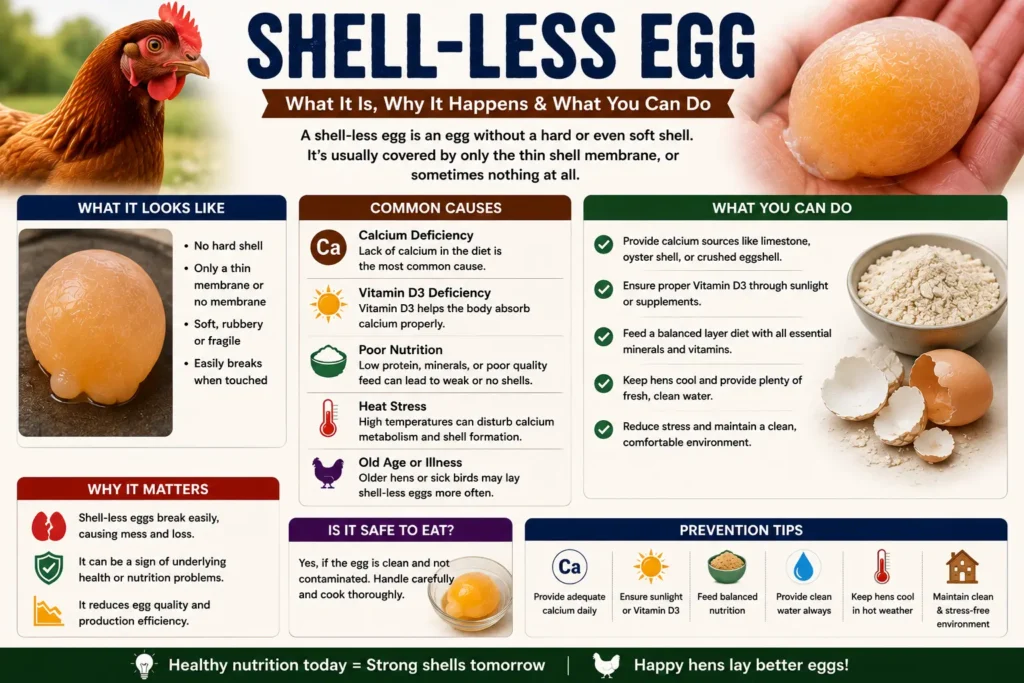
A shell-less egg is exactly what it sounds like: a fully formed egg that leaves the hen’s body wrapped only in a thin membrane, with no hard calcium shell around it. Some keepers call it a “rubber egg” or “membrane egg” because the covering feels soft and stretchy instead of brittle.
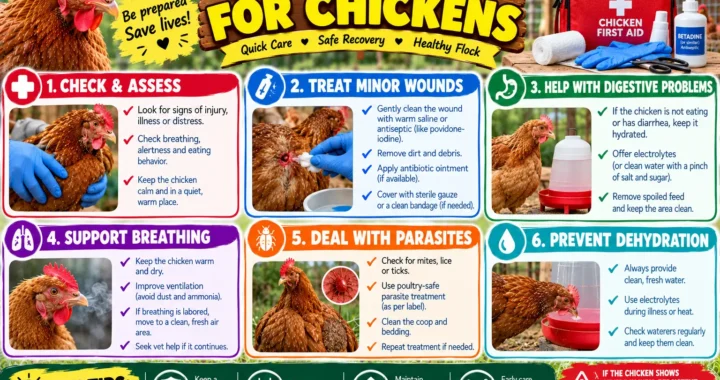
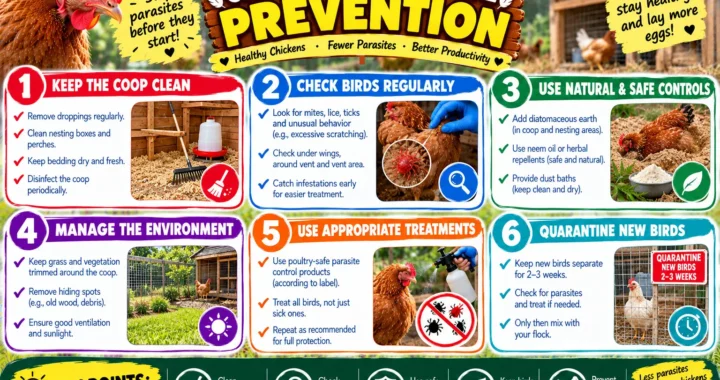
Finding one in the nest box can be alarming the first time it happens. Most of the time, though, a single shell-less egg is not an emergency. It usually points to something fixable, such as a calcium shortage, stress, or a hiccup in the hen’s reproductive cycle. Repeated shell-less eggs are a different story, and that pattern deserves closer attention.
This guide walks through every cause, what to do about each one, and the specific warning signs that mean it is time to call an avian veterinarian.
Table of Contents
Quick Answer
A shell-less egg is a normal egg without its outer calcium shell. It usually comes from low calcium, stress, illness, or a young or aging reproductive system. One occasional shell-less egg rarely needs treatment. Frequent ones need a diet check and possibly a vet visit.
How an Eggshell Normally Forms
To understand why a shell-less egg happens, it helps to know the process it skipped. Inside a hen, egg formation is an assembly line that takes roughly 24 to 26 hours from start to finish.
- Ovulation — a yolk releases from the ovary.
- Magnum — egg white (albumen) wraps around the yolk over about 3 hours.
- Isthmus — the two shell membranes form around the white, taking about 1 hour.
- Uterus (shell gland) — calcium carbonate is deposited onto the membrane over roughly 19 to 20 hours, forming the hard shell.
- Vagina — the finished egg is laid, usually pointed-end first.
A shell-less egg happens when the egg skips or rushes through step four. The membrane forms correctly, but the shell gland does not deposit enough calcium, or the egg passes through too quickly for the shell to build.
Read More: https://lashegg.com/soft-shell-egg-vs-lash-egg/
Common Causes of a Shell-Less Egg
1. Calcium Deficiency
This is the single most common reason hens lay a shell-less egg. Laying hens need a steady, high supply of calcium because a normal shell is made almost entirely of calcium carbonate. When dietary calcium runs low, the shell gland cannot pull enough material to finish the job.
Layer feed is formulated with this in mind, but problems creep in when:
- Backyard hens eat too many treats, scratch grains, or table scraps that dilute the balanced layer ration
- A flock with both hens and roosters is fed an all-flock feed without a separate calcium source
- Older hens need more calcium than younger ones but receive the same amount
2. Stress
Hens are sensitive to disruption. Loud noises, a predator scare, a new bird added to the flock, extreme heat, or even moving the coop can shorten the time an egg spends in the shell gland. Less time in the uterus means less shell.
3. Age of the Hen
Two age groups are especially prone to laying a shell-less egg:
- Pullets just starting to lay — their reproductive tract is still maturing and occasionally releases an egg before the system is fully synced.
- Older hens nearing the end of their laying years — the shell gland loses efficiency over time.
4. Infectious Bronchitis Virus (IBV) and Other Respiratory Diseases
IBV specifically targets the reproductive tract in laying hens, alongside the respiratory system. According to the Merck Veterinary Manual, infectious bronchitis can cause misshapen, soft-shelled, or shell-less eggs along with a drop in overall egg production. If several hens in the flock are affected at once, this is a strong signal to investigate infectious disease rather than diet.
5. Egg Drop Syndrome (EDS)
This viral disease, more common in commercial settings but possible in backyard flocks, specifically causes thin-shelled and shell-less eggs without other obvious symptoms in many birds.
6. Nutritional Imbalances Beyond Calcium
Vitamin D3 is required for a hen’s body to actually absorb and use calcium. A hen can eat enough calcium and still produce a shell-less egg if she is deficient in D3. Phosphorus imbalance can cause similar problems.
7. Heat Stress
In hot weather, hens pant instead of eating as much, which lowers overall calcium intake. Heat also speeds up the rate an egg moves through the reproductive tract, cutting shell formation time short.
8. Reproductive Tract Abnormalities
Less commonly, a hen may have a permanent or temporary defect in the shell gland itself, sometimes following infection, egg binding, or a prolapse. These hens may lay shell-less or soft-shelled eggs repeatedly.
9. Medication or Toxin Exposure
Certain dewormers, antibiotics, or exposure to toxins like excess salt can interfere with the reproductive cycle short-term.
Shell-Less Egg vs. Soft-Shell Egg: What’s the Difference?
People often use these terms interchangeably, but they are not quite the same thing.
| Feature | Shell-Less Egg | Soft-Shell Egg |
| Shell present? | No hard shell at all, only membrane | Thin, flexible, partial shell |
| Feel | Squishy, like a water balloon | Bends without breaking, leathery |
| Common cause | Egg skipped the shell gland stage entirely | Shell gland deposited some but not enough calcium |
| Severity signal | Often more concerning if repeated | Can still indicate calcium shortfall |
| First step | Check calcium and D3, monitor for other symptoms | Check calcium and D3, monitor for other symptoms |
Did You Know?
A hen can lay an egg without a shell and still be perfectly healthy the next day. The reproductive tract is a long assembly line, and any single-day glitch anywhere along it can produce an egg without shell for that one cycle only.
What to Do When You Find a Shell-Less Egg
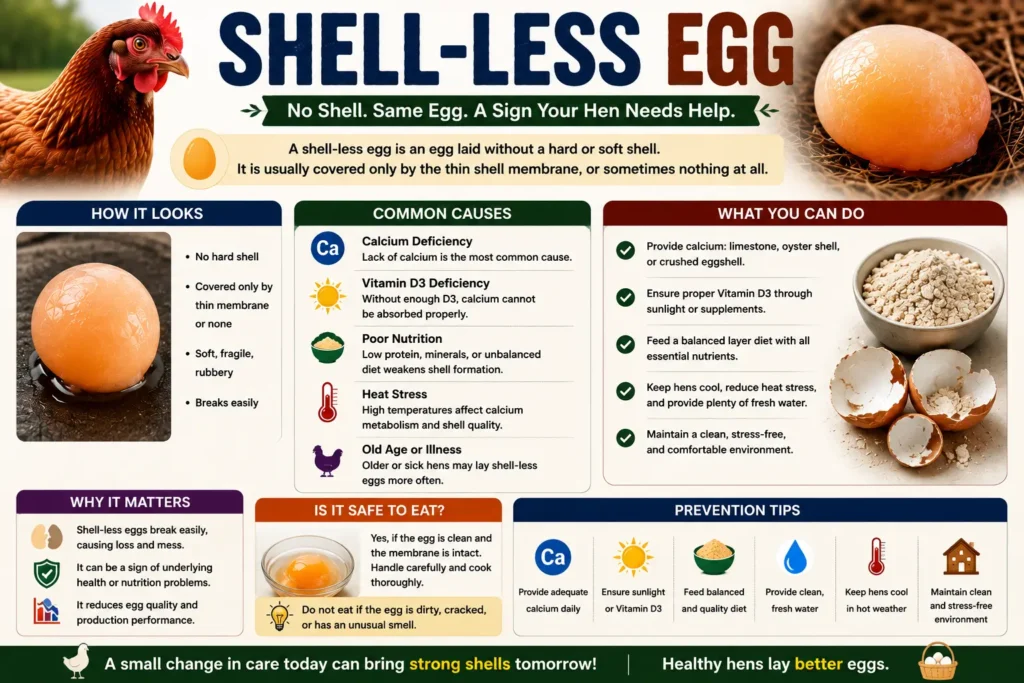
Step-by-Step Response Plan
- Note the date and which hen laid it, if you can identify her by watching the nest box.
- Check the flock’s diet. Confirm they are eating a complete layer feed (16–18% protein, roughly 4% calcium) as the bulk of their diet, not just scratch or treats.
- Offer free-choice calcium, such as crushed oyster shell, in a separate dish so hens can self-regulate intake.
- Reduce stress triggers. Check for predators near the coop, overcrowding, recent flock changes, or excessive heat.
- Watch for a pattern. One shell-less egg from one hen is usually not worrying. Multiple shell-less eggs from the same hen, or from several hens at once, warrants closer attention.
- Check for other symptoms. Look for lethargy, respiratory noise, reduced appetite, or a drop in overall egg production across the flock.
- Isolate and observe any hen that seems unwell beyond the egg issue.
- Contact a poultry veterinarian if the pattern continues past a week or if other symptoms appear.
Expert Tip
Keep a simple laying log with the date, hen, and any shell abnormality. Backyard keepers often catch disease outbreaks earlier this way, because a pattern across multiple hens in the same week is a much stronger signal than any single egg.
How Much Calcium Does a Laying Hen Actually Need?
Adult laying hens need roughly 3.5–4.5 grams of calcium per day, which is why layer feed is formulated at around 3.5–4% calcium. Compare that to a growing pullet or a rooster, which need far less and can actually be harmed by excess calcium over time.
| Bird Type | Approximate Daily Calcium Need | Best Feed Type |
| Actively laying hen | 3.5–4.5 g/day | Layer feed + free-choice oyster shell |
| Pullet (not yet laying) | Lower, growth-focused | Starter/grower feed |
| Rooster or non-laying bird | Lowest | Flock raiser or all-flock feed |
| Senior hen (past peak laying) | Similar to laying hen, sometimes higher | Layer feed + extra oyster shell |
Common Mistakes Backyard Keepers Make
- Feeding all-flock feed to a mixed flock without a separate calcium dish for hens
- Mixing crushed oyster shell directly into the feed instead of offering it separately
- Assuming scratch grains and treats provide enough calcium (they do not)
- Ignoring a repeated shell-less egg because “it happened before and she was fine”
- Confusing a shell-less egg with a fart egg or wind egg, which is actually a tiny yolk-less egg, not a calcium issue
Shell-Less Eggs in Young Hens (Pullets) vs. Older Hens
First Eggs From Pullets
It is common and usually harmless for a pullet’s very first few eggs to be small, misshapen, or occasionally shell-less. Her hormonal system and reproductive tract are still calibrating. This typically resolves within one to two weeks without any intervention.
Shell-Less Eggs in Aging Hens
Hens past their second or third laying year naturally produce eggs with thinner, weaker, or occasionally absent shells more often. Their shell gland becomes less efficient with age even on a perfect diet. This is a gradual, expected part of the laying cycle winding down, not usually a medical emergency on its own.
When a Shell-Less Egg Signals Something More Serious
Warning
Contact a poultry veterinarian promptly if you notice any of the following alongside a shell-less egg:
- Multiple hens affected in the same week
- A noticeable drop in total flock egg production
- Respiratory symptoms: coughing, sneezing, nasal discharge, or gurgling sounds
- Lethargy, ruffled feathers, or reduced appetite
- Signs of egg binding: straining, a wide stance, or a visibly swollen abdomen
- Green or watery droppings across the flock
- Shell-less eggs continuing for more than one to two weeks despite dietary correction
When to Call a Vet
A single shell-less egg from an otherwise healthy, active hen rarely requires a vet visit. Call a vet if the pattern repeats for more than a week, if it affects multiple birds at once, or if the hen shows any additional symptoms such as lethargy, respiratory distress, or straining. According to the Merck Veterinary Manual, infectious causes of poor shell quality often present with a flock-wide production drop rather than an isolated case, which is a useful way to separate a diet issue from a disease outbreak.
Diagnosis: What a Veterinarian Will Check
A vet investigating recurrent shell-less eggs typically evaluates:
| Diagnostic Step | What It Reveals |
| Physical exam | Body condition, signs of egg binding or prolapse |
| Diet and history review | Calcium, D3, and phosphorus intake; recent stressors |
| Flock production records | Whether the problem is isolated or flock-wide |
| Respiratory exam | Signs pointing to infectious bronchitis or similar disease |
| Blood work (in some cases) | Calcium levels, general health markers |
| Palpation of the abdomen | Checking for retained eggs or reproductive masses |
Treatment Options
Treatment depends entirely on the underlying cause, which is why an accurate diagnosis matters more than guessing.
| Cause | Home Care | Professional Treatment |
| Calcium deficiency | Free-choice oyster shell, quality layer feed | Rarely needed beyond diet correction |
| Vitamin D3 deficiency | Sun access, fortified feed | Vet-guided supplementation if severe |
| Stress | Reduce triggers, stabilize routine | Not usually needed |
| Infectious bronchitis | Supportive care, isolation | Vet-directed; no specific antiviral cure, supportive treatment and biosecurity |
| Egg Drop Syndrome | Biosecurity measures | Vet consultation, flock management changes |
| Reproductive tract abnormality | Monitor, reduce laying stress | Vet exam; may require ongoing management |
| Age-related decline | Extra calcium, acceptance of reduced laying | Vet exam to rule out other causes |
Prevention: Keeping Shells Strong Long-Term
- Feed a complete, age-appropriate layer ration as the majority of the diet, not just a supplement to treats
- Offer free-choice crushed oyster shell in a separate container at all times
- Ensure clean, unlimited water access, since dehydration affects every part of egg formation
- Provide consistent light exposure, since hens need roughly 14–16 hours of daylight to lay normally
- Minimize stress, keeping a stable flock, secure coop, and predator-proof run
- Manage heat, offering shade, cool water, and electrolytes during hot spells
- Practice good biosecurity to reduce the risk of respiratory disease introduction
- Review the flock’s diet every few months, especially as hens age
Recovery Timeline: What to Expect
Most diet-related and stress-related shell-less eggs resolve within one to two weeks of correcting calcium intake and reducing stress. Age-related shell thinning is more gradual and may never fully reverse, though extra calcium can improve shell quality somewhat. Infectious causes follow a longer, disease-specific timeline and require veterinary guidance to manage properly.
5. FAQ
Is it normal for a chicken to occasionally lay a shell-less egg? Yes. An occasional shell-less egg, especially from a very young or older hen, is common and usually not a cause for concern on its own.
What does it mean when a chicken lays an egg without a shell? It usually means the egg spent too little time in the shell gland, often due to low calcium, vitamin D3 deficiency, stress, or a temporary reproductive glitch.
Can a shell-less egg still be eaten? Yes, a shell-less egg is safe to eat as long as it was collected promptly and the membrane is intact and clean, just like any fresh egg.
How do I stop my hens from laying shell-less eggs? Offer a complete layer feed, provide free-choice oyster shell, ensure vitamin D3 through sunlight or fortified feed, and reduce stress and heat exposure in the coop.
Is a shell-less egg the same as a soft-shell egg? No. A shell-less egg has no shell at all, only membrane, while a soft-shell egg has a thin, flexible shell that bends instead of breaking.
Can disease cause a shell-less egg? Yes. Infectious bronchitis virus and Egg Drop Syndrome are two diseases known to cause shell-less or soft-shelled eggs, often alongside a flock-wide drop in production.
Should I worry if only one hen lays a shell-less egg one time? Generally no. Monitor her over the next week and check her diet. A single occurrence in an otherwise healthy hen is usually not an emergency.
When should I take my hen to the vet for a shell-less egg? See a vet if the pattern continues past one to two weeks, affects multiple hens, or comes with lethargy, respiratory symptoms, or signs of egg binding.