How to Increase Egg Production in Chickens: Start With the Basics

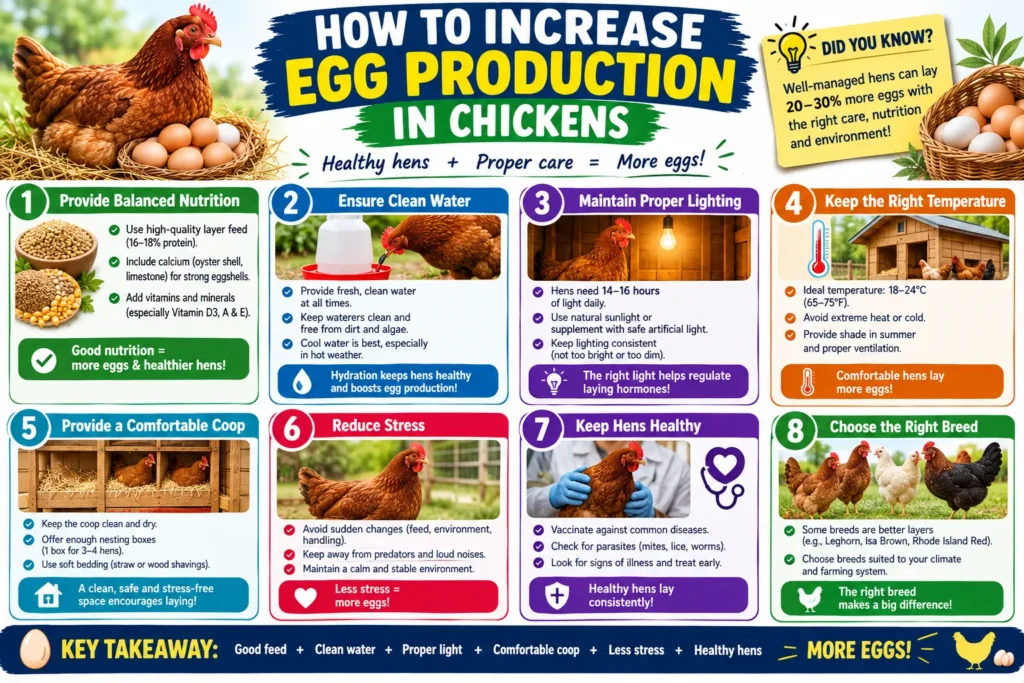
How to increase egg production in chickens comes down to addressing a handful of core needs consistently, rather than chasing a single trick or supplement. Light, nutrition, low stress, and good health form the foundation every high-laying flock relies on, and most production slumps trace back to a gap in one of these four areas.
This guide walks through exactly what actually works to increase chicken egg production, in the order that tends to make the biggest difference first, along with what to skip because it doesn’t hold up to how a hen’s body actually functions.
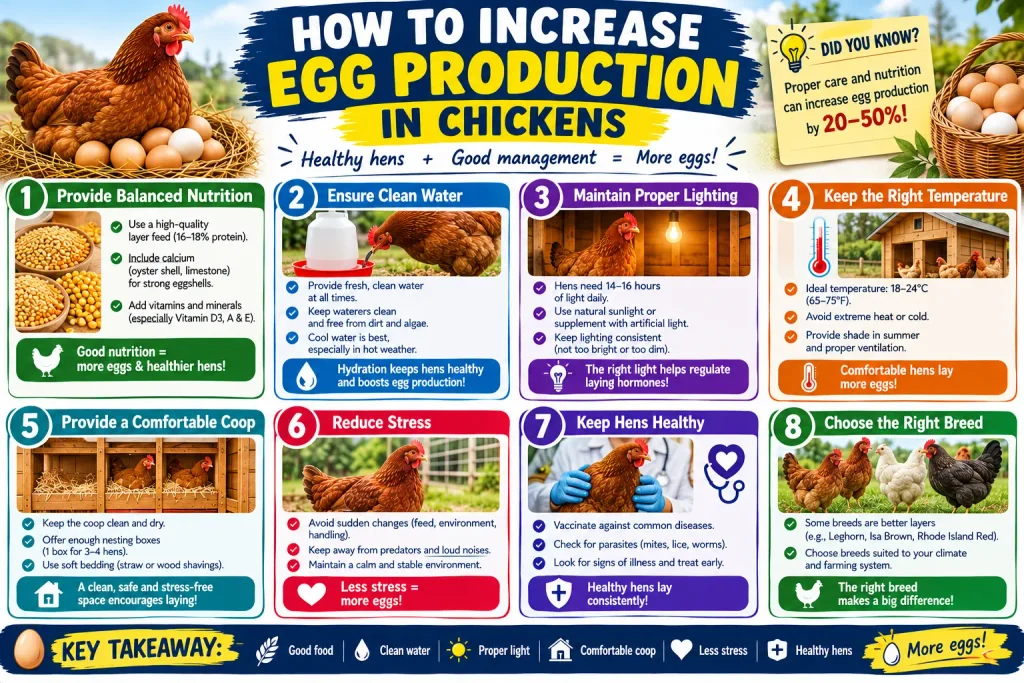
Quick Answer: To increase egg production in chickens, focus first on providing 14 to 16 hours of light daily, a complete layer feed with adequate protein and calcium, low-stress housing with enough space, and prompt treatment of any health issues. These four factors address the vast majority of cases where keepers are trying to get hens laying again after a slump.
Table of Contents
Step 1: Get the Lighting Right
Why Light Comes First
Since a hen’s laying hormones are triggered directly by light exposure, this is usually the single most effective lever for how to increase egg production in chickens, especially during fall and winter months.
How to Add Light Effectively
- Calculate current natural daylight hours. This tells you exactly how much supplemental light is needed to reach the target range.
- Aim for a total of 14 to 16 hours of light. Going beyond this range offers little additional benefit and can increase stress.
- Extend the morning rather than the evening. This allows hens to settle naturally onto the roost as it gets dark, rather than being caught off guard by sudden darkness.
- Use a timer for consistency. Irregular light exposure can disrupt the hormonal cycle more than no supplemental light at all.
- Choose warm-toned, moderate-intensity bulbs. Harsh lighting can increase stress rather than simply extending day length.
| Lighting Approach | Effect on Production | Notes |
| No supplemental light | Natural seasonal dip | Lower winter output, more natural rest |
| Consistent 14–16 hr light | Increased, more stable output | Most effective single change |
| Inconsistent light schedule | Can disrupt cycle | Avoid random on/off patterns |
Step 2: Dial In Nutrition
The Non-Negotiables
A complete layer feed with 16 to 18% protein and adequate calcium forms the nutritional backbone for anyone trying to increase chicken egg production. Treats, scratch grains, and kitchen scraps should stay a minor part of the diet, not a replacement for balanced feed.
Calcium Specifically
- Offer free-choice crushed oyster shell alongside layer feed
- Avoid mixing high calcium into grower feed for young, not-yet-laying pullets
- Watch for thin or soft shells as an early sign calcium intake needs attention
Protein and Energy
Hens actively laying need more protein than non-laying birds to keep up with consistent egg formation. A feed formulated specifically for layers, rather than an all-flock or grower blend, is generally the better choice for maximizing output.
Read More: https://lashegg.com/chicken-egg-production-cycle/
| Nutrient | Role in Egg Production | Practical Source |
| Protein | Supports egg white and overall formation | Complete layer feed, mealworms in moderation |
| Calcium | Shell formation | Layer feed, free-choice oyster shell |
| Water | Supports every stage of the laying cycle | Constant clean access, checked twice daily |
Step 3: Reduce Stress and Improve Housing
Why Stress Undermines Everything Else
Even perfect lighting and nutrition won’t fully translate into higher output if a flock is dealing with chronic stress. Overcrowding, predator pressure, and aggressive flock dynamics all interfere with the hormonal signals driving consistent laying.
Practical Housing Improvements
- Provide at least 3 to 4 square feet of coop space per standard-sized hen
- Predator-proof the run and coop to reduce chronic background stress
- Keep nesting boxes clean, private, and in a quiet part of the coop
- Introduce new birds gradually rather than all at once
Expert Tip
Watch for subtle stress signs like feather picking, excessive noise, or hens hiding in corners rather than waiting for laying to visibly drop. Addressing stress before it fully tanks production is far more effective than trying to recover output after weeks of decline.
Step 4: Address Health Issues Promptly
Common Health Barriers to Higher Output
Internal and external parasites, respiratory infections, and reproductive issues all reduce a hen’s ability to lay consistently, regardless of how well lighting and nutrition are managed. Getting hens laying again after illness starts with resolving the underlying health problem first.
Routine Health Practices That Support Production
- Deworm on a reasonable schedule. Follow product guidance or a vet’s recommendation based on your region and flock history.
- Check for external parasites regularly. Mites and lice cause anemia and stress that directly reduce output.
- Monitor body condition. Both underweight and overweight hens tend to lay less consistently than those at a healthy weight.
- Address illness quickly. Delayed treatment often means a longer recovery period before production returns.
| Health Issue | Effect on Production | Action |
| Internal parasites | Reduced nutrient absorption, lower output | Appropriate dewormer, clean litter |
| External parasites | Anemia, stress, reduced laying | Poultry-safe treatment, coop cleaning |
| Respiratory infection | Systemic stress, reduced laying | Veterinary evaluation |
| Reproductive infection | Often stops laying entirely | Veterinary treatment required |
Realistic Expectations: What “Increasing” Egg Production Actually Looks Like
Recovering From a Slump vs. Exceeding Genetic Potential
There’s an important difference between getting hens laying again after a stress-, diet-, or health-related slump versus trying to push a breed beyond its natural genetic ceiling. The steps in this guide reliably help with the first goal; they won’t turn a heritage breed into a 300-egg-a-year hybrid.
Realistic Timelines
| Cause of Low Production | Expected Recovery Time With Correction |
| Lighting adjustment | 1–3 weeks to see improvement |
| Nutrition correction | 1–2 weeks |
| Stress reduction | Days to 2 weeks |
| Health treatment | Variable, depends on illness severity |
| Natural molt | No acceleration possible, weeks to months |
Common Mistakes to Avoid
- Expecting immediate results the same week a change is made
- Overcorrecting with excessive light or forced feeding, which can backfire
- Ignoring an underlying health issue while focused only on lighting or diet
- Comparing a heritage breed’s realistic ceiling to a production hybrid’s numbers
- Adding supplements or additives without addressing the four core factors first
Warning
Aggressively forcing egg production through excessive artificial lighting, overfeeding calcium, or skipping natural rest periods can increase the risk of reproductive problems like egg binding or egg yolk peritonitis over time. Sustainable methods to increase egg production in chickens should support long-term flock health, not just short-term output.
When to Call a Vet
Contact a poultry veterinarian if egg production stays low despite correcting lighting, nutrition, and housing, especially when paired with lethargy, weight loss, or other symptoms. Persistent low output that doesn’t respond to these standard steps may point toward an underlying health issue that needs professional diagnosis rather than continued at-home adjustments.
People Also Ask
What is the fastest way to increase egg production in chickens? Adding consistent supplemental light to reach 14 to 16 hours daily is typically the fastest, most reliable single change, often showing results within one to three weeks.
Can diet alone increase chicken egg production? Diet plays a major role, but it works best combined with proper lighting and low stress; a perfect diet alone won’t fully offset inadequate light exposure or a stressful environment.
How do I get hens laying again after a molt? Molting must run its natural course, typically several weeks to a couple of months, though supporting good nutrition throughout helps hens return to laying as quickly as their biology allows.
Does adding a rooster help increase egg production? No, a rooster has no effect on how many eggs hens lay; roosters are only relevant for fertilizing eggs meant for hatching.
Is it possible to increase egg production in older hens? Yes, to a degree. Good nutrition, low stress, and prompt health care can help older hens lay closer to their remaining natural potential, though it won’t restore first-year peak output.
Final Thoughts
How to increase egg production in chickens ultimately comes down to consistently meeting four core needs: adequate light, complete nutrition, low stress, and good health. Addressing these in order typically resolves the majority of slumps keepers run into, often within a few weeks.
Track your flock’s response to each change individually, and reach out to a poultry veterinarian if production stays low despite correcting the basics, since a persistent slump beyond these fixes often points toward an underlying health issue worth investigating.
5. FAQ
Q: How to increase egg production in chickens during winter specifically? A: Supplemental lighting to reach 14 to 16 hours of daylight is the most effective winter-specific step, combined with maintaining consistent nutrition through the colder months.
Q: What’s the best way to increase chicken egg production without added light? A: Focus on nutrition, low stress, and prompt health care; output will still show natural seasonal variation, but these factors support a hen reaching her available potential.
Q: How long does it take to get hens laying again after correcting the basics? A: Most keepers see improvement within one to three weeks for lighting and nutrition changes, though health-related slumps vary based on the specific illness and its severity.
Q: Can supplements or additives increase chicken egg production beyond a normal diet? A: A complete, balanced layer feed generally covers what’s needed; additional supplements rarely outperform simply correcting gaps in light, nutrition, stress, or health first.
Q: Will increasing egg production shorten a hen’s overall laying lifespan? A: Reasonable, sustainable methods like proper lighting and nutrition don’t meaningfully shorten a hen’s lifespan, but aggressive forced production over years can increase long-term reproductive health risks.