The Chicken Egg Production Cycle, Start to Finish

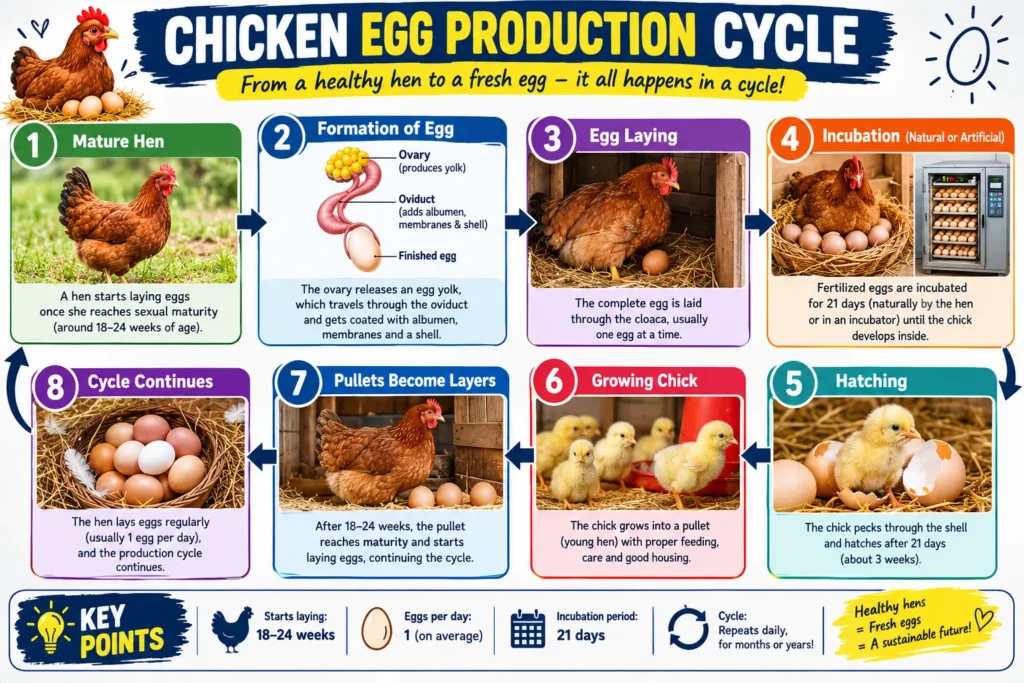
The chicken egg production cycle is a precise, multi-stage process that takes roughly 24 to 26 hours from start to finish, moving an egg through five distinct sections of the reproductive tract before it’s ever laid. Understanding each stage explains far more than just timing; it explains why nutrition, stress, and health all have such a direct impact on a hen’s ability to lay.
This guide walks through the full hen laying cycle anatomically and hormonally, section by section, rather than focusing on daily scheduling or annual output covered elsewhere. It’s built for keepers who want to understand exactly what’s happening inside a hen’s body each time she produces an egg.
Quick Answer: The chicken egg production cycle begins with a hormone-triggered ovulation, followed by the yolk moving through five sections of the oviduct where the white, membranes, shell, and pigment form in sequence. The full egg laying cycle takes about 24 to 26 hours, which is why laying times drift later each day until a hen skips a cycle and resets.
Table of Contents
Stage 1: Hormonal Trigger and Ovulation
What Starts the Cycle
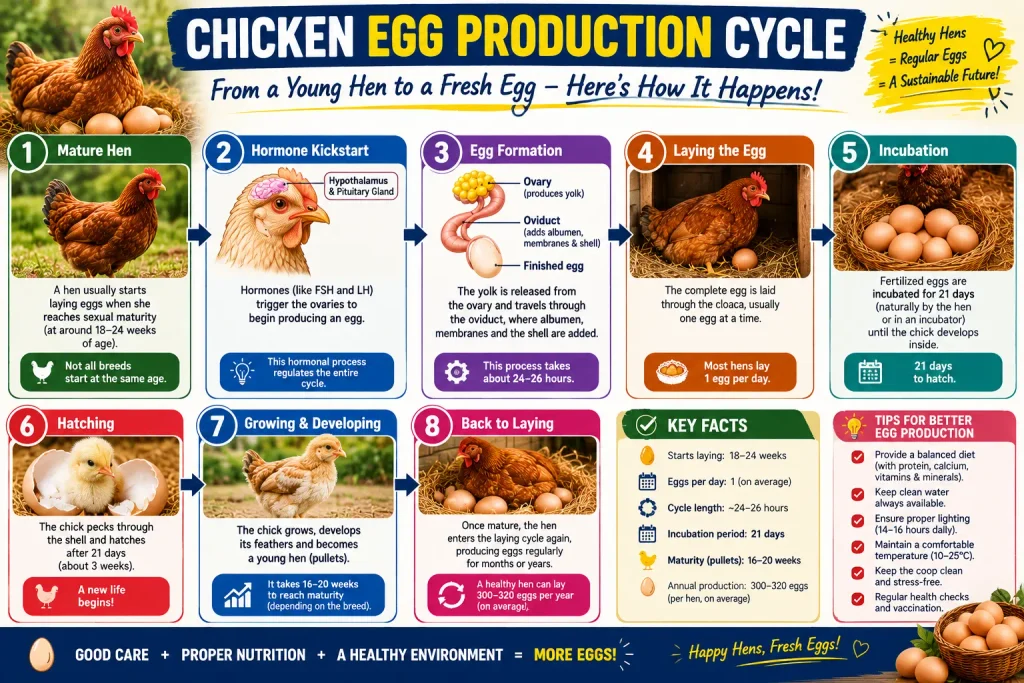
The chicken egg production cycle begins in the brain, not the ovary. Light entering the eye stimulates the hypothalamus, which signals the pituitary gland to release hormones that trigger the ovary to mature and release a yolk, a process called ovulation.
Why Light Matters So Much
This hormonal chain is exactly why daylight hours have such a strong effect on laying. Without adequate light exposure, roughly 14 to 16 hours daily, this trigger doesn’t fire consistently, which slows or halts the entire hen laying cycle.
| Stage | Location | Approximate Duration |
| Hormonal trigger | Brain (hypothalamus/pituitary) | Minutes |
| Ovulation | Ovary | Instantaneous release |
| Yolk capture | Infundibulum | 15–18 minutes |
Stage 2: The Journey Through the Oviduct
Infundibulum: Capturing the Yolk
Once released, the yolk is caught by the infundibulum, the funnel-shaped first section of the oviduct. This is also where fertilization occurs, if a rooster is present, though fertilization has no effect on whether an egg forms and is laid.
Magnum: Adding the Egg White
The yolk spends the most time here, roughly three hours, as the magnum secretes the layers of albumen, or egg white, around it. This section does the heavy lifting of the entire egg laying cycle in terms of time spent.
Isthmus: Forming the Membranes
Next, the isthmus adds the inner and outer shell membranes, thin protective layers that will later support the hard shell itself. This stage takes about an hour.
Shell Gland (Uterus): Building the Shell
The longest single stage, lasting roughly 18 to 20 hours, happens in the shell gland, where the hard, calcium-based shell forms around the egg. Pigmentation, for breeds that lay colored eggs, is also added here in the final hours.
Vagina: The Final Step
In the last stage, the completed egg passes through the vagina and is laid, typically small end first, with a protective coating called the bloom applied just before laying to help seal the shell’s pores.
Read More: https://lashegg.com/how-often-do-chickens-lay-eggs/
| Oviduct Section | Function | Approximate Duration |
| Infundibulum | Captures yolk, site of fertilization | 15–18 minutes |
| Magnum | Adds egg white (albumen) | ~3 hours |
| Isthmus | Forms shell membranes | ~1 hour |
| Shell gland (uterus) | Forms hard shell, adds pigment | 18–20 hours |
| Vagina | Final passage and laying | Minutes |
Did You Know? The bloom, or cuticle, added in the final moments of the chicken egg production cycle helps protect the egg from bacteria entering through the shell’s thousands of microscopic pores, which is part of why unwashed fresh eggs can be stored at room temperature longer than washed ones.
Why the Cycle Takes Slightly Over 24 Hours
The Drift Effect
Because the full hen laying cycle takes 24 to 26 hours rather than exactly 24, each egg is laid a little later in the day than the one before it. Eventually, the timing drifts too late for a new ovulation to occur that day, causing a hen to skip laying entirely before resetting to an earlier time.
How This Connects to Daily Patterns
This is the same mechanism behind the practical daily and weekly laying patterns backyard keepers observe, though the focus here is on the underlying biological process driving that pattern rather than the resulting schedule itself.
What Can Disrupt the Chicken Egg Production Cycle
1. Inadequate Light
Without sufficient light exposure to trigger the hormonal chain, the cycle slows or stops entirely, which is the core mechanism behind seasonal winter laying declines.
2. Poor Nutrition
Since the shell gland stage demands significant calcium, inadequate dietary calcium can disrupt shell formation, leading to thin, soft, or misshapen eggs, or in severe cases, a stalled cycle altogether.
3. Stress
Acute stress can interrupt hormone signaling at the very first stage of the egg laying cycle, which is why a predator scare or sudden environmental change can pause laying almost immediately.
4. Illness or Reproductive Disease
Infections such as salpingitis directly affect the oviduct sections responsible for forming the egg, which can disrupt or completely halt the normal cycle. According to the Merck Veterinary Manual, reproductive tract infections are a recognized and significant disruptor of normal egg formation in laying hens.
5. Molting
During a molt, the hormonal signals driving the chicken egg production cycle are redirected toward feather regrowth, pausing the entire process until molting completes.
Recognizing Cycle Problems From the Outside
| External Sign | Likely Stage Affected | Possible Cause |
| Soft or shell-less eggs | Shell gland | Calcium deficiency, stress |
| Wrinkled or misshapen shells | Shell gland | Stress, illness, disrupted timing |
| Blood or meat spots | Ovulation/infundibulum | Usually normal, occasional variation |
| Double-yolked eggs | Ovulation | Two yolks released close together |
| No eggs at all | Hormonal trigger stage | Light, stress, illness, or molting |
Expert Tip
Pay attention to shell quality, not just whether eggs appear at all. Thin, wrinkled, or oddly shaped shells often reveal a disruption partway through the hen laying cycle before a hen stops producing eggs altogether, giving you an earlier warning sign than a complete stop would.
Common Mistakes to Avoid
- Assuming egg problems are random rather than tied to a specific stage of the cycle
- Overlooking calcium intake as a cause of shell quality issues
- Ignoring early signs like wrinkled shells until laying stops completely
- Assuming fertilization affects whether an egg forms, when it does not
- Disrupting the cycle unnecessarily with inconsistent supplemental lighting
Warning
A sudden, complete stop in the chicken egg production cycle, especially paired with lethargy, vent discharge, or a swollen abdomen, points toward a reproductive infection rather than a normal pause. This combination needs veterinary evaluation rather than continued waiting.
When to Call a Vet
Contact a poultry veterinarian if a hen shows signs of a disrupted egg laying cycle alongside straining, vent discharge, lethargy, or a swollen abdomen. Persistent shell quality problems that don’t improve with better calcium and nutrition also warrant a professional look, since they can sometimes point toward an underlying reproductive issue rather than a simple dietary gap.
People Also Ask
How long does the full chicken egg production cycle take? The complete cycle takes approximately 24 to 26 hours from hormonal trigger to laying, which is why laying times drift later each day.
What part of the hen laying cycle takes the longest? The shell gland stage, where the hard shell forms, takes the longest at roughly 18 to 20 hours out of the full cycle.
Does a rooster affect the egg laying cycle? No, a rooster only affects whether an egg is fertilized, not whether the egg laying cycle occurs or how an egg forms and is laid.
Can stress really interrupt the chicken egg production cycle mid-process? Yes, acute stress can disrupt hormone signaling at the start of the cycle, which is why a stressful event can cause a hen to pause laying almost immediately.
Why do some eggs have blood spots if the cycle is normal? Blood spots usually result from a minor blood vessel rupture during ovulation and are a normal, harmless variation rather than a sign of a disrupted egg laying cycle.
Final Thoughts
The chicken egg production cycle is a precise, roughly 24-to-26-hour process moving through five sections of the oviduct, each responsible for a specific part of the finished egg. Understanding this process explains why light, nutrition, stress, and health all have such a direct, immediate effect on laying.
Watch for early warning signs like shell quality changes rather than waiting for a complete stop, and reach out to a poultry veterinarian if the hen laying cycle appears disrupted alongside other symptoms of illness.
5. FAQ
Q: What triggers the start of the chicken egg production cycle? A: Light exposure stimulates a hormonal chain starting in the brain that triggers the ovary to release a yolk, beginning the full cycle.
Q: How many stages are in the egg laying cycle? A: The cycle moves through five main sections of the oviduct: the infundibulum, magnum, isthmus, shell gland, and vagina, plus the initial hormonal trigger.
Q: Why does the hen laying cycle take longer than 24 hours? A: The combined time needed to form the egg white, membranes, shell, and pigment adds up to roughly 24 to 26 hours, slightly longer than a full day.
Q: Can nutrition problems disrupt a specific stage of the cycle? A: Yes, inadequate calcium specifically affects the shell gland stage, often showing up as thin, soft, or misshapen shells before any other symptoms appear.
Q: Is it normal for the chicken egg production cycle to pause during molting? A: Yes, molting redirects the hormonal resources that normally drive the cycle, causing a complete, temporary pause until the molt finishes.