How Long Do Chickens Molt? The Week-by-Week Answer

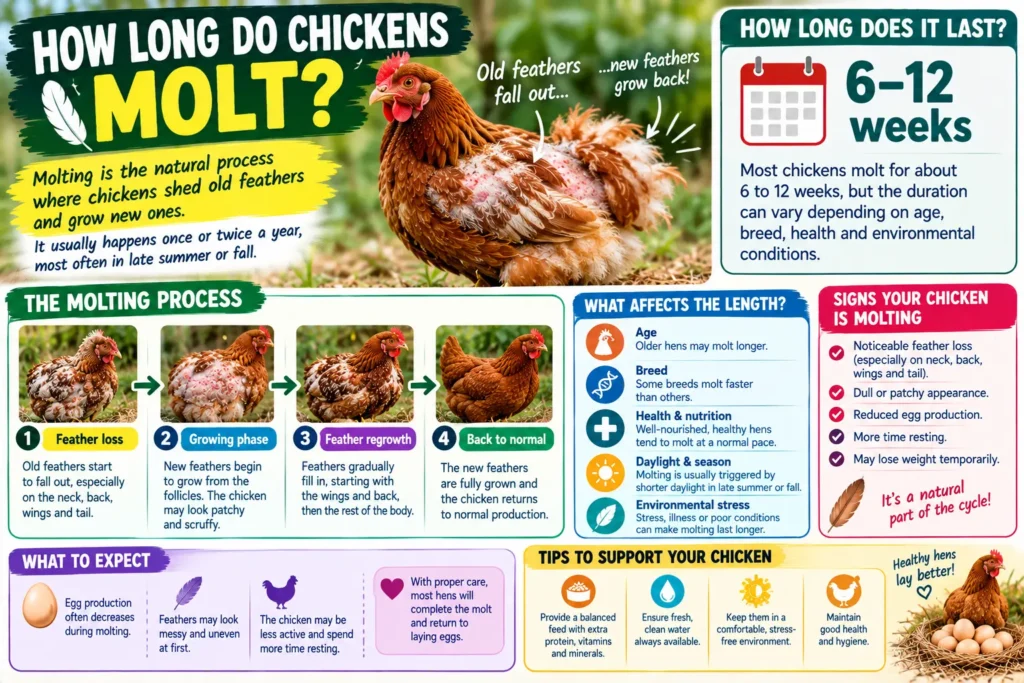
How long do chickens molt is usually asked by someone staring at a coop floor covered in feathers, wondering if this is going to last a few days or a few months. Chicken molting duration typically runs 8 to 12 weeks for a full molt, though the exact timeline varies enough by breed and individual bird that a general number only tells part of the story.
This guide breaks the process down week by week rather than just giving a single average, and compares hen molt duration across common breed categories so you can set realistic expectations for your specific flock.
Quick Answer: Most chickens molt for 8 to 12 weeks total, though some individuals finish in as little as 6 weeks while others, especially during a first hard molt, can take up to 16 weeks. Breed, age, and nutrition all affect exactly how long a given hen’s molt lasts.
Table of Contents
Week-by-Week: What Molting Actually Looks Like
Weeks 1–2: Early Feather Loss
Molting typically begins around the head and neck, with feather loss sometimes subtle enough that keepers don’t notice until it progresses further down the body. Egg production often slows or stops within this early window.
Weeks 3–5: Peak Feather Loss
This is usually the most visibly dramatic stage, with feather loss spreading across the breast, back, and body. Hens often look their roughest during this period, sometimes appearing patchy or thin.
Weeks 5–8: New Feather Growth Begins
Pin feathers, the small waxy-looking shafts of new feathers, start emerging across the body during this stage. The hen’s appearance typically starts improving noticeably as these fill in.
Weeks 8–12: Completion and Recovery
Wing and tail feathers, often the last to molt, typically finish regrowing during this final stretch. Egg production often begins resuming gradually as this stage progresses.
| Week Range | What’s Happening | Egg Production |
| Weeks 1–2 | Head/neck feather loss begins | Slowing or stopped |
| Weeks 3–5 | Peak feather loss across body | Typically stopped |
| Weeks 5–8 | New pin feathers emerging | Usually still stopped |
| Weeks 8–12 | Wing/tail feathers complete, appearance normalizes | Gradually resuming |
Did You Know? Individual hens within the same flock, even the same breed and hatch date, can be at completely different weeks of this timeline simultaneously, which is why a flock’s molting period can look messy and staggered from the outside even though each bird follows a fairly consistent internal pattern.
Read More: https://lashegg.com/molting-chickens-and-egg-production/
Chicken Molting Duration by Breed
Why Breed Affects Timeline
Some breeds and hybrid lines have been selected partly for faster, less disruptive molting, since a shorter molt means less total time without egg production for commercial-style operations. Heritage breeds, less selected for this trait, often show longer, more dramatic molts.
| Breed Type | Typical Molt Duration | Notes |
| Production hybrids (ISA Brown, Golden Comet) | 6–9 weeks | Often faster, less dramatic |
| Standard dual-purpose (Plymouth Rock, Wyandotte) | 8–12 weeks | Moderate, typical range |
| Heritage breeds (Orpington, Brahma) | 10–16 weeks | Often longer, more visibly dramatic |
| First-time molters (any breed) | Often longer | First hard molt sometimes exceeds typical range |
Individual Variation Within Breeds
Even accounting for breed tendencies, individual hens vary meaningfully. Two Orpingtons from the same hatch can show noticeably different molt durations based on nutrition, health, and simple individual variation.
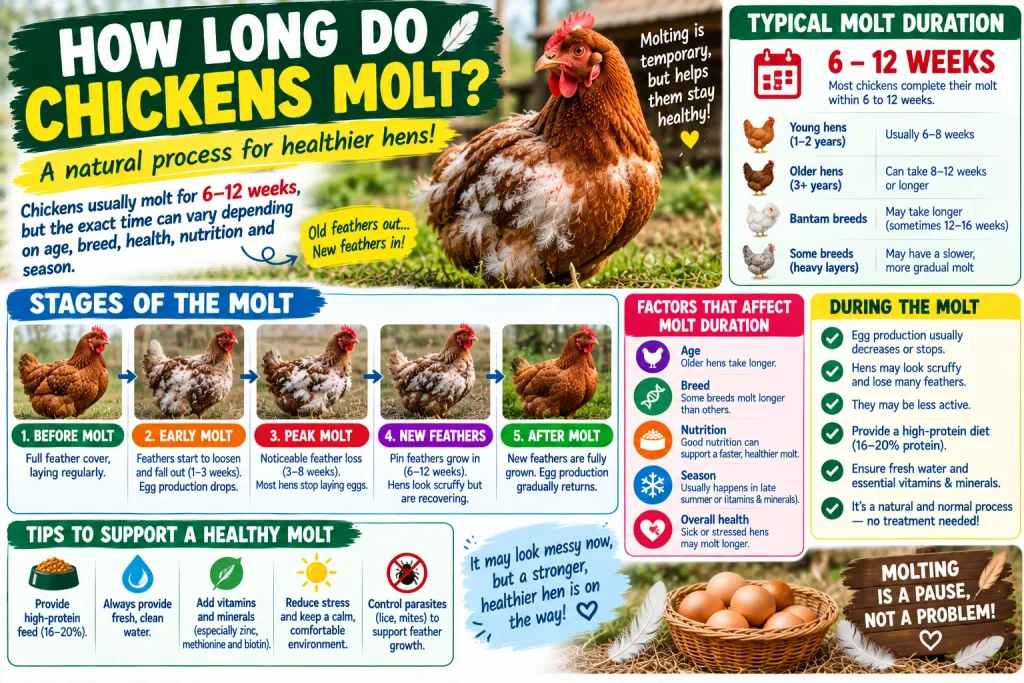
Factors That Extend or Shorten Chicken Molting Duration
What Extends Molt
- Inadequate dietary protein during the molting period
- Underlying illness or parasite load competing for the same resources
- Colder weather, which can slow overall metabolic processes
- Stress from overcrowding or flock disruption during the molt
What Supports a Shorter, Smoother Molt
- Consistent access to a higher-protein feed during the active molting period
- Low-stress environment without major changes during the process
- Good baseline health heading into the molt
- Adequate hydration and overall nutrition throughout
| Supporting Factor | Effect on Duration |
| Higher protein feed | Can shorten and smooth the process |
| Chronic stress | Can extend duration |
| Underlying illness | Can significantly extend duration |
| Cold weather | Can slow the process somewhat |
Step-by-Step: Tracking Your Flock’s Molt Timeline
- Note the date feather loss first becomes visible. This gives you a starting reference point for tracking progress.
- Photograph the flock weekly if possible. Visual comparison over time makes progress easier to judge than memory alone.
- Watch for pin feathers as the turning point. Their emergence typically signals the halfway point or later in the overall timeline.
- Track egg production alongside feather progress. The gradual return of laying often lines up closely with visible feather completion.
- Compare your timeline against breed expectations. A heritage breed taking 14 weeks isn’t unusual, while a production hybrid taking that long might warrant a closer look at nutrition or health.
Expert Tip
Don’t judge chicken molting duration by your fastest-molting hen. Flock-wide molt timelines are often set by your slowest individual bird, and comparing every hen against that single fast molter can create unnecessary worry about otherwise normal individual variation.
Common Mistakes to Avoid
- Expecting every hen in a flock to molt on exactly the same schedule
- Assuming a longer molt automatically signals a health problem without checking nutrition and breed first
- Panicking at the peak feather-loss stage, which looks dramatic but is a normal part of the process
- Keeping hens on standard, non-molt-supportive feed throughout an active molt
- Introducing new stress, like new flock members, during an already demanding molting period
Warning
A molt lasting significantly longer than 16 weeks, especially paired with poor appetite, lethargy, or patchy feather loss with visible skin irritation, may indicate something beyond a normal, if slow, molt. This combination is worth a closer look rather than continued waiting.
When to Call a Vet
Contact a poultry veterinarian if a molt extends well beyond the typical range for your bird’s breed and age, particularly alongside lethargy, poor appetite, or skin irritation. These signs may point toward an underlying nutritional deficiency, parasite issue, or illness rather than a simply prolonged but normal molt.
People Also Ask
How long do chickens molt on average? Most chickens complete a full molt within 8 to 12 weeks, though the exact chicken molting duration varies by breed, age, and individual bird.
Does hen molt duration get shorter after the first year? Often yes, many hens show a somewhat faster, less dramatic molt in subsequent years compared to their first significant molt.
Why is my chicken’s molt taking longer than others in the flock? Individual variation, breed differences, and nutrition all affect timing, so one hen taking noticeably longer than her flock mates isn’t necessarily unusual on its own.
Can diet actually shorten how long chickens molt? Yes, adequate protein during molt supports faster, more efficient feather regrowth, though it won’t dramatically compress the process beyond a bird’s natural biological timeline.
Is a molt lasting more than 16 weeks normal? It can happen, particularly with heritage breeds or a first hard molt, but this length combined with other symptoms like lethargy or poor appetite is worth investigating further.
Final Thoughts
How long do chickens molt comes down to a typical 8-to-12-week range, though breed, age, and individual variation stretch that window meaningfully in either direction. Tracking progress week by week, rather than judging by a single day’s appearance, gives a much clearer, less stressful picture of where your flock actually stands.
Support the process with good nutrition and low stress, and reach out to a poultry veterinarian if chicken molting duration extends well beyond expectations alongside other signs that something more than a slow molt might be going on.
5. FAQ
Q: How long do chickens molt compared to how long they stop laying? A: The full molt typically runs 8 to 12 weeks, though egg production often resumes before every single feather has finished regrowing, usually in the final weeks of the process.
Q: Does chicken molting duration differ between roosters and hens? A: Roosters do molt on a similar general timeline to hens, though since they aren’t balancing molt against egg production, their molt is sometimes less visibly disruptive to their overall condition.
Q: What’s considered a fast hen molt? A: A molt completing in around 6 to 8 weeks is considered relatively fast, more commonly seen in production-focused hybrid breeds than in heritage lines.
Q: Can weather affect how long chickens molt? A: Yes, colder weather can somewhat slow the overall process, which is part of why molting that begins in late fall can sometimes stretch into early winter.
Q: Should I intervene if my chicken’s molt seems slow? A: Focus on supporting nutrition and reducing stress first; a slow but otherwise normal-looking molt usually just needs time and good support rather than direct intervention.