Calcium for Chickens: Why “It Depends on the Bird” Is the Real Answer

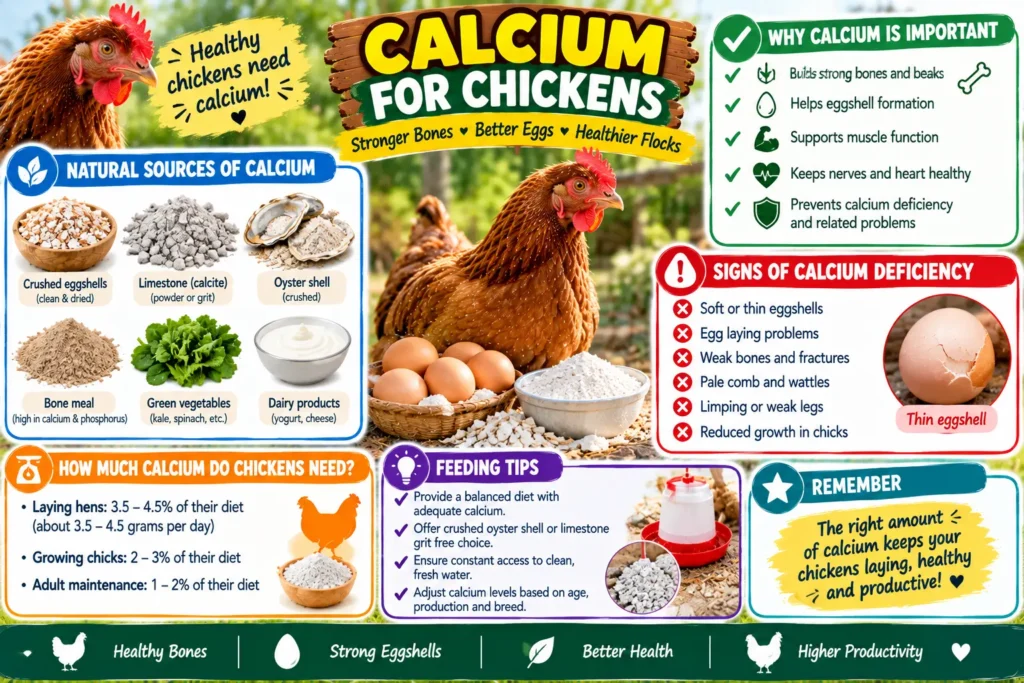
Calcium for chickens isn’t a single number, since a laying hen, a rooster, a growing chick, and a retired hen all have genuinely different needs. Layer-specific calcium requirements get detailed coverage elsewhere; this guide focuses on the fuller picture, especially the non-laying birds whose calcium needs are just as important but far less discussed.
Getting calcium right across a mixed flock means understanding not just how much a laying hen needs, but why giving that same amount to a rooster or young pullet can actually cause harm.
Quick Answer: Calcium needs vary dramatically by bird type: actively laying hens need roughly 4 grams daily for shell formation, while chicks, growing pullets, roosters, and non-laying adult hens need significantly less and can be harmed by chronic excess. Calcium supplements for hens, like free-choice oyster shell, should be offered in a way that lets each bird self-regulate rather than exposing the whole flock equally.
Table of Contents
Calcium Needs by Bird Type
Laying Hens
Covered in full depth elsewhere, actively laying hens have the highest calcium needs of any group, roughly 4 grams daily, to support consistent eggshell formation.
Chicks and Growing Pullets
Young, non-laying birds need calcium levels appropriate for skeletal development, but far lower than layer-level amounts. Their kidneys aren’t yet equipped to process the higher calcium load layer feed provides.
Roosters
Roosters never need layer-level calcium, since they have no shell-formation demand at all. Long-term exposure to layer feed’s higher calcium content can contribute to kidney strain over time.
Read More: https://lashegg.com/grit-for-chickens/
Retired or Non-Laying Adult Hens
Once a hen’s laying years end, her calcium needs drop back down closer to maintenance levels, similar to a rooster’s, even though she’s the same general size and age category as an actively laying hen.
| Bird Type | Approximate Calcium Need | Appropriate Feed |
| Actively laying hen | High (~4g/day) | Layer feed + free-choice supplement |
| Chick/growing pullet | Low | Starter/grower feed |
| Rooster | Low | All-flock/maintenance feed |
| Retired/non-laying hen | Low | All-flock/maintenance feed |
Did You Know? A rooster living alongside laying hens for years, sharing the same layer feed, is one of the most common ways non-laying birds end up with chronic calcium overexposure, simply because separating feed in a mixed flock takes deliberate effort.
The Real Risk of Excess Calcium in the Wrong Birds
Why More Isn’t Just “Extra,” It’s Harmful
Unlike some nutrients that simply pass through when not needed, chronic excess calcium in non-laying birds can contribute to kidney damage over time, since their bodies aren’t designed to process and excrete it at the same rate as an actively laying hen’s shell-forming system.
Signs of Potential Calcium Excess
- Reduced activity or appetite in non-laying birds (a nonspecific sign that warrants investigation)
- Known long-term exposure to layer feed in roosters or retired hens
- General decline in a rooster or non-laying hen with no other obvious explanation
| Bird Type at Risk | Primary Concern | Prevention |
| Roosters on layer feed | Kidney strain over time | Separate feed or free-choice-only calcium |
| Young pullets on layer feed | Kidney strain during development | Keep on grower feed until laying age |
| Retired hens on layer feed | Ongoing unnecessary calcium load | Transition to all-flock feed |
Managing Calcium for Chickens in a Mixed Flock
Step-by-Step: Setting Up Mixed-Flock Feeding
- Identify each bird’s actual category. Laying hens, non-laying adults, roosters, and growing birds all belong in different groups for this purpose.
- Choose an all-flock or maintenance feed as the shared base. This lower-calcium formulation is safe for every bird in the flock.
- Offer free-choice oyster shell separately. This lets actively laying hens supplement up to their higher need without exposing non-layers to the same calcium load.
- Avoid feeding straight layer feed to a mixed-age or mixed-purpose flock. This is the single most common calcium management mistake in flocks that include roosters or non-laying birds.
- Reassess as flock composition changes. A hen retiring from laying, or a new rooster joining, should prompt a feed strategy review.
Expert Tip
If you’re unsure whether your current setup over-exposes non-laying birds to calcium, the safest default is all-flock feed plus free-choice oyster shell for the whole group, rather than straight layer feed. This approach works safely for every bird type simultaneously.
Common Mistakes to Avoid
- Feeding straight layer feed to a flock that includes roosters or retired hens
- Assuming all adult chickens have the same calcium needs regardless of laying status
- Introducing layer feed to pullets before they’ve actually started laying
- Continuing layer feed for a hen well past her productive laying years without adjustment
- Mixing oyster shell directly into shared feed rather than offering it free-choice
Warning
Long-term calcium excess in non-laying birds, particularly roosters and retired hens sharing a flock’s layer feed, is a genuine, if often overlooked, health risk. Reviewing your feed strategy against actual flock composition, not just bird age, protects against this outcome.egg
When to Call a Vet
Contact a poultry veterinarian if a non-laying bird, rooster, retired hen, or young pullet, shows signs of declining health with a known history of layer feed exposure, since kidney-related effects from chronic calcium excess may not be immediately obvious without professional evaluation.
People Also Ask
Do all chickens need the same calcium for chickens regardless of type? No, actively laying hens need significantly more calcium than roosters, chicks, or non-laying adult hens, making feed type an important consideration in any mixed flock.
Can calcium supplements for hens harm roosters if they share a coop? Yes, if a rooster has ongoing access to the same calcium supplementation intended for laying hens, chronic excess can contribute to kidney strain over time.
What calcium needs do retired hens have compared to active layers? Retired hens’ calcium needs drop back to maintenance levels similar to non-laying adults, meaning continuing layer feed after retirement provides more calcium than they actually need.
Is it safe to feed chicks any amount of calcium for chickens formulated for layers? No, layer-level calcium is inappropriate for chicks and growing pullets, whose kidneys aren’t yet developed to handle that load safely.
How can I tell if my mixed flock’s calcium setup is actually safe for every bird? Using an all-flock or maintenance feed as the shared base, with free-choice oyster shell available separately for laying hens, is a reliable, safe approach for virtually any mixed-flock composition.
Final Thoughts
Calcium for chickens genuinely depends on which chicken you’re talking about, with actively laying hens needing far more than roosters, chicks, or retired birds sharing the same coop. Managing this well in a mixed flock means choosing a lower-calcium base feed and offering supplementation free-choice rather than uniformly.
Review your flock’s actual composition against these categories, and reach out to a poultry veterinarian if a non-laying bird shows signs of decline with a history of inappropriate calcium exposure.
5. FAQ
Q: How much calcium for chickens is safe for a mixed-age flock? A: An all-flock or maintenance feed with free-choice oyster shell available separately safely covers a mixed-age, mixed-purpose flock without over-exposing non-laying birds.
Q: Do calcium supplements for hens ever expire or lose effectiveness? A: Oyster shell and similar supplements don’t spoil quickly, but proper dry storage helps maintain quality and prevents clumping over time.
Q: Can a rooster’s calcium needs change if he’s the only male in a large flock of hens? A: No, a rooster’s calcium needs stay low regardless of flock size or composition, since he has no egg-related demand driving that requirement upward.
Q: Is it too late to fix calcium exposure if my rooster has been on layer feed for years? A: Switching to an appropriate feed now still reduces ongoing exposure, and a veterinarian can help assess whether any existing effects warrant further evaluation.
Q: What’s the easiest way to manage calcium needs across a very mixed flock? A: Defaulting to all-flock feed as the shared base, with free-choice oyster shell for any actively laying hens, is generally the simplest, safest approach across bird types.