Can Salpingitis Come Back in Chickens?

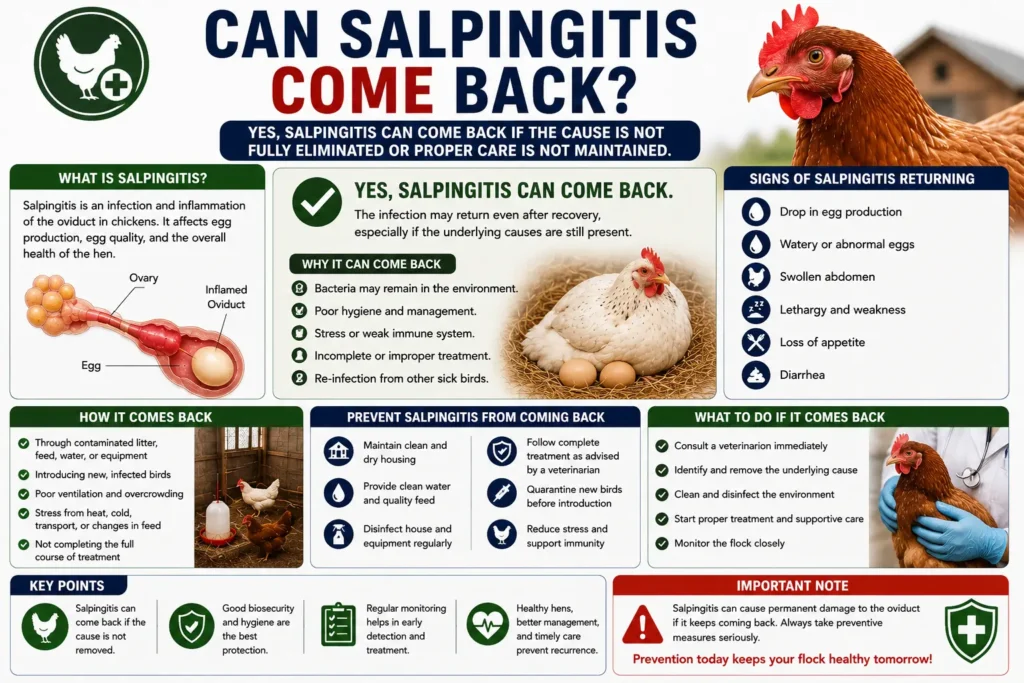
Can salpingitis come back? Yes, and it does so often enough that experienced poultry vets consider recurrence one of the defining challenges of this condition, not an unlucky exception. A hen who recovers from one episode of salpingitis carries a real, documented risk of a repeat infection, sometimes weeks later, sometimes months later.
This isn’t meant to alarm you if your hen just pulled through her first bout. It’s meant to set realistic expectations, because the way you manage her going forward is different once you know recurrent infection is a genuine possibility rather than a rare fluke.
Quick Answer: Yes, salpingitis can come back. Recurrent infection is especially common in hens treated with antibiotics or minor surgery without full removal of the affected oviduct tissue. The underlying risk factors, like age, high egg production, and prior oviduct damage, often remain in place even after a hen appears to recover.
This guide explains why recurrence happens, what raises the odds, and what you can realistically do to lower the risk going forward.
Table of Contents
Why Recurrent Infection Happens So Often
Salpingitis recurrence comes down to one central issue: treating the visible symptoms doesn’t always resolve the underlying vulnerability. A hen can look and act completely healthy for weeks while damaged tissue, residual bacteria, or an ongoing structural problem in the oviduct sets her up for another round.
The Oviduct Doesn’t Fully Reset
Once the oviduct lining has been damaged by inflammation, scarring, or a mass of infected material, that tissue doesn’t necessarily return to its original, fully functional state, even after antibiotics clear the active infection. Weakened or scarred tissue is more vulnerable to a second infection than healthy tissue was the first time around.
Read More: https://lashegg.com/can-chickens-lay-eggs-after-salpingitis/
Removing the Lash Egg Isn’t the Same as Removing the Cause
When a vet removes a lash egg or pus mass without removing the surrounding oviduct tissue, the infection’s original entry point and any residual bacteria can still be present. Veterinary sources describe a significantly increased risk of recurrence in exactly this scenario, which is part of why full surgical removal of the oviduct is sometimes recommended for hens with repeated episodes.
The Original Risk Factors Rarely Go Away
Most of the conditions that made a hen prone to salpingitis in the first place, such as high egg production, obesity, advanced age, or a history of vent trauma, are still present after she recovers. Unless something changes, like reduced light exposure to slow laying or a diet adjustment to address weight, those same pressures can trigger another infection.
Did You Know? Antibiotics work best when salpingitis is caught extremely early, while any pus or infected material is still soft. By the time visible symptoms like a lash egg appear, the infection has often been developing for weeks or months already, which limits how completely antibiotics alone can resolve it, and raises the odds of recurrent infection afterward.
What Raises the Risk of Salpingitis Coming Back
| Risk Factor | Why It Increases Recurrence |
| Partial treatment (antibiotics only, no surgery) | Underlying tissue damage and any residual infection source remain |
| Lash egg or mass removed without oviduct removal | Entry point and residual bacteria often stay in place |
| High egg production continuing unchanged | Ongoing hormonal activity and oviduct stress continue as before |
| Advanced age | Oviduct tissue has less capacity to fully repair itself |
| Obesity | Continued risk of vent trauma and pressure on the reproductive tract |
| Chronic or untreated respiratory illness | Ongoing pathway for bacteria to reach the oviduct |
| No dietary or environmental changes after recovery | Same conditions that triggered the first episode remain unchanged |
How Common Is Recurrence, Really?
There’s no single statistic that applies to every hen, since outcomes depend heavily on the individual case and the treatment chosen. That said, a consistent pattern shows up across veterinary and poultry-keeping sources:
- Hens treated with antibiotics alone often see the infection return, sometimes within a few months.
- Hens who have had a mass surgically removed without full oviduct removal face a meaningfully higher recurrence risk than hens who undergo complete oviduct removal (salpingohysterectomy).
- Some hens pass a single lash egg, recover fully, and never experience another episode, though this outcome is less common than partial recovery followed by recurrence.
- Hens who continue laying eggs at high rates after recovery appear to face a higher likelihood of a repeat infection than hens whose laying is intentionally slowed during recovery.
Expert Tip: If your hen has already had one episode of salpingitis, ask your vet directly about her specific recurrence risk based on what treatment she received. A hen who had a full oviduct removal carries a very different outlook than one who was only treated with antibiotics.
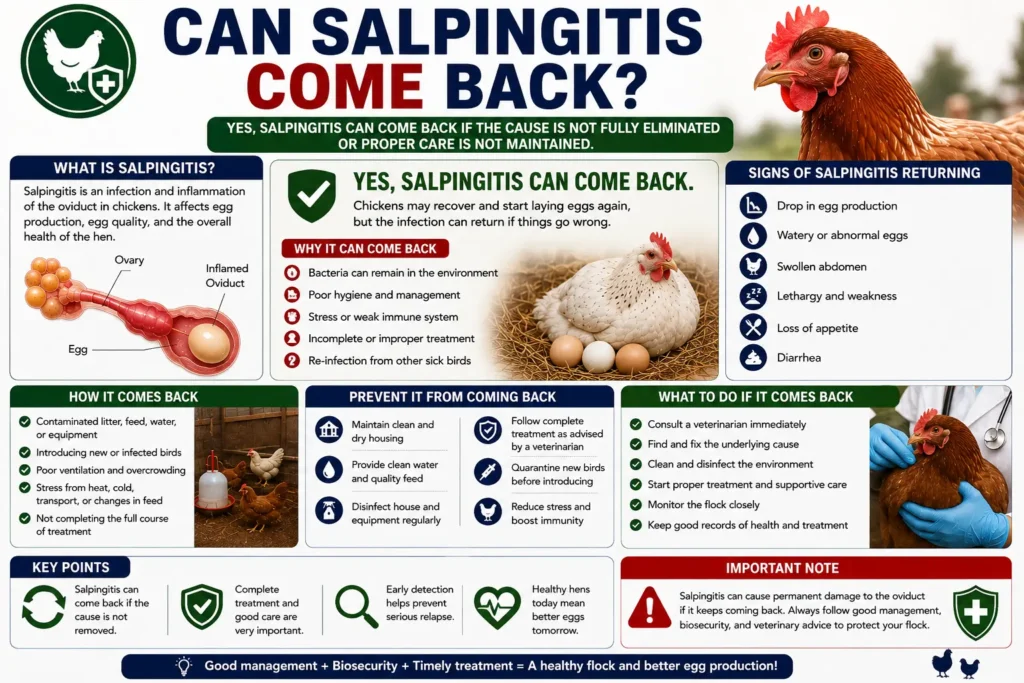
Treatment Options and Their Impact on Recurrence
Antibiotics Alone
Best suited for infections caught very early, while any mass is still soft. This approach can resolve mild cases, but it doesn’t address existing oviduct damage, which is part of why recurrent infection is common after antibiotic-only treatment.
Surgical Removal of the Mass Only
Removes the visible lash egg or pus material but leaves the oviduct itself in place. This offers relief from the immediate blockage but carries a meaningfully higher chance that infection returns, since the tissue that allowed the first infection is still there.
Full Oviduct Removal (Salpingohysterectomy)
The most definitive option for preventing recurrence, since it removes the tissue where the infection originates. It’s a more invasive, costly procedure that requires an experienced avian vet, and it isn’t without its own risks, particularly in hens with advanced disease at the time of surgery.
Supportive Measures to Reduce Future Risk
- Reducing light exposure to slow or pause egg production during and after recovery
- Switching to a lower-calorie, molt-supporting diet if weight is a factor
- Improving nest box hygiene to reduce ongoing bacterial exposure
- Monitoring closely for early signs if another episode does begin
Warning: Don’t assume a hen is fully in the clear just because weeks have passed without symptoms. Recurrent infection can develop quietly before becoming visible again, the same way the original episode likely did.
Signs That Salpingitis Might Be Returning
Watch a previously affected hen for the same signs you saw the first time:
- Decreased or irregular egg production after a period of normal laying
- Return of lethargy or reduced appetite
- Abdominal swelling or the upright “penguin” stance
- A new lash egg, even if the first one seemed like an isolated event
- Yellow, watery, or unusual droppings
When to Call a Vet
- At the very first sign of any symptom returning, even mild ones
- If a previously recovered hen suddenly stops laying again
- Before deciding on a treatment plan if this is a repeat episode
- If you’re weighing surgical options and want guidance on the recurrence risk of each approach
- If a hen’s quality of life seems to be declining despite treatment
Common Mistakes That Increase Recurrence Risk
- Assuming a hen is cured once initial symptoms resolve, without addressing underlying risk factors
- Skipping the follow-up vet visit that would catch early signs of recurrent infection
- Returning a hen to full, unrestricted egg production immediately after recovery
- Choosing the cheapest treatment option without understanding its recurrence risk
- Not adjusting diet or environment after a first episode, leaving every original risk factor unchanged
How to Lower the Odds That Salpingitis Comes Back
- Discuss treatment options fully with your vet, including the recurrence risk associated with each one, before deciding on a plan.
- Support a laying pause during recovery, using reduced light and appropriate diet changes if your vet recommends it.
- Address weight and nutrition, since obesity is a modifiable risk factor that continues to matter after recovery.
- Keep nest boxes and coop conditions clean, reducing ongoing bacterial exposure.
- Monitor closely for months, not just weeks, since recurrent infection can take time to become visible again.
- Consider reduced breeding or reproductive demands for hens with a history of salpingitis, if that fits your goals for keeping her.
Is It Really a Recurrence, or a New Infection?
Not every second episode of salpingitis is technically the same infection returning. It helps to understand the difference, even though the practical response, prompt veterinary attention, is the same either way.
True Recurrence
This happens when the same damaged tissue or an incompletely resolved infection flares up again. It’s more likely after antibiotic-only treatment or partial mass removal, since the original vulnerability was never fully addressed. True recurrence often develops faster than the initial episode did, since the tissue is already compromised.
A New, Separate Infection
A hen can also develop a completely new case of salpingitis, unrelated to a prior episode, if the same underlying risk factors, like age, obesity, or high egg production, are still present. In this scenario, the oviduct tissue may have genuinely healed from the first infection, but the hen’s overall susceptibility never went away, so a fresh infection took hold through a different route.
Why the Distinction Matters
Your vet may approach treatment differently depending on which scenario fits. A true recurrence in already-damaged tissue often points more strongly toward considering full oviduct removal, since repeated flare-ups in the same location suggest the tissue can’t reliably stay healthy. A new, separate infection may still respond well to a fresh round of antibiotics if caught early, particularly if the hen fully recovered and had a genuine symptom-free period beforehand.
Either way, from a practical standpoint, don’t spend too much time trying to diagnose which type of recurrent infection you’re dealing with on your own. That’s exactly the kind of detail a bacterial culture or veterinary exam can clarify, and it directly affects which treatment path makes the most sense going forward.
Long-Term Management for Hens With a History of Salpingitis
Once a hen has recovered from even one episode, many experienced keepers shift into a longer-term management mindset rather than treating recovery as the finish line.
- Track her laying pattern over months, not days. A gradual decline in frequency or a return of irregular eggs can be an early clue before more obvious symptoms appear.
- Keep her weight in a healthy range permanently, not just during the initial recovery period, since obesity remains a standing risk factor for as long as it’s present.
- Revisit her light exposure schedule with your vet if reduced light was part of her original treatment plan, since resuming a full laying schedule too aggressively can contribute to renewed stress on the oviduct.
- Build in periodic wellness checks, especially if she’s an older hen or had a severe first episode, rather than waiting for visible symptoms to prompt the next vet visit.
This kind of ongoing attention doesn’t guarantee a hen will never face recurrent infection again, but it does give you the best chance of catching a second episode early, when treatment options are still the most effective.
Frequently Asked Questions From Chicken Keepers
How soon can salpingitis come back after treatment?
There’s no fixed timeline. Some hens show signs of recurrent infection within weeks, while others go months before symptoms return, if they return at all.
Does removing a lash egg cure salpingitis?
Not on its own. Removing the mass relieves the immediate blockage, but the oviduct tissue that allowed the infection often remains, which is why recurrence is common after this approach alone.
Is surgery the only way to prevent salpingitis from coming back?
Full oviduct removal offers the most definitive protection against recurrence, but it isn’t the only option. Supportive measures like reducing egg production and addressing risk factors can also lower, though not eliminate, the chances of a repeat episode.
Can a hen survive multiple episodes of salpingitis?
Some do, though repeated episodes generally carry a worse prognosis each time, since the oviduct sustains additional damage with every infection.
The Bottom Line: Can Salpingitis Come Back?
Yes, salpingitis can come back, and for many hens, it does. Recurrent infection is closely tied to how the first episode was treated and whether the underlying risk factors were addressed afterward. Talk with your vet about which treatment approach fits your hen’s situation, keep a close eye on her in the weeks and months after recovery, and don’t hesitate to seek veterinary care again at the first sign that symptoms are returning.
5. FAQ
Can salpingitis come back in chickens? Yes. Recurrent infection is common, especially in hens treated with antibiotics alone or with partial mass removal rather than full oviduct removal.
What increases the chance of recurrent salpingitis? Continuing high egg production, unresolved oviduct damage, obesity, advanced age, and skipping full surgical removal of the affected tissue all raise the risk.
Is surgery guaranteed to stop salpingitis from coming back? No treatment offers a complete guarantee, but full oviduct removal offers the most definitive reduction in recurrence risk compared to antibiotics or partial mass removal alone.
How do I know if my hen’s salpingitis has come back? Watch for the same signs as the first episode: decreased egg production, lethargy, abdominal swelling, or another lash egg. Any of these warrant a prompt vet visit.
Can a hen live a normal life even if salpingitis comes back more than once? Some hens do manage reasonably well through repeat episodes with supportive care, though each recurrence tends to carry a more guarded prognosis than the one before.
Should I change my hen’s diet to prevent recurrent infection? A balanced diet that supports a healthy weight can help reduce one risk factor, but it won’t address existing oviduct damage on its own. Combine dietary support with your vet’s broader treatment plan.