
How Often Do Chickens Lay Eggs? Understanding the Pattern

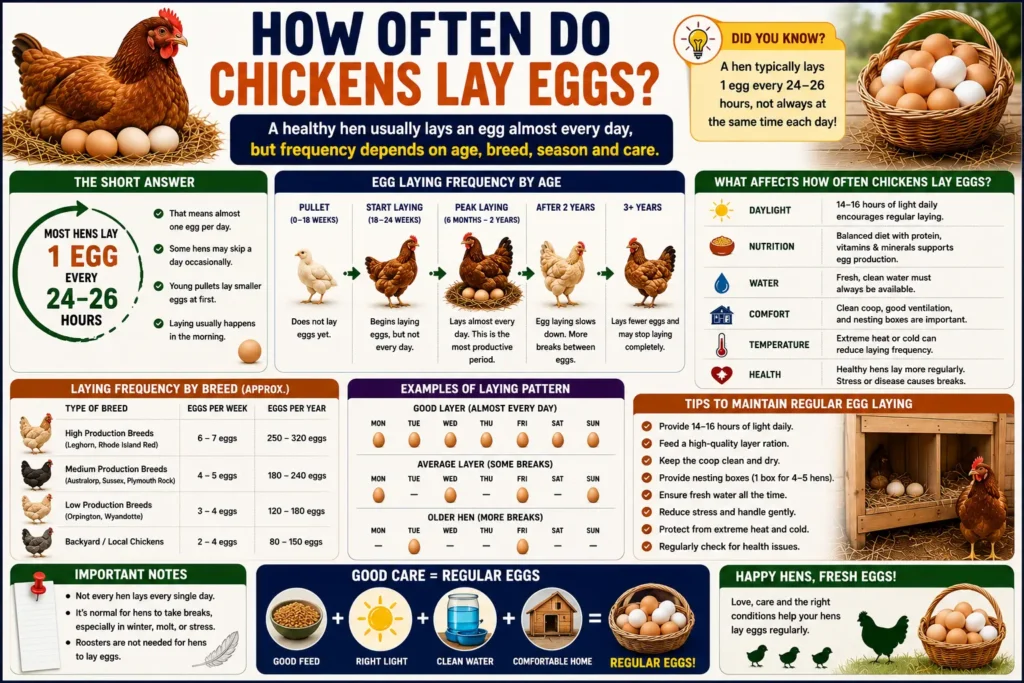
How often do chickens lay eggs comes down to a biological rhythm most people don’t expect: hens don’t lay on a strict daily schedule, and the exact timing actually shifts a little later each day until it resets. Understanding this pattern explains a lot of the “why did she skip a day” questions new keepers run into.
This guide focuses specifically on chicken laying frequency, the internal cycle driving it, and the real-world daily and weekly patterns you can expect to see, rather than annual totals or breed comparisons covered elsewhere.
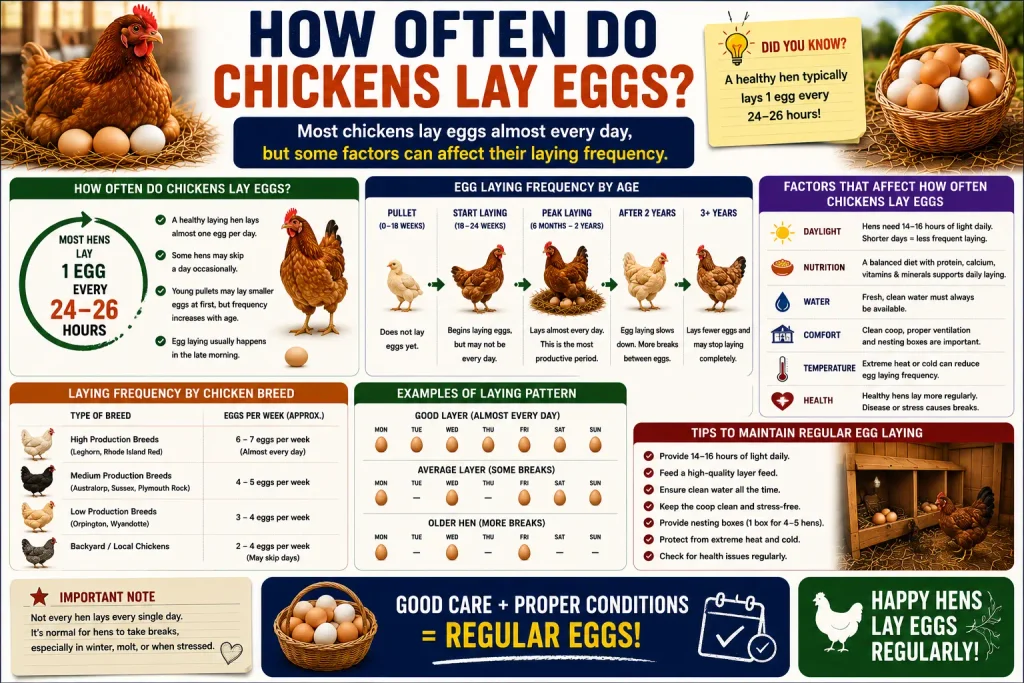
Quick Answer: Most hens lay an egg roughly every 24 to 26 hours during peak production, which works out to about 5 to 6 eggs per week rather than one every single day. How often hens lay shifts with age, season, and individual biology, and it’s completely normal for the exact time of day to drift later with each cycle until a skipped day resets it.
Table of Contents
The 24-to-26-Hour Cycle Explained
Why It’s Not a Perfect 24 Hours
A hen’s body takes roughly 24 to 26 hours to form a complete egg, from ovulation through shell formation. Because this cycle runs slightly longer than a full day, the time she lays each egg drifts a little later every day.
Why Hens Eventually Skip a Day
Since ovulation for the next egg needs to happen within a certain window of daylight to keep the cycle going, a hen’s laying time eventually drifts too late in the day for a new cycle to start. When that happens, she skips a day entirely and resets to an earlier time the following day.
| Cycle Stage | What’s Happening | Approximate Time |
| Ovulation | Egg yolk released into oviduct | Triggers new cycle |
| Formation | Egg white, membranes, and shell form | 20–24 hours |
| Laying | Completed egg is laid | 24–26 hours after ovulation |
| Reset | Cycle drifts too late, day is skipped | Varies by hen |
Did You Know? This drifting pattern is why a hen who lays first thing in the morning early in a laying streak often shifts to laying in the afternoon by the end of that streak, right before she skips a day and starts the pattern over.
Read More: https://lashegg.com/how-many-eggs-does-a-chicken-lay/
How Often Hens Lay: Realistic Weekly Patterns
What a Strong Laying Week Looks Like
A hen at peak production typically lays 5 to 6 eggs per week, with one or two rest days built into that natural cycle. This is very different from a full 7-egg week, which is uncommon even for the most productive individual hens.
| Production Level | Eggs Per Week | Eggs Per Year (Approximate) |
| Peak production | 5–6 | 260–300+ |
| Moderate production | 3–5 | 150–250 |
| Low or declining production | 1–3 | 50–150 |
| Non-laying period (molt, broody, winter) | 0 | 0 during that phase |
Why “Almost Every Day” Is the Realistic Expectation
Marketing language sometimes implies daily eggs, but chicken laying frequency naturally includes rest days built into the biological cycle itself, separate from any external factor like illness or stress.
What Affects How Often Chickens Lay Eggs
1. Age
Younger hens in their first one to two years typically show the most consistent, frequent laying pattern, with rest days becoming more common as hens age.
2. Season and Daylight
Shorter winter days can extend the natural cycle length, leading to more frequent skipped days, while long summer daylight often supports a tighter, more consistent cycle.
3. Breed
Production breeds have been selected specifically for a shorter, more consistent laying cycle, while heritage breeds often show more natural variation in how often hens lay from one week to the next.
4. Molting
During an active molt, the laying cycle pauses entirely rather than simply slowing, since the body redirects resources toward feather regrowth.
5. Stress and Health
Illness, parasites, or environmental stress can disrupt the normal cycle, sometimes causing more frequent skipped days or a temporary full stop even outside of molting or seasonal patterns.
Daily Timing Patterns Explained
Why Most Eggs Appear in the Morning
Because a hen’s cycle is tied to light exposure, most hens lay earlier in the day, often within a few hours of when they wake and become active. As explained above, this timing drifts later across a laying streak before resetting.
Step-by-Step: Tracking Your Own Flock’s Pattern
- Note the time of day for each egg over one to two weeks. This reveals your specific flock’s natural rhythm rather than relying on general averages.
- Track which hens skip which days. Individual patterns often become clear after just a week or two of observation.
- Compare against season and molting status. A sudden change in frequency often lines up with one of these factors rather than indicating a new problem.
- Watch for a pattern shift rather than a single skipped day. One missed day rarely means anything on its own; a sustained change is more meaningful.
Expert Tip
Don’t panic over a single skipped day from any individual hen. Given the natural 24-to-26-hour cycle, occasional gaps are a normal and expected part of how often hens lay, not a sign that something has gone wrong.
When a Change in Frequency Signals a Problem
Normal Frequency Changes
- Occasional single skipped days within an otherwise consistent pattern
- A gradual slowdown tied to molting season or shortening daylight
- Slightly reduced frequency as a hen ages past her first couple of years
Frequency Changes Worth Investigating
- A sudden, sustained stop with no clear seasonal or molting explanation
- Reduced frequency paired with lethargy, weight loss, or other symptoms
- A previously consistent hen skipping most days for more than two to three weeks without an obvious cause
| Pattern | Likely Cause | Concern Level |
| Occasional skipped day | Normal biological cycle | None |
| Slower frequency in winter | Seasonal daylight change | None |
| No eggs during molt | Normal molting pause | None |
| Sudden stop, no clear cause | Possible illness or stress | Investigate further |
Common Mistakes to Avoid
- Expecting a perfect daily egg from every hen, every day
- Assuming a single skipped day means a hen has stopped laying entirely
- Overlooking seasonal daylight as an explanation for reduced chicken laying frequency
- Confusing normal cycle-based rest days with illness-related decline
- Comparing an individual hen’s pattern too strictly against general breed averages
Warning
A sustained, sudden stop in a hen’s laying frequency, especially paired with lethargy, poor appetite, or other symptoms, should not be dismissed as a normal skipped day. This pattern deserves closer attention rather than continued waiting.
When to Call a Vet
Contact a poultry veterinarian if a hen’s laying frequency drops suddenly and significantly, especially alongside lethargy, weight loss, vent discharge, or other signs of illness. A pattern that doesn’t match typical seasonal, molting, or age-related explanations is worth a closer, professional look rather than continued at-home monitoring alone.
People Also Ask
How often do chickens lay eggs at their absolute peak? At peak production, most hens lay roughly 5 to 6 eggs per week, following a natural 24-to-26-hour cycle that includes occasional rest days.
Do all hens lay eggs at the same time of day? No, timing varies by individual hen and drifts later across each laying streak before resetting, so exact timing differs even within the same flock.
Why do hens skip days instead of laying every single day? Because the internal cycle runs slightly longer than 24 hours, the laying time eventually drifts too late for a new cycle to start that day, causing a natural skip.
Does chicken laying frequency change with the seasons? Yes, shorter winter daylight often extends the cycle and leads to more frequent skipped days, while long summer days tend to support more consistent frequency.
Is it normal for how often hens lay to slow down as they age? Yes, older hens typically show more frequent rest days and an overall slower pace compared to their first couple of peak-production years.
Final Thoughts
How often do chickens lay eggs comes down to a natural 24-to-26-hour cycle rather than a strict daily schedule, which means occasional skipped days are expected, not a warning sign. Season, age, breed, and molting all shape the exact rhythm for any individual hen.
Track your flock’s pattern over a couple of weeks to understand its normal rhythm, and reach out to a poultry veterinarian if chicken laying frequency drops suddenly and stays low without a clear seasonal or biological explanation.
5. FAQ
Q: How often do chickens lay eggs compared to laying one every single day? A: Chickens don’t typically lay every single day; most hens follow a 24-to-26-hour cycle that naturally includes rest days, averaging around 5 to 6 eggs per week at peak.
Q: Why does chicken laying frequency slow down in winter? A: Shorter daylight hours extend the natural laying cycle, which leads to more frequent skipped days and an overall lower weekly frequency during winter months.
Q: How often hens lay changes with age — is that normal? A: Yes, it’s completely normal for laying frequency to gradually decline as hens move past their first one to two peak production years.
Q: Can stress affect how often a chicken lays eggs? A: Yes, stress from predators, overcrowding, or sudden changes can disrupt the normal cycle and lead to more frequent skipped days or a temporary pause.
Q: Do production breeds lay more consistently than heritage breeds? A: Yes, production breeds have been selectively bred for a tighter, more consistent laying cycle, while heritage breeds often show more natural week-to-week variation.