Common Myths About Salpingitis That Confuse Backyard Chicken Owners

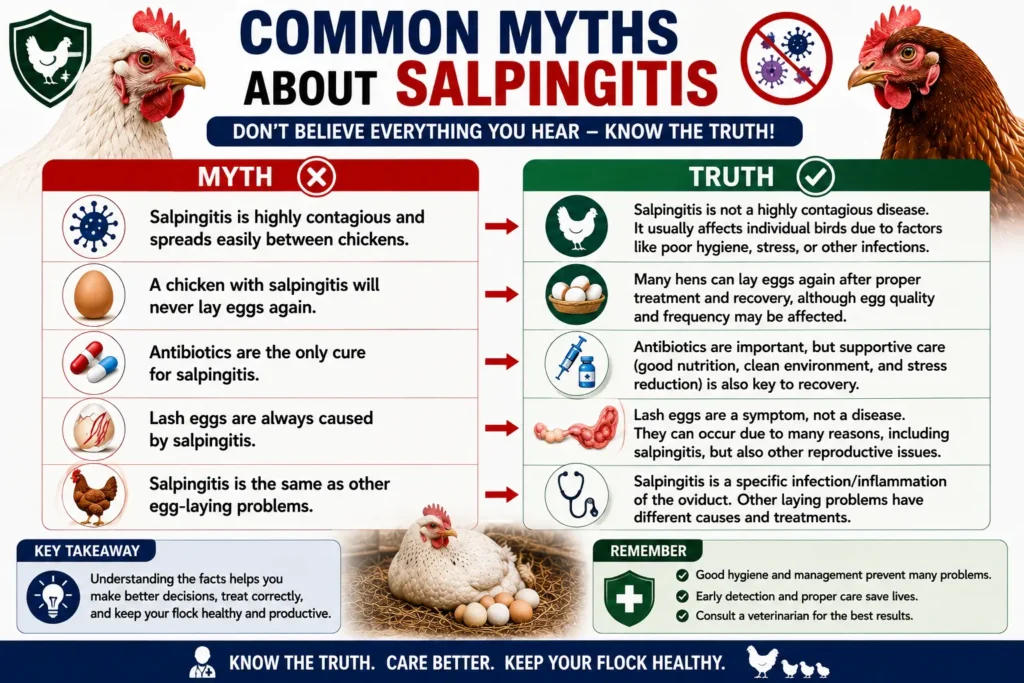
Search “lash egg” or “hen not laying” online and you’ll run into a pile of contradictory advice. Some of it is outdated. Some of it comes from forums repeating the same guess for years. That’s how so many common myths about salpingitis took hold, and why hens with this condition are so often misdiagnosed or left untreated.
Salpingitis is inflammation or infection of the oviduct, the tube that forms and moves the egg through a hen’s reproductive tract. It’s one of the leading causes of death in backyard laying hens, yet misconceptions about its causes, symptoms, and treatment keep spreading. This article separates what’s actually documented in veterinary literature from what’s just repeated folklore.
Quick Answer: Salpingitis is not caused by “too much love” from a rooster, it isn’t always visible from the outside, it isn’t automatically fatal, and it isn’t something you can reliably cure with home remedies alone. It’s a bacterial infection of the oviduct that requires veterinary evaluation for accurate diagnosis and treatment.
Table of Contents
Myth #1: Salpingitis Only Happens to Old Hens
This is one of the most common myths about salpingitis, and it leads owners to overlook symptoms in younger birds. While age-related decline in reproductive health does raise risk, salpingitis has been documented in pullets as young as their first laying season, especially high-production breeds pushed into early, frequent laying.
The real risk factors are reproductive stress, not birthdays. Breeds selected for heavy egg output, hens that started laying very young, or birds with a history of reproductive irregularities are all vulnerable regardless of age.
Read More: https://lashegg.com/when-to-call-a-veterinarian-for-chickens/
H3: Misconceptions About Age and Egg Production
A hen laying daily at full production is working her reproductive tract harder than a bird laying twice a week. That workload, not age alone, is what drives a lot of oviduct inflammation. Owners who assume “she’s young, she’s fine” sometimes miss early signs simply because they weren’t looking.
Myth #2: You Can Always See a Lash Egg If It’s Salpingitis
A “lash egg” is a solid mass of pus, tissue, and egg material that some hens pass. It’s dramatic, and it’s become the poster image for salpingitis online — which has created another one of the common myths about salpingitis: that no visible lash egg means no problem.
In reality, many hens with salpingitis never pass a visible lash egg. The inflammation can build up internally without producing anything the owner sees in the nest box. Relying on a lash egg as the sole diagnostic sign means missing a large share of actual cases.
| Sign | Always Present? | What It Actually Indicates |
| Lash egg | No — many cases never produce one | Advanced buildup of infected material |
| Reduced or stopped laying | Common, but not universal | Reproductive tract dysfunction |
| Swollen abdomen, “penguin stance” | Frequent in advanced cases | Fluid or mass buildup in the abdomen |
| Lethargy, appetite loss | Common but nonspecific | General illness, not salpingitis-specific |
| Pale comb | Sometimes | Poor circulation, advanced illness |
Myth #3: A Rooster Mating Too Much Causes Salpingitis
This misconception shows up constantly in flock forums, and it isn’t supported by veterinary literature. Salpingitis is a bacterial infection, most commonly linked to organisms like E. coli ascending into the reproductive tract, not physical trauma from mating.
Over-mating can cause separate problems — feather damage, skin injury, stress — but it isn’t the documented mechanism behind oviduct infection. Confusing the two misconceptions means owners sometimes separate a rooster from the flock while the actual bacterial cause goes untreated.
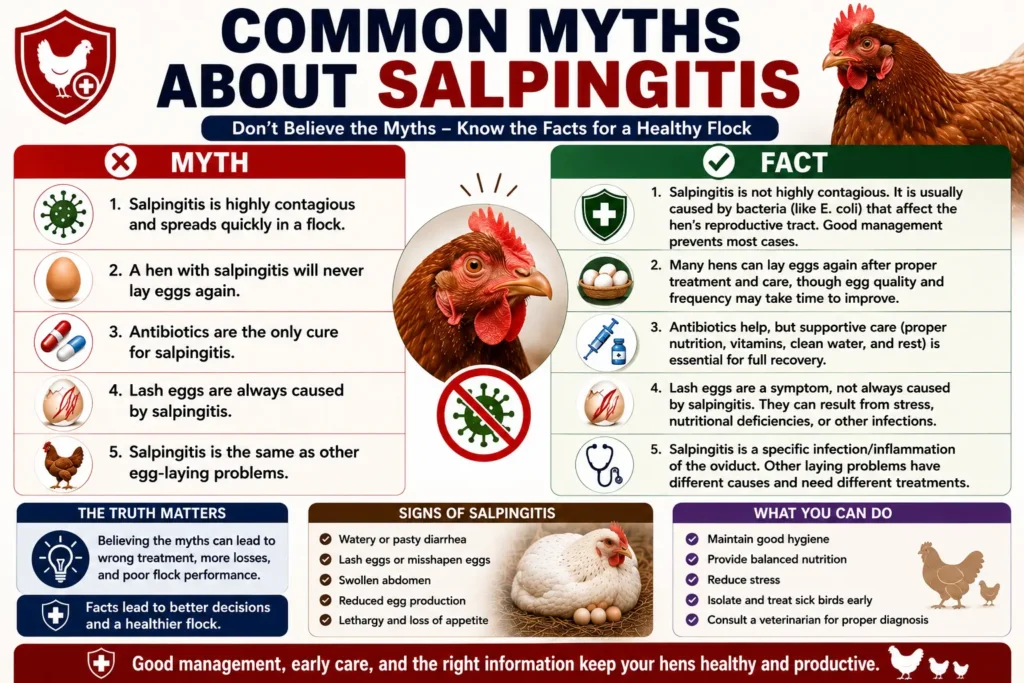
Myth #4: Salpingitis Is Always Fatal
Salpingitis carries real risk, and advanced cases are a leading cause of death in laying hens. But “always fatal” oversimplifies a condition with a real range of severity. Mild or early-stage inflammation, caught and treated with veterinary guidance, can sometimes resolve or at least be managed to extend a hen’s quality of life.
The prognosis depends heavily on how early it’s caught, how much of the oviduct is affected, and whether infection has spread into the abdominal cavity. That range is exactly why a veterinary exam — not an internet symptom checklist — determines the real outlook for an individual bird.
Warning: Advanced salpingitis with abdominal fluid buildup (sometimes called “egg yolk peritonitis”) is a serious, often poor-prognosis stage. Waiting to see if a hen “gets better on her own” at this stage usually costs valuable treatment time.
Myth #5: You Can Cure Salpingitis With Home Remedies Alone
Apple cider vinegar in the water, herbal supplements, and diet changes show up constantly as home fixes. None of these have documented evidence of resolving an active bacterial oviduct infection. General health support has a place, but it isn’t a substitute for veterinary diagnosis and, when appropriate, prescribed treatment.
This particular myth is risky because it delays real intervention. A hen given “natural remedies” for two or three weeks while the infection progresses has lost time that mattered.
H3: What Home Care Can and Can’t Do
Home care can support a hen’s comfort and general condition — clean housing, hydration, reduced stress, isolation from flock pressure. It cannot diagnose whether inflammation is bacterial, viral, or mechanical, and it cannot deliver the antibiotics or supportive treatment a veterinarian might prescribe based on an actual exam.
Myth #6: Diet Alone Prevents Salpingitis
Nutrition matters for overall reproductive health, and a poor diet can contribute to a weaker immune response. But no feeding protocol reliably prevents a bacterial infection from establishing itself in the oviduct. This oversimplification is one of the more persistent misconceptions because it offers owners a sense of control that isn’t fully backed by evidence.
Good nutrition — balanced layer feed, adequate calcium, clean water — supports a hen’s overall resistance to illness. It’s one part of prevention, not a guarantee against it.
Myth #7: If One Hen Has It, the Whole Flock Will Get It
Salpingitis is generally not considered a contagious, flock-sweeping disease the way some respiratory illnesses are. It typically develops from an individual hen’s own reproductive stress and bacterial exposure, not transmission bird-to-bird in the way owners often assume.
That said, if the whole flock shares the same underlying stressors — overcrowding, poor sanitation, breeds pushed into heavy production — multiple hens can develop it independently around the same time. That’s a shared risk factor, not contagion.
| Myth | Reality |
| Only affects old hens | Can affect young, high-production hens too |
| Always shows a visible lash egg | Many cases have no visible lash egg |
| Caused by rooster over-mating | Caused by bacterial infection, most often ascending E. coli |
| Always fatal | Prognosis varies with severity and how early it’s caught |
| Home remedies can cure it | Home care supports comfort, doesn’t treat infection |
| Diet alone prevents it | Diet supports overall health, isn’t a guarantee |
| Spreads bird-to-bird like an infection | Typically not contagious; shared risk factors can look like spread |
What Actually Causes Salpingitis
Veterinary sources point to ascending bacterial infection, most often from E. coli, as the leading documented cause. Contributing factors include:
- High egg-laying frequency and reproductive stress
- Poor sanitation in nesting and coop areas
- Prior reproductive tract abnormalities or egg-binding history
- Genetic predisposition in certain high-production breeds
- Underlying illness that weakens general immune response
Did You Know? According to sources referencing the Merck Veterinary Manual, salpingitis and related reproductive disorders are among the most common causes of mortality in commercial and backyard laying hens, which is part of why accurate information — not myths — matters so much for flock owners.
Recognizing Real Symptoms
Because so many common myths about salpingitis focus on the dramatic lash egg, it helps to know the fuller symptom picture:
- Reduced, irregular, or stopped egg-laying
- Swollen, firm, or fluid-filled abdomen
- A “penguin-like” upright stance from abdominal discomfort
- Lethargy and reduced appetite
- Pale or dull comb and wattles
- Occasional lash egg passage
- General decline in condition over days to weeks
H3: When to Call a Vet
When to Call a Vet: Contact a veterinarian if a hen stops laying and shows abdominal swelling, a hunched or upright “penguin” posture, lethargy lasting more than a day, or passes a lash egg. Early evaluation gives the best chance at effective treatment and an accurate prognosis.
How Salpingitis Is Actually Diagnosed
A veterinarian typically diagnoses salpingitis through a combination of physical exam, abdominal palpation, and sometimes imaging such as radiographs or ultrasound to check for fluid or mass in the abdomen. In some cases, bloodwork helps assess the hen’s overall infection response and organ function.
This is worth repeating because it’s where misconceptions cause the most harm: diagnosis requires a professional exam, not a checklist of symptoms matched against a forum post.
| Diagnostic Step | What It Shows |
| Physical exam | Abdominal swelling, body condition, posture |
| Palpation | Fluid or mass presence in the abdominal cavity |
| Radiographs/ultrasound | Extent of internal involvement |
| Bloodwork | General infection and organ status |
| History review | Laying pattern, breed, prior reproductive issues |
Treatment Approaches
Treatment depends on severity, and this is another area where oversimplified myths cause real harm. A veterinarian may recommend:
- Supportive care for mild or early cases — hydration, reduced stress, calcium support if needed
- Antibiotic therapy when bacterial infection is confirmed or strongly suspected, prescribed and dosed by a veterinarian
- Hormonal management in some cases, to reduce laying frequency and oviduct workload
- Surgical intervention in select advanced cases, evaluated on an individual basis
- Humane euthanasia discussion when prognosis is poor and quality of life has declined significantly
Expert Tip: Ask your veterinarian directly about prognosis at the time of diagnosis rather than relying on general online odds. Individual factors — how far the infection has progressed, the hen’s overall condition, and response to initial treatment — change the outlook case by case.
Common Mistakes Owners Make
Common Mistakes
- Waiting for a visible lash egg before taking symptoms seriously
- Blaming the rooster instead of investigating the actual bacterial cause
- Trying weeks of home remedies before contacting a vet
- Assuming a hen who “seems fine” between symptoms is recovering on her own
- Isolating a sick hen without also seeking a diagnosis for the underlying cause
Prevention: What Actually Helps
No approach guarantees prevention, but these habits reduce documented risk factors:
- Keep nesting boxes and coop bedding clean and dry
- Choose feed appropriate for your hens’ life stage and production level
- Avoid pushing pullets into very early, high-frequency laying where possible
- Monitor high-production breeds more closely as they age
- Address egg-binding or reproductive irregularities early rather than waiting
- Reduce overcrowding and general flock stress
Final Thoughts
The common myths about salpingitis persist because the condition is confusing, the symptoms overlap with other illnesses, and dramatic images of lash eggs spread faster online than nuanced medical explanations. The reality is more specific: it’s a bacterial infection with a range of severity, not a mysterious curse tied to age, mating, or diet alone.
Watch your flock for the fuller set of symptoms, not just the one dramatic sign everyone talks about. When a hen shows abdominal swelling, stopped laying, or ongoing lethargy, treat it as worth a veterinary opinion rather than a guessing game based on things you’ve read online.
FAQ
What are the most common myths about salpingitis in chickens? The most common myths about salpingitis include the beliefs that it only affects old hens, always produces a visible lash egg, is caused by rooster over-mating, is always fatal, and can be cured with home remedies. None of these hold up against veterinary evidence.
Can salpingitis be cured? Some cases, especially mild or early-stage ones caught quickly, can be managed or resolved with veterinary treatment such as antibiotics and supportive care. Advanced cases with abdominal fluid buildup carry a more guarded prognosis.
Is salpingitis contagious to other hens? It’s not generally considered a contagious disease spread bird-to-bird. Multiple hens in one flock can develop it around the same time because they share the same underlying risk factors, not because it transmits like a respiratory illness.
Does a rooster cause salpingitis by mating too often? No. This is one of the most persistent misconceptions. Salpingitis is caused by bacterial infection of the oviduct, most often linked to ascending E. coli, not physical trauma from mating.
How do I know if my hen has salpingitis without a lash egg? Watch for stopped or irregular laying, abdominal swelling, an upright “penguin” posture, lethargy, and appetite loss. A veterinarian can confirm the diagnosis through physical exam and imaging even without a visible lash egg.
Is salpingitis more common in certain breeds? High-production laying breeds that lay eggs very frequently tend to show higher documented rates, since their reproductive tracts are under more consistent workload.