
How Long Do Chickens Lay Eggs? The Realistic Timeline

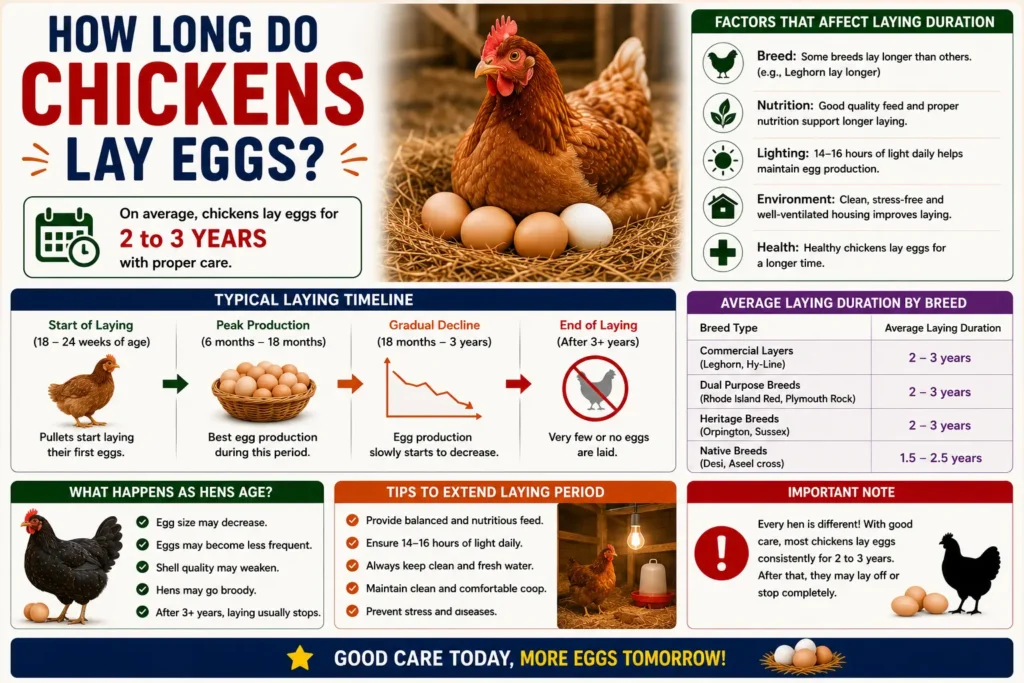
How long do chickens lay eggs is a question every keeper eventually asks, usually right around the time a favorite hen’s production starts to slow. The honest answer involves a curve, not a fixed number: most hens lay heavily for their first two years, then gradually decline over the following several years.
This guide breaks down the full chicken egg production lifespan, what a hen’s laying years typically look like decade by decade, well, year by year, and the specific factors that push some hens toward longer or shorter productive spans than others.
Quick Answer: Chickens typically lay eggs consistently for about 2 to 3 years, with peak production in year one. Total laying years can extend to 5 to 8 years or more, though frequency drops steadily each year. Most hens live 5 to 10 years, meaning many spend their later years laying only occasionally or not at all.
Table of Contents
The Laying Curve: Year by Year
What a Typical Hen’s Production Looks Like Over Time
| Age | Typical Laying Pattern |
| 18–24 weeks | First eggs begin, gradually increasing |
| Year 1 | Peak production, often 250–300+ eggs for hybrids |
| Year 2 | Slight decline, still strong production |
| Year 3 | Noticeable decline, roughly 10–20% fewer eggs than year one |
| Year 4–5 | Continued decline, more seasonal variation |
| Year 6+ | Sparse, inconsistent laying; some hens stop entirely |
Why Production Declines Gradually Rather Than Stopping Suddenly
A hen is born with a finite number of egg cells already present in her ovaries, and each year of laying draws down that reserve. Combined with natural aging of the reproductive system, this explains why chicken egg production lifespan follows a gradual downward curve rather than an abrupt cutoff.
How Long Do Chickens Lay Eggs by Breed Type
Production Breeds vs. Heritage Breeds
Production-focused hybrids are bred to lay heavily and consistently in their first couple of years but tend to decline faster afterward. Heritage breeds often start slower but can maintain more moderate, steady laying years spread across a longer overall lifespan.
| Breed Type | Peak Laying Years | Total Laying Years (Realistic) |
| Production hybrids | Year 1–2 | 3–5 years total |
| Standard dual-purpose | Year 1–3 | 5–7 years total |
| Heritage breeds | Year 1–3, more gradual decline | 6–8+ years total |
Why This Trade-Off Exists
Breeding for maximum early egg output generally comes at the cost of a shorter overall productive lifespan, while breeds developed for general hardiness tend to spread more modest production across more years.
Did You Know? The record for total eggs laid by a single hen in one year is well over 350, though this level of output is far beyond what most backyard hens produce and reflects highly specialized commercial breeding lines.
Read More: https://lashegg.com/when-do-chickens-start-laying-eggs/
Factors That Affect Chicken Egg Production Lifespan
1. Genetics and Breed
As covered above, breed selection has the single biggest impact on both peak output and how long laying years extend across a hen’s life.
2. Nutrition Throughout Life
Consistent access to a complete, balanced layer feed supports steady production for longer, while poor nutrition can shorten productive years and increase the risk of reproductive problems.
3. Overall Health
Hens who avoid chronic parasite loads, recurring infections, and reproductive disease tend to maintain more consistent laying over a longer span than hens with a history of health issues.
4. Molting Patterns
Hens who molt on a healthy annual cycle typically return to strong production afterward, while those with irregular or prolonged molting may show more inconsistent laying years overall.
5. Living Conditions
Adequate space, low stress, and protection from predators and extreme weather all support a hen’s body in maintaining steady production for a longer portion of her life.
When Laying Slows: What’s Normal Aging vs. a Problem
| Pattern | Likely Explanation | Action Needed |
| Gradual yearly decline | Normal aging | None, expected |
| Sudden stop at a young age | Possible illness or stress | Investigate further |
| Stops entirely by year 2–3 | Unusual for most breeds | Health check recommended |
| Occasional eggs into year 6+ | Normal for a long-lived hen | None, expected |
Distinguishing Age From Illness
A gradual decline over successive years, especially one that lines up with molting cycles and seasonal daylight changes, is a normal part of how long chickens lay eggs across a full lifespan. A sudden stop, especially paired with lethargy, weight loss, or other symptoms, points toward a health cause rather than simple aging.
Supporting Hens Through Their Laying Years
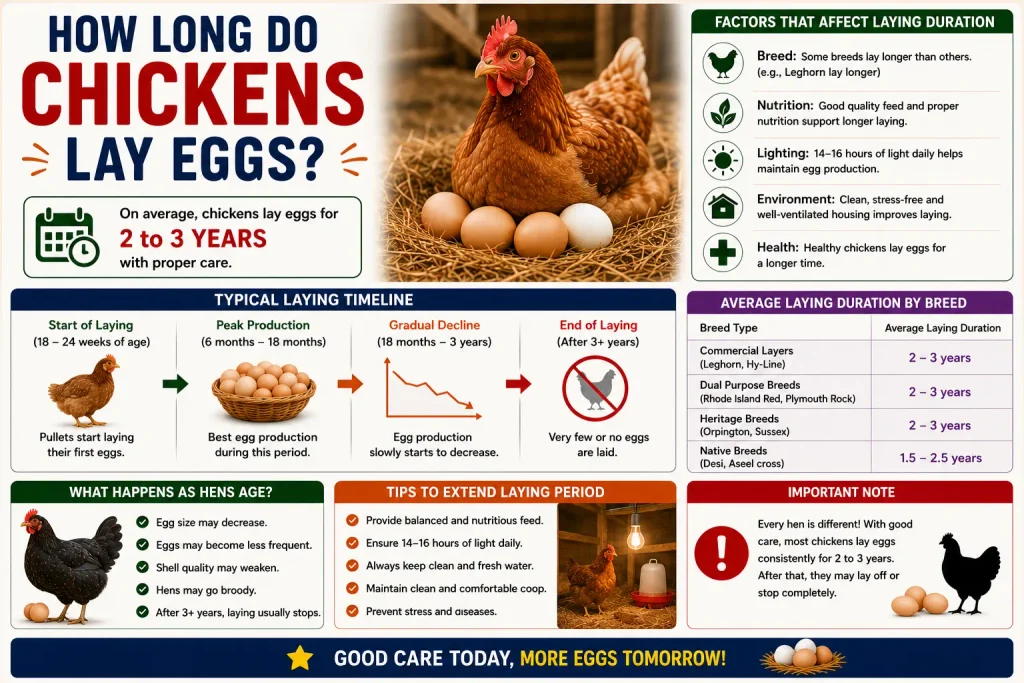
Step-by-Step: Extending Healthy Production
- Feed a complete layer diet consistently. Adequate protein and calcium throughout a hen’s life support both current laying and long-term reproductive health.
- Manage body weight. Both underweight and overweight hens tend to show shorter, less consistent laying years than hens maintained at a healthy weight.
- Reduce chronic stress. Predator-proof housing, adequate space, and stable routines all support more consistent production over time.
- Address health issues early. Treating parasites and infections promptly helps prevent lasting damage to the reproductive system.
- Allow natural rest periods. Letting hens pause during molting and winter, rather than forcing year-round production, may support a longer overall productive lifespan.
Expert Tip
Keep per-hen laying records rather than judging the flock as a whole. A flock’s total egg count can look steady even as individual older hens decline, simply because younger birds are picking up the slack, which can mask how an aging hen’s personal laying years are actually progressing.
Common Mistakes to Avoid
- Assuming a hen has stopped laying for good the moment output drops, rather than checking for normal seasonal or age-related decline
- Forcing continuous production with aggressive lighting well into a hen’s later laying years
- Culling hens for reduced output without considering their non-laying value, such as pest control or companionship
- Ignoring sudden, severe drops in young hens as “just normal decline” when it may signal illness
- Overlooking nutrition adjustments as hens age into their later laying years
Warning
A sudden, complete stop in egg production in a hen still within her expected peak laying years, especially paired with lethargy, weight loss, or vent discharge, should not be dismissed as normal aging. These signs suggest an underlying health issue rather than a typical decline.
When to Call a Vet
Contact a poultry veterinarian if a hen’s egg production drops suddenly and significantly outside the expected pattern for her age, especially alongside lethargy, weight loss, vent discharge, or a swollen abdomen. A vet visit is also reasonable if a hen well within her expected laying years shows a decline that doesn’t match typical seasonal or molting patterns.
People Also Ask
How long do chickens lay eggs before stopping completely? Most hens lay consistently for 2 to 3 years, with declining but continued production for several more years, and some hens lay occasionally into their sixth year or beyond.
Do chickens lay eggs their whole life? No, egg-laying naturally slows and eventually stops well before a hen’s full lifespan ends, since hens can live 5 to 10 years while active laying years are typically shorter.
What is the average chicken egg production lifespan for backyard hens? Most backyard hens provide meaningful production for around 3 to 5 years, though this varies significantly by breed and individual health.
Does breed affect how many total laying years a hen has? Yes, production hybrids often peak hard early but decline faster, while heritage breeds tend to spread more moderate production across additional laying years.
Can a hen’s laying years be extended with better care? Yes, consistent nutrition, low stress, a healthy weight, and prompt treatment of health issues can all support more consistent production across a longer span of a hen’s life.
Final Thoughts
How long do chickens lay eggs comes down to a gradual curve shaped by breed, health, and care rather than a single fixed number. Most hens peak in their first year or two, decline steadily afterward, and may continue laying occasionally for several more years depending on genetics and overall condition.
Track each hen’s individual laying pattern over time, and reach out to a poultry veterinarian if a decline in laying years looks sudden or severe rather than the gradual pattern that’s typical of normal aging.
5. FAQ
Q: How long do chickens lay eggs at their peak production level? A: Peak production typically lasts through the first one to two years, after which most hens show a gradual, steady decline in output.
Q: What is the longest chicken egg production lifespan on record for backyard breeds? A: While exceptions exist, most well-cared-for hens continue occasional laying into their sixth to eighth year, though frequency by that point is usually low.
Q: Do all hens have the same number of laying years? A: No, laying years vary significantly by breed, individual health, and care, with production hybrids generally showing shorter productive spans than heritage breeds.
Q: Does molting shorten a hen’s total laying years? A: No, healthy annual molting is a normal part of the laying cycle and doesn’t shorten overall laying years; it actually supports continued production afterward.
Q: Is it normal for older hens to lay fewer, larger eggs? A: Yes, many hens produce fewer but occasionally larger eggs as they age, reflecting the natural changes in their reproductive system over time.