Rubber Egg vs Soft Shell Egg: What’s Actually Different?

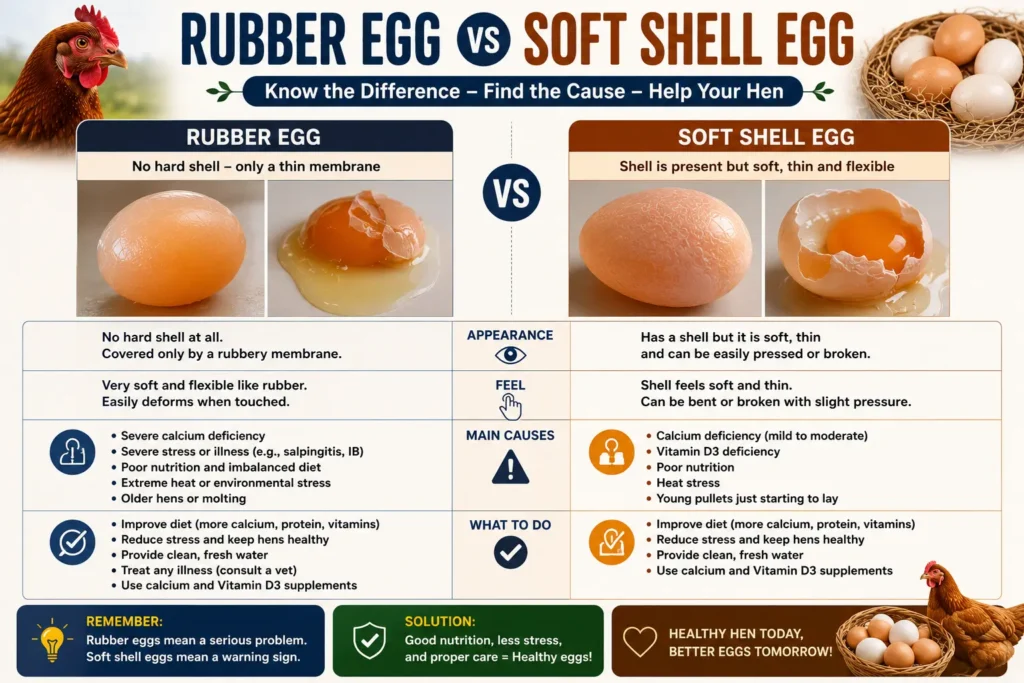
Rubber egg vs soft shell egg is a comparison that trips up even experienced keepers, because both terms describe an egg that came out without a proper hard shell. The real difference comes down to degree: one has no shell coverage at all, while the other has a thin, partial shell that still holds some shape.
That distinction matters more than it sounds like it would. It can point you toward a slightly different cause, and it changes what you should watch for next. This guide breaks down exactly how to tell them apart, what causes each one, and which situations call for a vet instead of a diet fix.
Table of Contents
Quick Answer
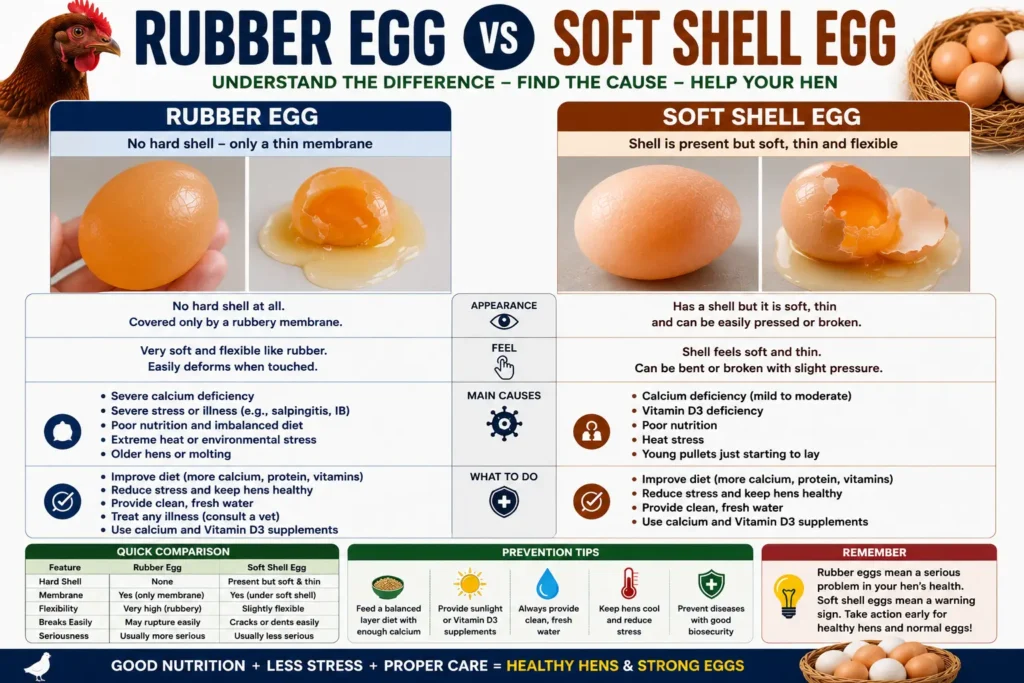
A rubber egg has no shell at all, only a stretchy membrane. A soft shell egg has a thin, flexible shell that still partly covers the egg. Both usually share the same root causes — calcium deficiency, stress, or age — but a soft shell egg means the shell gland got further along in the process before the egg was laid.
Side-by-Side Comparison
| Feature | Rubber Egg | Soft Shell Egg |
| Shell coverage | None — membrane only | Thin, partial, flexible shell present |
| Feel | Squishy, like a small water balloon | Bends without snapping, leathery texture |
| What it suggests | Shell gland process interrupted very early or skipped entirely | Some calcium was deposited, just not enough to harden fully |
| Visual appearance | Translucent, wrinkled membrane | Dull, chalky, or slightly textured thin shell |
| Common nicknames | Rubbery egg, leathery egg, shell-less egg | Thin-shelled egg, soft egg |
| Severity if repeated | Can indicate a more significant calcium or health issue | Often an earlier warning sign of the same underlying issue |
Why the Difference Happens
Every egg spends roughly 19 to 20 hours inside the shell gland, or uterus, where calcium carbonate is layered onto the membrane to build a hard shell. A rubber egg happens when this stage is skipped almost entirely. A soft shell egg happens when the process starts but doesn’t finish, leaving a thin, underbuilt shell instead of no shell at all.
Think of it as two points on the same timeline rather than two separate problems. The same root causes push a hen toward one outcome or the other, depending on how severe or how sudden the disruption is.
Did You Know?
A hen can lay a rubber egg one day and a soft shell egg the next, especially during a short-term calcium dip. The severity often shifts day to day as her calcium levels fluctuate, rather than staying fixed at one type.
Shared Causes Behind Both Rubber Eggs and Soft Shell Eggs
1. Calcium Deficiency
The leading cause of both. A laying hen needs roughly 3.5–4.5 grams of calcium daily, and a shortfall — even a mild one — reduces shell strength before it disappears entirely.
2. Vitamin D3 Deficiency
Calcium intake alone isn’t enough without adequate D3 to help the body absorb and use it, whether from sunlight or a fortified feed.
3. Acute Stress
A predator scare, a new flock member, or a sudden loud noise can rush an egg through the shell gland, cutting shell-building time short in either direction.
4. Age of the Hen
New pullets and hens past their second or third laying year are both prone to weaker or missing shells as their reproductive system calibrates or naturally slows down.
5. Heat Stress
Hot weather reduces feed intake and speeds up how quickly an egg moves through the reproductive tract, pushing toward either outcome depending on severity.
6. Infectious Disease
Infectious bronchitis virus is well documented as a cause of both soft-shelled and shell-less eggs. Per the Merck Veterinary Manual, this virus directly affects the reproductive tract in laying hens and typically comes with a broader, flock-wide drop in egg production, which helps distinguish it from a simple dietary cause.
Read More: https://lashegg.com/what-causes-rubber-eggs/
Does One Type Signal a Bigger Problem Than the Other?
Not necessarily on its own. A single soft shell egg or a single rubber egg from an otherwise healthy hen usually points to the same manageable causes: diet, stress, or age. What matters more than which type you find is the pattern over time.
| Situation | What It Likely Means |
| One rubber egg, one time | Usually diet, stress, or age — not urgent |
| One soft shell egg, one time | Same as above — not urgent |
| Repeated rubber eggs from the same hen | Worth a closer look at ongoing calcium/D3 intake |
| Progression from soft shell to rubber egg over days | Suggests a worsening calcium deficit that needs quicker correction |
| Multiple hens affected by either type at once | Raises suspicion of infectious disease over diet |
Expert Tip
If you notice a hen’s eggs sliding from soft shell to fully rubbery over a few days, treat that as a signal to act faster, not slower. It usually means her calcium reserves are dropping further, not stabilizing on their own.
How to Respond to Either Type
Step-by-Step Action Plan
- Identify which hen is affected, if possible, by watching the nest box.
- Audit the diet. Confirm a complete layer feed makes up most of the intake.
- Add free-choice oyster shell in a separate dish, not mixed into feed.
- Check sunlight or D3-fortified feed access.
- Think back on recent stress, including new birds, predators, or a coop change.
- Track the pattern for a week, noting whether it’s a single egg or a repeated issue.
- Watch for other symptoms: coughing, sneezing, lethargy, or a flock-wide drop in production.
- Contact a vet if the pattern worsens, spreads to other hens, or continues past one to two weeks.
Common Mistakes When Comparing the Two
- Assuming a soft shell egg is automatically less serious than a rubber egg
- Treating each egg as an isolated event instead of tracking the pattern over several days
- Mixing oyster shell into feed instead of offering it free-choice
- Overlooking heat or stress as a shared trigger for both types
- Waiting too long to act when soft shell eggs are clearly progressing toward rubber eggs
When Either Type Points to Something Serious
Warning
Treat it as more than a diet issue if you see:
- Multiple hens laying rubber or soft shell eggs in the same week
- A clear drop in total flock egg production
- Respiratory symptoms: coughing, sneezing, nasal discharge
- Lethargy, reduced appetite, or ruffled feathers
- Signs of egg binding: straining, a wide stance, visible abdominal swelling
- Either type continuing past one to two weeks despite dietary correction
When to Call a Vet
See a poultry veterinarian if a rubber egg or soft shell egg pattern continues beyond a week of consistent home correction, affects more than one hen, or comes with respiratory or behavioral symptoms. The Merck Veterinary Manual notes that infectious causes of poor shell quality typically present as a flock-wide production drop, which is a reliable way to separate a disease-driven case from a nutritional one, regardless of which shell type appears.
Treatment Comparison
| Cause | Rubber Egg Treatment | Soft Shell Egg Treatment |
| Calcium deficiency | Free-choice oyster shell, layer feed | Same approach, often faster resolution |
| Vitamin D3 deficiency | Sunlight, fortified feed | Same approach |
| Stress | Remove trigger, stabilize routine | Same approach |
| Heat stress | Shade, cool water, electrolytes | Same approach |
| Infectious disease | Vet-directed supportive care | Vet-directed supportive care |
Recovery timelines are also similar: most diet and stress-related cases of either type improve within three to seven days once calcium and D3 support are in place, while infectious causes follow a longer, vet-guided timeline.
Prevention: One Plan Covers Both
Because rubber eggs and soft shell eggs share nearly identical root causes, one prevention plan covers both outcomes.
- Feed a complete, age-appropriate layer ration as the core of the diet
- Offer free-choice crushed oyster shell at all times
- Ensure consistent sunlight exposure or D3-fortified feed
- Maintain 14–16 hours of daylight for actively laying hens
- Build a low-stress, predator-proof coop environment
- Prepare for heat waves with shade and constant water access
- Practice solid biosecurity to reduce disease risk
- Reassess flock nutrition every few months, especially as hens age
Whichever one you find in the nest box, the underlying story is usually the same: a shell gland that didn’t get enough time or enough calcium to finish the job. Track the pattern, correct the diet and environment first, and bring in a vet if either type keeps showing up or spreads across the flock.
5. FAQ
What is the real difference between a rubber egg vs soft shell egg? A rubber egg has no hard shell at all, only membrane, while a soft shell egg has a thin, flexible shell that still partially covers the egg.
Do rubber eggs and soft shell eggs have the same causes? Yes, largely. Both are most often caused by calcium deficiency, vitamin D3 deficiency, stress, age, heat, or occasionally infectious disease.
Is a soft shell egg less serious than a rubber egg? Not necessarily. Severity depends more on the pattern over time than on which type appears. A worsening trend from soft shell to rubber eggs deserves quicker attention.
Can the same hen lay both types? Yes. A hen’s calcium status can fluctuate day to day, so she may lay a soft shell egg one day and a fully rubber egg the next during a calcium dip.
How do I treat a rubber egg or soft shell egg at home? Offer free-choice oyster shell, confirm a complete layer feed, ensure vitamin D3 exposure, and reduce stress. Most cases improve within a week.
When should I worry about either type? Worry if the pattern continues past one to two weeks, affects multiple hens, or comes with respiratory symptoms, lethargy, or signs of egg binding.