Why Chickens Peck Each Other: More Than Just Hierarchy

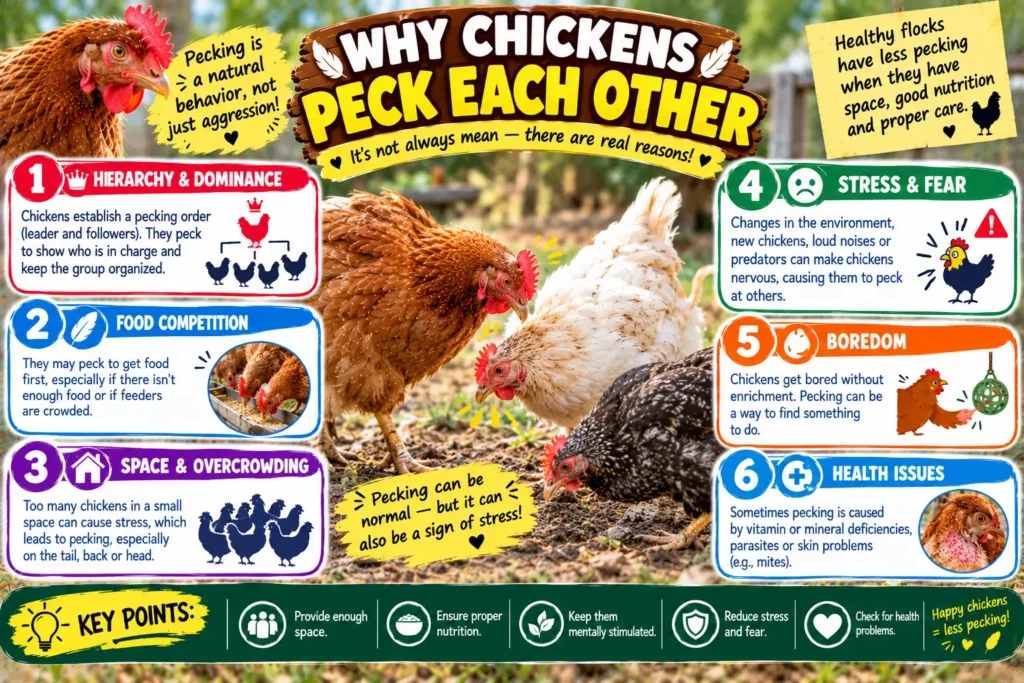
Why chickens peck each other has more than one answer. Normal social hierarchy, covered in depth elsewhere, explains a good portion of it, but aggressive chickens can also be reacting to boredom, overcrowding, nutritional gaps, or a specific, more serious phenomenon: pecking triggered by visible injury or blood.
This guide works through the full range of causes beyond basic hierarchy, including chicken bullying that escalates into genuinely dangerous territory, so you can identify what’s actually driving the behavior in your specific flock.
Quick Answer: Chickens peck each other for several reasons: establishing normal social hierarchy, boredom or overcrowding, nutritional deficiencies, and a serious pattern where visible blood or injury attracts increasingly aggressive pecking that can escalate to cannibalism. Identifying which cause applies determines whether you need to simply monitor, adjust management, or intervene urgently.
Table of Contents
Hierarchy-Related Pecking: The Baseline
Quick Recap
Normal pecking order establishment explains a large share of chicken bullying that isn’t actually a problem, particularly in new flocks or after introducing new birds. The full mechanics of this, and when it crosses into a genuine issue, are covered in the dedicated pecking order guide.
| Sign | Normal Hierarchy | True Problem |
| Timing | Settles within 1-2 weeks | Continues indefinitely |
| Injury | Minimal or none | Visible wounds |
Boredom and Overcrowding
Why Confinement Drives Pecking
Chickens with insufficient space or environmental stimulation, especially during extended bad weather confinement, often redirect natural foraging and pecking instincts toward flock mates instead of the environment.
Practical Fixes
- Increase available space per bird, both in the coop and run
- Add enrichment items like hanging vegetables or foraging toys
- Provide a dust bath area to support natural behavior
- Reduce overall flock density if consistently overcrowded
| Contributing Factor | Fix |
| Insufficient space | Increase coop/run square footage |
| Lack of stimulation | Add enrichment, foraging opportunities |
| Extended confinement | Provide indoor enrichment during bad weather |
Did You Know? Chickens have a strong innate drive to peck and forage for roughly a significant portion of their waking hours; when this drive isn’t satisfied by the environment, redirecting it toward flock mates is a well-documented behavioral outcome.
Nutritional Deficiencies
The Protein Connection
Inadequate dietary protein, particularly relevant during molting when feather regrowth demands increase significantly, is a recognized contributor to increased pecking and even feather-eating behavior in some flocks.
Other Nutritional Factors
Salt deficiency has historically been associated with increased pecking behavior in commercial poultry settings, though backyard flocks on complete, balanced feed rarely encounter this specific issue.
Read More: https://lashegg.com/chicken-pecking-order/
| Deficiency | Pecking-Related Effect |
| Protein | Increased pecking, feather-eating |
| Salt (rare in complete feed) | Historically linked to pecking in some settings |
The Serious Pattern: Injury-Attracted Pecking and Cannibalism
Why This Is Different From Other Causes
Chickens are strongly visually attracted to the color red and to open wounds, meaning even a minor injury, a small cut, a prolapse, or excessive redness around the vent, can trigger escalating pecking from flock mates that quickly worsens the original injury. egg
Common Triggers
- A minor injury or scratch that becomes a pecking target
- Vent prolapse, which presents visible pink or red tissue
- A hen with vent-area irritation from another cause, like vent gleet
- Blood from a broken feather shaft during molt
Step-by-Step: Responding to Injury-Attracted Pecking
- Remove the injured or targeted bird immediately. This is the single most urgent step, since continued exposure worsens the injury rapidly.
- Clean and assess the wound. Determine whether the injury needs veterinary attention beyond basic first aid.
- Apply a poultry-safe wound treatment. Products designed to mask the appearance of blood and injury can help if reintroduction becomes necessary before full healing.
- Keep the bird separated until fully healed. Reintroducing too early risks the same targeting resuming.
- Identify and address the root cause of the original injury. Whether it was another pecking incident, an accident, or a health issue, preventing recurrence matters.
| Trigger | Escalation Risk | Urgency |
| Minor cut/scratch | Moderate to high | Address same day |
| Vent prolapse | Very high | Urgent, often needs vet involvement |
| Vent irritation (other cause) | Moderate to high | Address underlying cause + separate |
| Molt-related blood feather | Moderate | Monitor closely, separate if targeted |
Warning
Injury-attracted pecking can escalate to true cannibalism remarkably quickly once blood is visible to the flock. A bird showing any open wound, especially around the vent, needs immediate separation rather than a wait-and-see approach, since delay can result in severe injury or death within hours.
Comparing the Causes of Aggressive Chickens
| Cause | Key Sign | Urgency Level |
| Normal hierarchy | Settles within 1-2 weeks, minimal injury | Low, monitor only |
| Boredom/overcrowding | Ongoing, tied to space/stimulation | Moderate, address management |
| Nutritional deficiency | Coincides with molt or poor diet | Moderate, correct diet |
| Injury-attracted pecking | Visible wound present, rapid escalation | High to urgent |
Preventing Chicken Bullying Before It Starts
Step-by-Step: A Preventive Approach
- Provide adequate space per bird from the start. This addresses one of the most common root causes across multiple categories.
- Offer environmental enrichment consistently, not just during obvious boredom periods. Dust baths, foraging opportunities, and varied treats all help.
- Feed a complete, appropriate diet matched to life stage and season. This reduces nutritionally-driven pecking behavior.
- Do routine health checks to catch injuries early. Catching a minor wound before flock mates do prevents the injury-attraction cycle entirely.
- Introduce new birds thoughtfully. Gradual introduction reduces the intensity of hierarchy-related pecking during flock changes.
Common Mistakes to Avoid
- Assuming all pecking is simply normal pecking order without checking for other causes
- Missing a minor injury before it attracts escalating attention from flock mates
- Overlooking overcrowding as a root cause of ongoing aggressive behavior
- Waiting to separate an injured bird, allowing pecking to worsen the wound
- Not addressing the underlying cause after resolving an immediate incident
When to Call a Vet
Contact a poultry veterinarian immediately if a bird has sustained a significant injury from pecking, particularly involving the vent area or if bleeding is substantial, since these situations can escalate quickly and may need professional wound care beyond basic first aid.
People Also Ask
Why do chickens peck each other’s feathers specifically? Feather pecking can stem from boredom, nutritional deficiency, particularly protein during molt, or occasionally hierarchy-related behavior, making the underlying cause important to identify for effective correction.
Can aggressive chickens ever fully stop the behavior? Yes, addressing the specific underlying cause, whether that’s space, nutrition, or a triggering injury, typically resolves the behavior, though normal hierarchy-related pecking never fully disappears and isn’t meant to.
How fast can chicken bullying turn into cannibalism? Once a wound is visible and attracting attention, escalation can happen within hours, making prompt separation of an injured bird a genuine priority rather than something to monitor casually.
Do certain chicken breeds peck more than others? Yes, some breeds are known for more assertive or higher-energy temperaments, making them somewhat more prone to pecking-related behavior, though management factors matter just as much as breed tendency.
Is red pecking deterrent spray effective for aggressive chickens? Products designed to mask the appearance of blood or redness can help prevent escalation on an existing wound, though they work best combined with actual separation of the injured bird rather than as a standalone solution.
Final Thoughts
Why chickens peck each other has several possible answers beyond simple hierarchy: boredom, overcrowding, nutritional gaps, and the particularly serious pattern of injury-attracted pecking that can escalate into cannibalism. Identifying which cause applies to your specific situation determines whether the right response is patience, management changes, or urgent separation.
Watch closely for any visible injury as your highest-priority warning sign, and reach out to a poultry veterinarian promptly if pecking has caused significant injury, particularly involving the vent area.
5. FAQ
Q: Why do chickens peck each other even in a spacious, well-fed flock? A: Normal pecking order establishment still occurs regardless of space and nutrition, meaning some pecking is expected even in an otherwise ideal setup, especially with new birds.
Q: What’s the difference between chicken bullying and normal pecking order behavior? A: Bullying involves visible injury, resource blocking, or intensity well beyond a typical 1-2 week adjustment period, while normal pecking order behavior settles on its own without lasting harm.
Q: Can aggressive chickens be a sign of an underlying health issue? A: Sometimes, particularly if the aggression coincides with nutritional deficiency or if the target bird has an underlying condition like vent irritation attracting pecking.
Q: How do I stop chickens from pecking at a specific injured flock mate? A: Immediate separation of the injured bird, wound treatment, and use of a pecking deterrent product if reintroduction is needed before full healing are the most effective steps.
Q: Does adding more chickens to a flock increase pecking problems? A: It can, particularly if space and resources aren’t increased proportionally, since overcrowding is one of the most common contributors to aggressive pecking beyond normal hierarchy establishment.