Causes of Egg Peritonitis: Why Yolk Ends Up Where It Shouldn’t

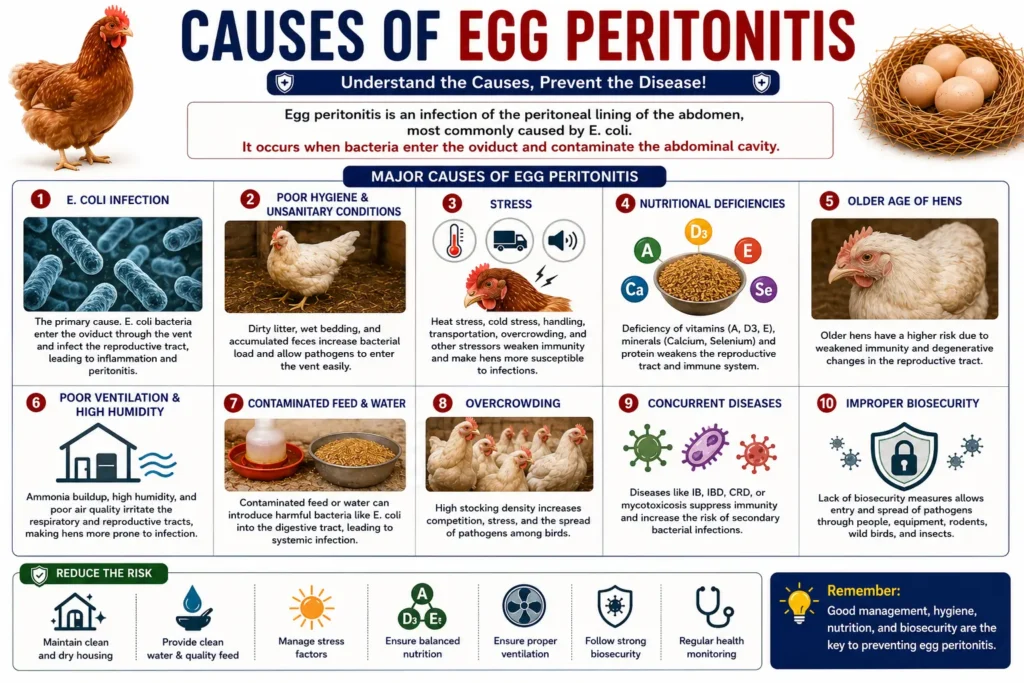
The causes of egg peritonitis all trace back to one basic failure: yolk material escaping into a hen’s abdomen instead of traveling normally down the oviduct. Once that happens, the body reacts to the yolk as foreign matter, and bacteria often join in, turning a mechanical problem into a serious infection.
This condition, also called egg yolk peritonitis (EYP), is one of the most common reproductive problems in backyard and commercial laying hens. Understanding what actually causes egg peritonitis — rather than just treating the symptoms — is the key to preventing it from happening again.
Below is a breakdown of every known trigger, from the mechanical to the bacterial to the genetic, along with how each one plays out inside a hen’s body.
Table of Contents
Quick Answer: The causes of egg peritonitis include ovulation errors where the infundibulum misses the yolk, oviduct blockages or ruptures, ascending bacterial infections like salpingitis, internal egg breakage, obesity, high-production breeding, and age-related reproductive decline.
How the Chicken Reproductive System Normally Works
A hen releases one yolk at a time from her ovary. The infundibulum, a funnel-shaped structure at the top of the oviduct, is supposed to catch that yolk within about 15–30 minutes. From there, the yolk moves through the magnum (where albumen forms), the isthmus (shell membranes), and the shell gland (where the shell hardens), emerging as a finished egg roughly 24–26 hours later.
Every cause of egg peritonitis is really a breakdown somewhere in this chain. When you understand the normal pathway, the reasons things go wrong make a lot more sense.
Read More: https://lashegg.com/egg-peritonitis-treatment/
The Primary Causes of Egg Peritonitis
1. Ovulation Errors (Missed Yolk Capture)
This is the most direct of all causes of egg peritonitis. If the infundibulum fails to catch a released yolk — due to inflammation, scarring, or simple timing failure — the yolk falls straight into the abdominal cavity. The body cannot reabsorb large amounts of yolk quickly, so it sits there, triggering inflammation.
2. Salpingitis (Oviduct Infection)
Salpingitis is inflammation or infection of the oviduct, usually caused by bacteria such as E. coli, Salmonella, or Mycoplasma species ascending from the cloaca. Left untreated, this infection can spread to surrounding tissue and is one of the most frequent bacterial causes of egg peritonitis.
3. Oviduct Blockage or Impaction
A partially formed or misshapen egg can lodge in the oviduct. Pressure builds behind it, and in some cases the oviduct wall ruptures, spilling egg material directly into the abdomen.
4. Internal Egg Rupture
Soft-shelled or thin-shelled eggs are more fragile inside the body. If one breaks before it’s laid, its contents leak into the coelomic cavity rather than passing out normally — a mechanical cause that’s easy to overlook.
5. Obesity and Excess Body Fat
Fat deposits around the reproductive tract can physically interfere with the infundibulum’s ability to capture yolk and can compress the oviduct. Overweight hens, especially those on high-calorie treats or scratch-heavy diets, show this pattern more often.
6. High Egg-Production Genetics
Modern hybrid layers are bred to ovulate far more frequently than their wild ancestors. Every additional ovulation cycle is another chance for something to go wrong, which is why heavy-laying breeds like production Leghorns and commercial hybrids appear disproportionately in peritonitis cases.
7. Age-Related Reproductive Decline
Hens over two to three years old show more oviduct scarring, reduced elasticity, and a higher rate of abnormal ovulations. Age doesn’t cause egg peritonitis directly, but it steadily raises the odds.
8. Stress and Environmental Disruption
Sudden stress — predator scares, overcrowding, extreme temperature swings, or abrupt diet changes — can disrupt the normal laying cycle and increase the rate of malformed or poorly timed eggs.
Causes of Egg Peritonitis at a Glance
| Cause | Category | Typical Onset |
| Missed yolk capture by infundibulum | Mechanical | Any age, more common in older hens |
| Salpingitis (bacterial infection) | Infectious | Any age |
| Oviduct blockage or rupture | Mechanical | Often linked to abnormal eggs |
| Internal egg breakage | Mechanical | Soft-shell-prone hens |
| Obesity | Metabolic | Overfed or low-activity flocks |
| High-production genetics | Genetic/breeding | Hybrid layers, commercial breeds |
| Age (2+ years) | Physiological | Gradual, cumulative risk |
| Acute stress | Environmental | Sudden onset after a stress event |
What Causes Egg Peritonitis to Become an Infection Rather Than Just Inflammation?
Yolk itself is sterile when it’s released, so the initial reaction is inflammatory, not infectious. But yolk is also a rich nutrient source, and bacteria already present in the abdomen — or bacteria that migrate from the oviduct or cloaca — multiply quickly once they reach it. Within days, sterile inflammation can become a full bacterial infection, which is why fast diagnosis matters so much.
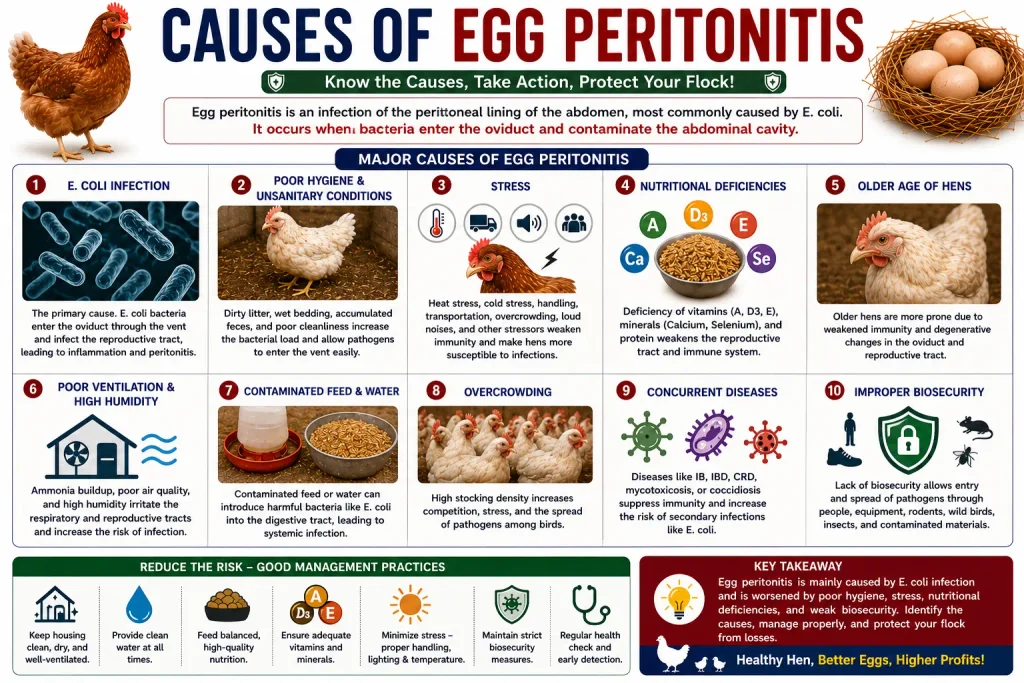
Yolk Peritonitis Causes: Are They Different From “Egg” Peritonitis Causes?
Not really — “yolk peritonitis” and “egg peritonitis” describe the same underlying event, just with slightly different emphasis. Yolk peritonitis causes focus specifically on the yolk material escaping into the abdomen, while “egg peritonitis” is sometimes used more broadly to include cases involving fully or partially shelled egg material. In practice, vets and researchers use the terms interchangeably.
Risk Factors That Increase Susceptibility
- Breed: hybrid layers and heavy production breeds carry higher lifetime risk
- Diet: excess calcium, imbalanced protein, or overly rich treats
- Housing: cramped or unsanitary conditions that raise bacterial exposure
- Reproductive history: hens with prior soft-shelled or misshapen eggs
- Lack of molting breaks: continuous laying without a rest period
- Genetics within a flock: some bloodlines show recurring reproductive issues
Did You Know? Wild jungle fowl, the ancestor of the domestic chicken, lay a small clutch of eggs a few times a year. Selective breeding for near-daily egg production is a major reason reproductive disorders like egg peritonitis are far more common in modern layers than in wild bird populations.
How Diagnosis Confirms the Underlying Cause
Because so many causes can produce a similarly swollen abdomen, a vet typically needs more than a visual exam to pinpoint the actual trigger.
- Physical exam and palpation — checks for fluid, masses, or firmness
- Ultrasound or radiographs — identifies fluid pockets, retained eggs, or organ changes
- Abdominocentesis (fluid tap) — collects fluid for lab culture and cytology
- Bloodwork — evaluates infection markers and organ function
Expert Tip: Don’t assume a swollen belly automatically means egg peritonitis. Ascites from heart or liver disease and abdominal tumors can look almost identical from the outside — only diagnostic testing separates them.
Egg Peritonitis Causes vs. Look-Alike Conditions
| Condition | Primary Cause | Key Distinguishing Feature |
| Egg (yolk) peritonitis | Misdirected yolk + possible infection | History of laying disruption, yolk material on fluid tap |
| Ascites | Heart or liver dysfunction | Clear, watery fluid; no yolk material |
| Abdominal tumor | Reproductive or other tissue growth | Firm mass rather than free fluid |
| Egg binding | Egg stuck in the oviduct/vent | Straining, no internal yolk leakage |
Can the Causes of Egg Peritonitis Be Prevented?
Not every cause is preventable — genetics and age aren’t within an owner’s control — but several risk factors are manageable.
- Keep hens at a healthy weight with balanced, portion-controlled feeding
- Choose a quality layer feed with appropriate calcium and protein levels
- Reduce sudden stressors: secure housing, stable routines, predator-proofing
- Monitor hens with a history of soft-shelled or oddly shaped eggs
- Discuss hormone implants with a vet for hens with recurring risk factors
- Give older hens closer observation rather than assuming symptoms are “just age”
Warning: Don’t wait for a swollen abdomen to act if a hen has already had one episode of egg peritonitis. Recurrence is common because the underlying tendency toward abnormal ovulation usually doesn’t disappear on its own.
Common Mistakes When Identifying the Cause
Common Mistakes: Assuming a hen “just has a fat belly” without checking further, blaming diet alone when infection is actually driving the illness, and skipping vet diagnosis because symptoms briefly improve are three of the most frequent errors owners make when trying to pin down what caused the problem.
When to Call a Vet
When to Call a Vet: Any hen with a swollen abdomen, a sudden stop in laying, labored breathing, or ongoing lethargy needs a vet exam — not just to treat symptoms, but to identify which of the underlying causes of egg peritonitis is actually at play, since treatment differs depending on the trigger.
People Also Ask
What causes egg peritonitis in chickens most often? Ovulation errors, where the infundibulum fails to catch a released yolk, combined with ascending bacterial infection, are the most frequently cited causes in veterinary literature and clinical case reviews.
Is egg peritonitis caused by poor diet? Diet is a contributing risk factor, particularly around obesity and excess calcium, but it’s rarely the sole cause. Most cases involve a combination of mechanical, infectious, and genetic factors.
Can stress cause egg peritonitis? Stress alone doesn’t directly cause it, but stress can disrupt normal ovulation and increase the rate of malformed eggs, which raises the risk of the mechanical failures that lead to peritonitis.
Do all hens eventually develop egg peritonitis? No. Many hens lay eggs for years without issue. Risk rises with age, breed, and individual reproductive health, but it isn’t an inevitable outcome for every laying hen.
FAQ
What are the main causes of egg peritonitis? The main causes of egg peritonitis are misdirected yolk (missed by the infundibulum), oviduct blockage or rupture, ascending bacterial infection such as salpingitis, obesity, high-production breeding, and age-related reproductive decline.
What causes egg peritonitis to keep coming back in the same hen? Recurrence usually happens because the underlying tendency — often genetic, age-related, or tied to ongoing high egg production — hasn’t been addressed. Vets often recommend a hormone implant to reduce ovulation frequency in hens with repeat episodes.
Are yolk peritonitis causes the same in backyard and commercial flocks? The core biological causes are the same, but commercial flocks bred purely for maximum egg output tend to show higher rates linked to production genetics, while backyard flocks may see more cases tied to obesity or individual health history.
Can a single stressful event cause egg peritonitis? It’s unlikely to be the sole cause, but acute stress can disrupt ovulation timing and increase the chance of an abnormal egg, which can then contribute to the mechanical failures behind peritonitis.
Is egg peritonitis caused by a virus? No specific virus is established as a direct cause. The condition is primarily mechanical and bacterial in nature, though underlying illness that weakens a hen’s immune system could make bacterial complications more likely.