Can Nutrition Cause Lash Eggs? The Direct Answer

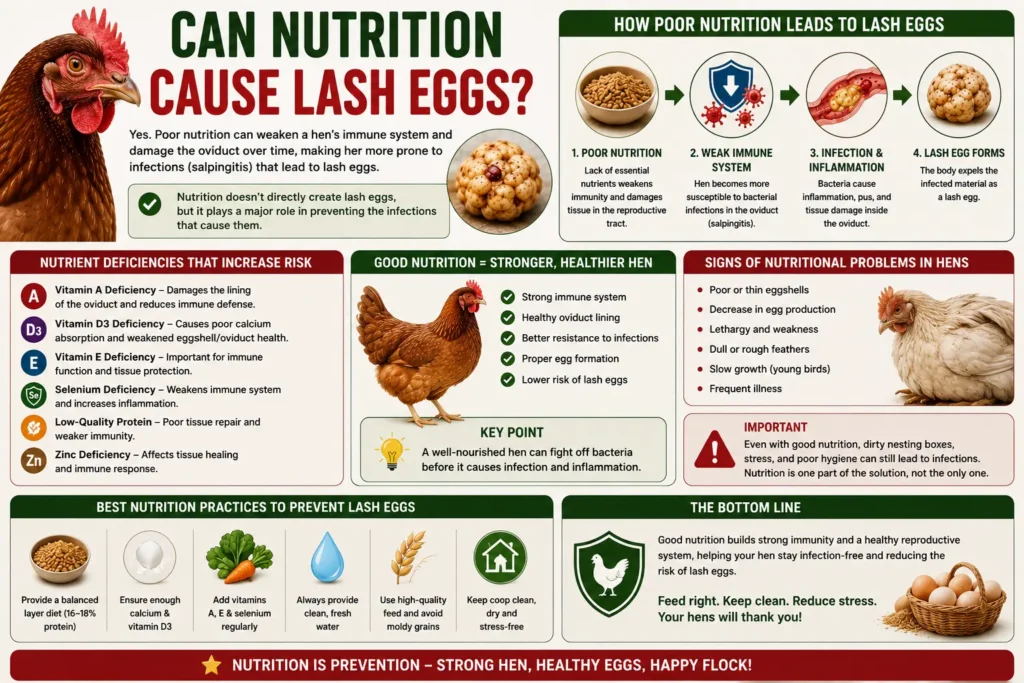
Can nutrition cause lash eggs by itself? Not directly. A lash egg forms because of salpingitis, an infection or inflammation in the oviduct, and diet alone doesn’t introduce bacteria or viruses into a hen’s body. What poor nutrition does is weaken her immune system, making it easier for an infection to take hold once it’s present.
This is a distinction worth understanding clearly, because it’s easy to lump every unusual egg into one category. A calcium deficiency, for example, causes very real problems, but those problems usually show up as soft-shelled or misshapen eggs, not lash eggs. The two issues can overlap in a run-down hen, but they aren’t the same thing.
Quick Answer: Nutrition doesn’t directly cause lash eggs, but a poor diet weakens immune defenses and makes a hen more vulnerable to the bacterial or viral infections that do cause salpingitis. Calcium deficiency specifically affects shell quality, not infection risk, in most cases.
Table of Contents
Why This Question Gets Asked So Often
Backyard keepers often assume abnormal eggs share one root cause, since they all fall under the umbrella of “something’s off with my hen.” That assumption makes sense on the surface, but soft-shelled eggs, wind eggs, and lash eggs each come from different underlying problems.
Poor diet absolutely plays a role in a hen’s overall health, immune strength, and shell quality. Whether it directly causes a lash egg, though, depends on whether an infection is also present.
How a Calcium Deficiency Actually Affects Egg Formation
Calcium is essential for building a strong, complete eggshell. A hen without enough dietary calcium may lay eggs with thin, soft, or missing shells, since her body has to pull calcium from her own bones to keep production going. This is a well-documented issue in poultry nutrition research and university extension guidance.
What calcium deficiency doesn’t do is introduce bacteria into the oviduct. Shell quality problems and infection-based problems like salpingitis are related to the same reproductive tract, but they stem from different root causes.
Read More: https://lashegg.com/lashegg-com-can-stress-cause-lash-eggs/
Nutrition’s Real Role: Immunity, Not Direct Infection
| Nutritional Factor | Primary Effect | Lash Egg Connection |
| Calcium deficiency | Soft or missing eggshells | Indirect; weakens overall condition, doesn’t cause infection directly |
| Protein deficiency | Reduced egg size, slower recovery from illness | Indirect; weaker immune response to infection |
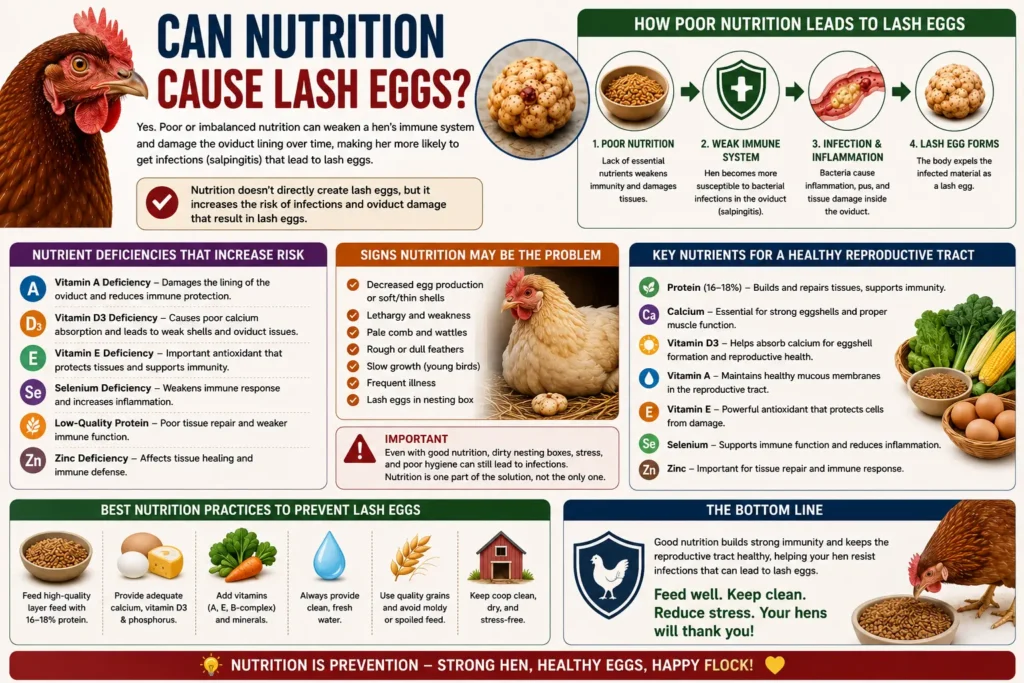
| Vitamin A deficiency | Weakened mucous membrane health, including the oviduct lining | Indirect; may make the oviduct more vulnerable to bacteria |
| Vitamin E and selenium deficiency | Reduced immune function | Indirect; documented link to weaker infection resistance |
| Chronic underfeeding or imbalance | Overall immune suppression | Indirect; increases general disease susceptibility |
Did You Know? According to general poultry nutrition guidance from university extension programs, vitamin A plays a specific role in maintaining healthy mucous membranes throughout the body, including the lining of the oviduct, which is part of why severe deficiencies are sometimes associated with higher rates of reproductive tract infection.
Can Nutrition Cause Lash Eggs Without Any Infection Present?
Based on how salpingitis develops, this is very unlikely. Lash eggs form when pus, tissue, and inflammatory debris get incorporated into the egg-forming process, which requires an active infection or significant inflammation in the oviduct. Diet alone, without bacteria or a virus involved, doesn’t typically produce that kind of infected material.
What poor diet can do is make an existing or incoming infection more likely to progress into full salpingitis rather than being cleared quickly by a healthy immune system.
Does Poor Diet Make Existing Infections Worse?
Yes, this is where nutrition has its clearest connection to lash eggs. A hen fighting off E. coli or another bacterial infection needs strong immune function to clear it. If her diet lacks key nutrients, that fight becomes harder, and the infection has a better chance of settling into the oviduct and becoming chronic.
Nutrients Most Linked to Immune Health in Laying Hens
- Vitamin A: Supports mucous membrane integrity throughout the respiratory and reproductive tract
- Vitamin E and selenium: Work together to support immune cell function
- Protein: Needed for antibody production and general tissue repair
- Calcium and phosphorus: Critical for shell quality and bone health, indirectly supporting overall condition
- B vitamins: Support metabolic processes tied to energy and recovery from illness
A diet consistently low in several of these nutrients puts a hen in a weaker overall position, even if no single deficiency directly causes a lash egg.
Recognizing Nutrition-Related Symptoms vs. Infection Symptoms
| Symptom | More Likely Nutrition-Related | More Likely Infection-Related |
| Soft or thin-shelled eggs | Yes | No |
| Pale comb or wattles | Yes | Possible, in advanced cases |
| Slower growth or reduced egg size | Yes | Not typical |
| Abdominal swelling | No | Yes |
| Foul-smelling vent discharge | No | Yes |
| Lash egg itself | No, on its own | Yes |
Warning: If your hen shows both signs of poor nutrition and any infection symptom, like abdominal swelling or a lash egg, treat it as a health issue requiring veterinary attention. Diet correction alone won’t resolve an active infection.
How This Plays Out in a Real Flock
A hen on a poor diet for weeks or months, especially one lacking calcium, protein, or key vitamins, is generally in a weaker position to fight off infection. If bacteria reach her oviduct during that window, whether from dirty bedding, contaminated water, or another hen, her body has fewer resources to stop it before salpingitis develops.
This is different from a hen with a strong, balanced diet who’s briefly exposed to the same bacteria. Her immune system is more likely to clear the exposure before it becomes a full infection.
How Vets Approach Cases Involving Diet and Salpingitis
A veterinarian won’t diagnose “poor nutrition” as the direct cause of a lash egg, since diet alone isn’t an infectious agent. Instead, they’ll look for the actual infection while considering nutritional status as part of the hen’s overall health picture. Diagnostic steps typically include:
- Physical exam, including body condition scoring
- Bloodwork to assess infection markers and general health
- Radiographs or ultrasound to evaluate the oviduct
- Culture and sensitivity testing of discharge, to identify the specific bacteria involved
- A review of current diet and feeding practices
That last step often reveals gaps that, while not the direct cause, likely made the hen more vulnerable.
Improving Nutrition to Support Recovery and Lower Risk
- Feed a complete, age-appropriate layer feed formulated for laying hens, not scratch grains alone
- Offer free-choice calcium, such as oyster shell, alongside a balanced feed
- Avoid excessive treats or scratch that dilute the nutritional balance of a complete feed
- Ensure consistent access to clean water, since dehydration compounds nutritional stress
- Watch body condition regularly, since both underweight and overweight hens face higher health risks
- Rotate in leafy greens and other whole foods in moderation to support micronutrient intake
Expert Tip: A complete commercial layer feed is formulated to cover calcium, protein, and key vitamins in the right ratios. Keepers who rely heavily on scratch grains or table scraps often unintentionally create the kind of nutritional gaps that weaken immune defenses over time.
Common Mistakes When Addressing Nutrition and Lash Eggs
Common Mistakes: A common mistake is assuming that adding more calcium alone will fix or prevent a lash egg. Calcium supports shell quality, not infection resistance specifically, so this step alone won’t address an active bacterial or viral cause. Another mistake is ignoring diet quality entirely because “it’s just an infection,” when a stronger nutritional foundation genuinely helps a hen recover and resist future infections.
Recovery Outlook When Nutrition Is a Contributing Factor
| Situation | General Outlook |
| Diet corrected early, no infection develops | Full recovery expected, with improved shell quality and condition |
| Mild infection alongside diet correction | Good outlook when paired with appropriate veterinary treatment |
| Chronic poor nutrition plus recurring infection | Variable; addressing both together improves long-term results |
| Advanced infection despite improved diet | Requires veterinary treatment regardless of nutritional status |
When to Call a Vet
When to Call a Vet: Contact a poultry-experienced veterinarian if a hen shows both signs of poor nutrition, like thin shells or low body condition, and any physical symptom of infection, including abdominal swelling, lethargy, or a lash egg. Diet correction supports recovery but doesn’t replace treatment for an active infection.
Frequently Asked Questions
Can nutrition cause lash eggs directly, without any infection involved? It’s very unlikely. Lash eggs form from an active infection or significant inflammation in the oviduct, which diet alone doesn’t produce.
Does a calcium deficiency specifically cause lash eggs? Not directly. Calcium deficiency mainly affects eggshell quality, leading to soft or thin shells, rather than causing the infection behind lash eggs.
Can poor diet make an existing infection worse? Yes. A hen with nutritional gaps has weaker immune defenses, which can allow an existing bacterial or viral infection to progress more easily into full salpingitis.
What’s the difference between a nutrition-related abnormal egg and a lash egg? Nutrition-related issues typically show up as soft-shelled, thin-shelled, or unusually small eggs, while a lash egg specifically contains pus or tissue tied to an oviduct infection.
Will improving my hen’s diet cure an existing lash egg problem? Diet improvement supports recovery and immune function, but an active infection typically needs veterinary treatment, including possible antibiotics, not diet correction alone.
What nutrients matter most for preventing lash eggs indirectly? Vitamin A, vitamin E, selenium, and adequate protein all support immune function, which plays an indirect but meaningful role in resisting the infections that cause lash eggs.
Bringing It All Together
The honest answer to can nutrition cause lash eggs is that it doesn’t, at least not directly. Diet plays a supporting role by strengthening or weakening a hen’s immune system, which affects how well she resists or fights off the bacterial and viral infections actually responsible for salpingitis. A calcium deficiency and poor diet in general deserve real attention, but mainly for shell quality and overall condition rather than as a standalone cause of lash eggs.
If your hen shows both nutritional red flags and physical symptoms like abdominal swelling or an actual lash egg, treat it as a health concern that needs veterinary evaluation, not something better feed alone will resolve. Correcting diet gaps while also addressing any underlying infection gives your flock the strongest path back to full health.
FAQ (Standalone Section)
Q: Can nutrition cause lash eggs in a hen with no bacterial exposure at all? A: It’s very unlikely. Without bacteria or a virus present, poor nutrition alone typically doesn’t produce the infected material found in a lash egg.
Q: Is calcium deficiency the same issue as a lash egg? A: No. Calcium deficiency mainly causes soft or thin-shelled eggs, while a lash egg specifically involves pus and tissue from an oviduct infection.
Q: How quickly can improving a hen’s diet help after a lash egg episode? A: Nutritional improvements support long-term immune health, but recovery timelines vary and often depend more on how the underlying infection is treated.
Q: Should I change my whole flock’s diet if one hen gets a lash egg? A: It’s a reasonable precaution, especially if the flock’s current diet has obvious gaps, but it should complement, not replace, proper veterinary evaluation of the affected hen.