Can Stress Cause Lash Eggs? The Direct Answer

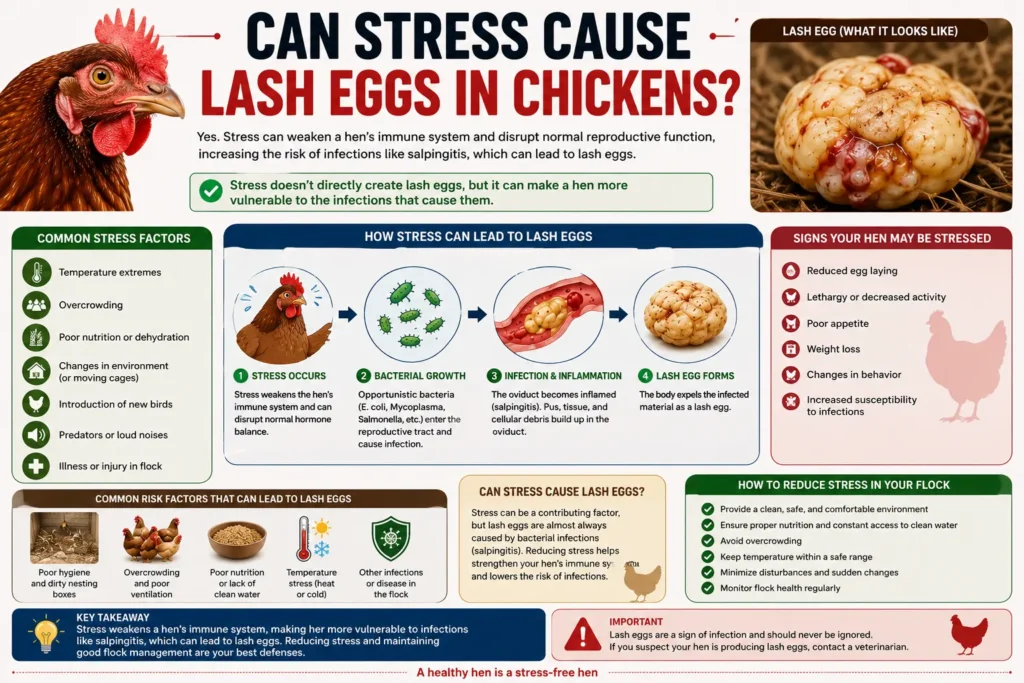
Can stress cause lash eggs on its own? Not usually. Stress doesn’t directly infect a hen’s oviduct the way bacteria or viruses do. What it does is weaken her immune defenses, making it easier for an existing infection to take hold and progress into salpingitis, the condition behind every lash egg.
This distinction matters more than it sounds. A stressed hen in an otherwise clean, low-pathogen environment may never develop a lash egg at all. But a stressed hen exposed to bacteria like E. coli or Salmonella is far more likely to end up with one than a calm, well-supported hen facing the same exposure.
Quick Answer: Stress alone rarely causes lash eggs directly, but it significantly raises the risk by weakening a hen’s immune system, making her more vulnerable to the bacterial and viral infections that do cause salpingitis.
Table of Contents
Why This Question Comes Up So Often
Keepers ask whether stress causes lash eggs because the timing often lines up. A hen goes through a stressful event, a move, a predator scare, a new flock member, and shortly after, she passes a lash egg. That timing feels like cause and effect, and in a sense, it is, just not in the direct way most people assume.
Stress is what researchers call a contributing factor rather than a root cause. It doesn’t manufacture bacteria or viruses out of nothing. It just makes the hen’s body less equipped to fight them off once they’re present.
How Stress in Laying Hens Actually Affects the Body
Chronic stress raises cortisol and related hormones, which in turn suppresses immune function over time. This is well documented in general poultry physiology research, not unique to reproductive issues. A hen under sustained stress has fewer resources available to fight off bacteria that would otherwise be handled before reaching the oviduct.
This is why stress in laying hens shows up as a recurring theme across nearly every poultry health discussion, not just lash eggs specifically. It’s a background factor that makes almost every other health problem more likely.
Read More: https://lashegg.com/lashegg-com-bacterial-infection-causing-lash-eggs/
The Real Chain of Events Behind Most Lash Eggs
| Step | What Happens |
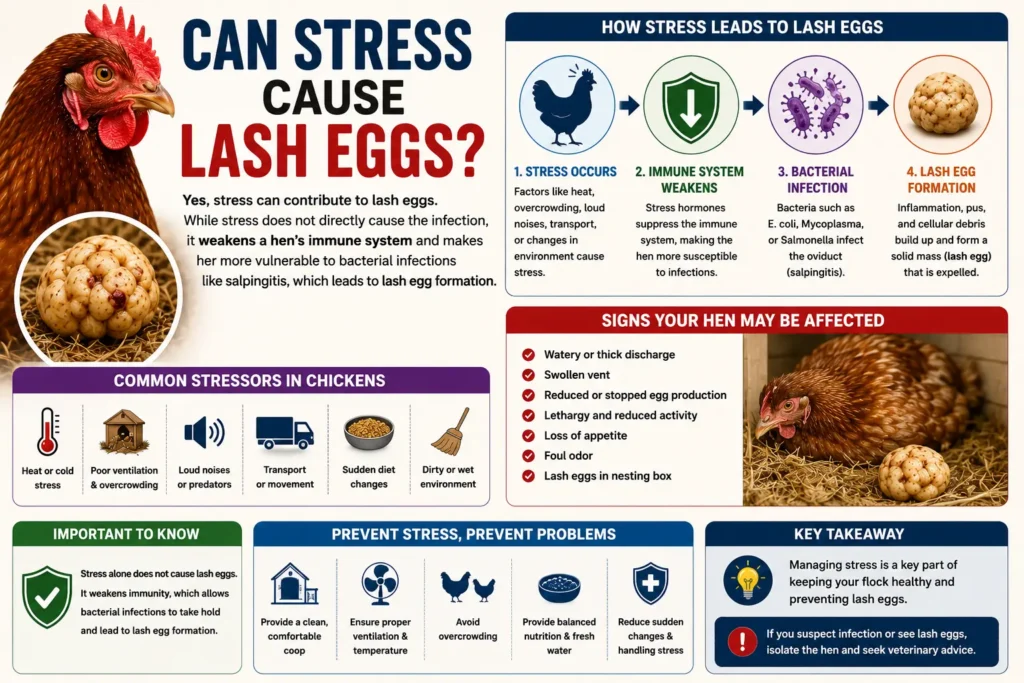
| 1. Stress event occurs | Moving coops, overcrowding, predator activity, flock changes, illness elsewhere in the body |
| 2. Immune defenses weaken | Cortisol and related hormones suppress the hen’s ability to fight infection |
| 3. Bacteria or virus takes hold | Organisms like E. coli, Salmonella, or infectious bronchitis reach the oviduct more easily |
| 4. Salpingitis develops | Oviduct becomes inflamed and infected |
| 5. Lash egg appears | Pus and tissue debris get incorporated into the egg-forming process |
Skipping straight from “stress” to “lash egg” without steps two through four misses what’s actually happening physiologically.
Common Stressors in Backyard and Commercial Flocks
Understanding what triggers stress in laying hens helps you figure out where your flock’s risk might be coming from.
- Overcrowding. Not enough space per bird raises both physical stress and bacterial exposure.
- Sudden environmental changes. Moving to a new coop, introducing new birds, or major weather shifts.
- Predator pressure. Even near-misses can elevate stress hormones for days afterward.
- Pecking order disputes. Ongoing bullying or a disrupted hierarchy after adding or losing flock members.
- Extreme heat or cold. Temperature stress taxes the whole body, immune system included.
- Feed or water shortages. Even brief gaps can compound stress, especially in already vulnerable hens.
- Illness elsewhere in the body. A respiratory infection or parasite load adds physical stress on top of everything else.
Did You Know? According to general findings referenced by university extension poultry programs, chronic low-grade stress tends to have a bigger cumulative impact on flock health than single acute stress events, since the immune system never gets a full chance to recover between episodes.
Can Stress Cause Lash Eggs Without Any Infection Present?
This is the core of the question, and the honest answer is: it’s very unlikely, though not entirely disproven in every documented case. Salpingitis is fundamentally an infectious and inflammatory condition. Without bacteria or a virus present to exploit a weakened immune system, most documented cases don’t progress to full lash egg formation from stress hormones alone.
That said, chronic stress can contribute to broader reproductive tract irritation and irregular egg formation in general, which is part of why stressed hens sometimes produce other abnormal eggs, like soft-shelled or misshapen ones, even when a full lash egg doesn’t appear.
Does High Egg Production Count as a Stressor?
Yes, in a physiological sense. Hens under heavy laying pressure experience ongoing strain on the reproductive tract, and this functions similarly to other stressors by relaxing vent muscles over time and taxing the hen’s overall system. High-production breeds face this more consistently than lower-output or heritage breeds.
Recognizing Stress-Related Symptoms Before They Escalate
Since stress in laying hens often precedes infection rather than causing lash eggs directly, catching early stress signs can help you intervene before salpingitis develops.
- Reduced or irregular egg production
- Increased hiding or reduced flock interaction
- Feather picking, either self-directed or toward other birds
- Changes in appetite
- More vocalization or restlessness than usual
- Slower return to normal routine after a disruption
Warning: If a hen shows both prolonged stress signs and any symptom of salpingitis, such as abdominal swelling, lethargy, or a stop in laying, treat it as a health concern requiring veterinary attention rather than something that will resolve with rest alone.
Symptom Pattern, Likely Explanation, and Next Step
| Symptom Pattern | Likely Explanation | Recommended Action |
| Stress signs only, no physical symptoms | Behavioral stress response | Address the stressor, monitor for changes |
| Stress signs plus a single unusual egg | Possible early infection, stress as contributing factor | Monitor closely for one to two weeks |
| Stress signs plus repeated lash eggs | Likely chronic salpingitis, stress worsening the picture | Veterinary exam and testing |
| Stress signs plus abdominal swelling | Advanced infection needing prompt care | Veterinary visit as soon as possible |
How Vets Approach Cases Involving Stress and Salpingitis
A veterinarian won’t diagnose “stress” as the cause of a lash egg on its own, since stress itself isn’t an infectious agent. Instead, they’ll look for the underlying infection while also considering stress as a factor in the hen’s overall vulnerability. Diagnostic steps typically include:
- Physical exam and abdominal palpation
- Bloodwork to check for active infection and inflammation
- Radiographs or ultrasound to assess the oviduct
- Culture and sensitivity testing of any discharge, to identify the specific bacteria involved
This combination tells the full story: what infection is present, and how much a stressed immune system may have let it progress.
Reducing Stress in Laying Hens to Lower Overall Risk
While stress rarely causes lash eggs by itself, reducing it is still one of the most useful things you can do to protect your flock’s overall health.
- Provide adequate space per bird to reduce crowding and pecking order conflict
- Introduce new birds gradually, with a proper quarantine period first
- Keep predator-proofing solid to reduce chronic anxiety within the flock
- Maintain consistent feeding and watering schedules
- Provide shade, ventilation, and temperature management during extreme weather
- Keep routines predictable; sudden changes are more stressful than gradual ones
- Give hens enrichment, like dust baths and foraging space, to reduce boredom-related stress
Expert Tip: Reducing chronic, low-grade stress does more for long-term flock immunity than trying to eliminate every single stressful event. Focus on the ongoing conditions, like space and routine, rather than only reacting to one-off incidents.
Recovery Outlook When Stress Is a Contributing Factor
| Situation | General Outlook |
| Stress reduced early, no infection develops | Full recovery expected, often without medical intervention |
| Mild infection caught early alongside stress reduction | Good outlook with antibiotics and improved conditions |
| Chronic stress plus recurring infection | Variable; addressing both factors together improves results |
| Advanced infection despite stress management | Requires veterinary treatment regardless of stress levels |
Hens whose environmental stressors get addressed alongside any necessary medical treatment tend to have better long-term outcomes than those treated for infection while the same stressful conditions remain in place.
Common Mistakes When Blaming Stress for Lash Eggs
Common Mistakes: A frequent mistake is assuming a single stressful event fully explains a lash egg and skipping any further investigation. This can delay identifying and treating an actual underlying infection. Another mistake is the opposite: dismissing stress reduction entirely because “it’s just an infection,” when reducing ongoing stress genuinely improves a hen’s ability to recover and resist future infections.
When to Call a Vet
When to Call a Vet: Reach out to a poultry-experienced veterinarian if a hen shows both signs of stress and any physical symptom of salpingitis, including abdominal swelling, lethargy, foul-smelling discharge, or a lash egg itself. Stress reduction alone won’t resolve an active infection.
Frequently Asked Questions
Can stress cause lash eggs directly, without any infection? It’s very unlikely. Stress weakens immune defenses, but salpingitis, the condition behind lash eggs, is fundamentally infectious or inflammatory in nature.
How much does stress in laying hens actually raise the risk of lash eggs? It’s difficult to put an exact number on it, but chronic stress is widely recognized as a significant contributing factor that makes existing infections more likely to take hold and progress.
If I reduce my flock’s stress, will lash eggs stop completely? Reducing stress lowers overall risk and supports better immune function, but it won’t eliminate risk entirely if bacteria or viruses are still present in the environment.
Can moving a hen to a new coop cause a lash egg? The move itself won’t directly cause one, but the stress of relocation can weaken her immune defenses temporarily, raising vulnerability if an infection is already present or introduced during the transition.
Is high egg production a form of stress that can cause lash eggs? Yes, in a physiological sense. Heavy laying puts ongoing strain on the reproductive tract, which can contribute to the same vulnerability seen with other stressors.
Should I treat a stressed hen differently than one showing infection symptoms? Yes. Stress reduction supports recovery, but any signs of actual infection, like abdominal swelling or a lash egg, require veterinary evaluation rather than stress management alone.
Bringing It All Together
The honest answer to can stress cause lash eggs is that it rarely does so on its own. Stress functions as a background factor, weakening a hen’s immune system and making her more vulnerable to the bacterial or viral infections that actually cause salpingitis. Addressing stress in laying hens is still worthwhile, since it supports better overall immunity and recovery.
If your hen shows both stress signals and physical symptoms like abdominal swelling or a lash egg, treat it as a health issue requiring veterinary attention rather than something a calmer environment alone will fix. Reducing stress and monitoring for infection together gives your flock the best chance at staying healthy.
FAQ (Standalone Section)
Q: Can stress cause lash eggs in a completely healthy flock with no bacteria present? A: It’s very unlikely. Without an underlying infection to exploit a weakened immune system, stress alone rarely produces a full lash egg.
Q: What kind of stress in laying hens is most linked to reproductive issues? A: Chronic, ongoing stress, like overcrowding or an unstable pecking order, tends to have a bigger impact on reproductive health than brief, one-time stressful events.
Q: Does stress make lash eggs worse once they’ve already started? A: It can. Ongoing stress may slow a hen’s recovery and make it harder for her immune system to fully clear an existing infection.
Q: Can reducing stress alone treat an existing lash egg infection? A: No. Stress reduction supports overall health, but an active bacterial or viral infection typically needs veterinary treatment, not just a calmer environment.