Should You Isolate a Chicken With Salpingitis?

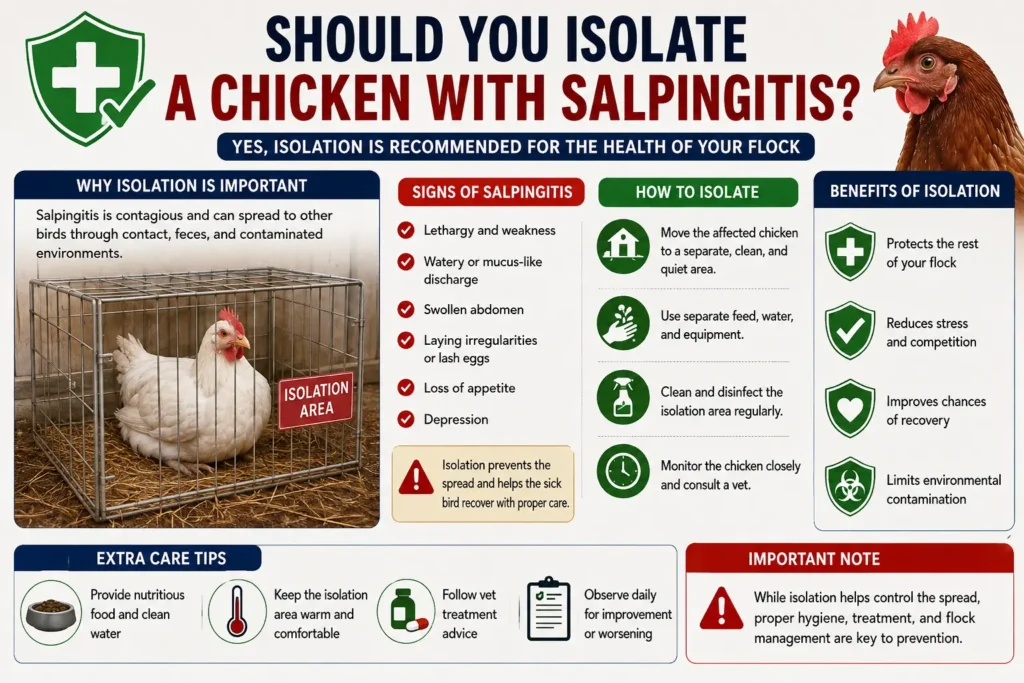
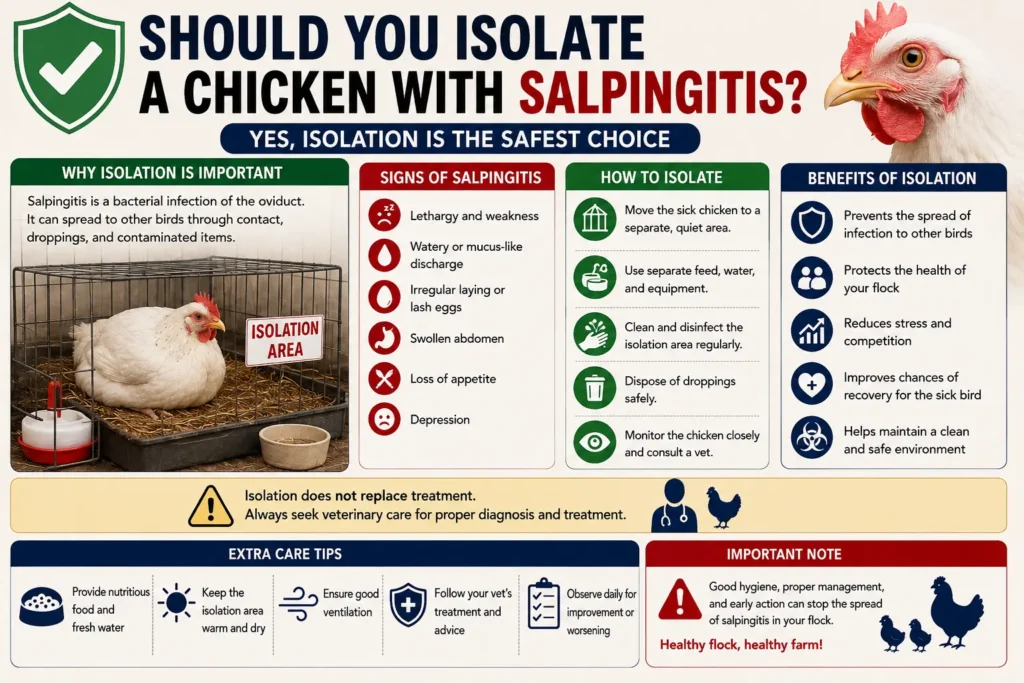
Should you isolate a chicken with salpingitis? Yes, in almost every case, isolating her is the right call. Salpingitis itself doesn’t spread directly from hen to hen, but separating a sick bird still protects her from stress, bullying, and injury while she recovers, and it gives you a controlled space to monitor her symptoms closely.
It also buys you something just as important: time to figure out what actually caused her salpingitis. If the trigger turns out to be a contagious respiratory illness, isolating her early can genuinely limit how far it spreads through your flock.
Quick Answer: Yes, isolate a hen with suspected or confirmed salpingitis. Move her to a separate, quiet space right away, monitor her closely, and consult a vet. Quarantine sick hens for at least two to four weeks, or until a vet confirms the underlying cause and clears her.
This guide covers exactly how to isolate a hen with salpingitis, how long to keep her separated, what her setup should look like, and when it’s safe to reintroduce her to the flock.
Table of Contents
Why Isolate a Hen With Salpingitis at All?
If salpingitis isn’t contagious, it’s fair to ask why quarantine matters. The answer comes down to four practical reasons that have nothing to do with the salpingitis itself spreading.
Read More: https://lashegg.com/can-humans-catch-salpingitis-from-chickens/
1. Sick Hens Get Bullied
Chickens have a strict pecking order, and a weak or visibly unwell flockmate is an easy target. Hens showing lethargy, a swollen abdomen, or reduced mobility from salpingitis are at real risk of being pecked, pushed off the roost, or blocked from food and water by healthier birds.
2. Recovery Needs Rest
A hen fighting an internal infection needs calm, low-stress conditions to heal. Constant flock activity, competition for resources, and normal pecking-order squabbles all work against that.
3. You Need Accurate Monitoring
It’s nearly impossible to track one hen’s appetite, droppings, and energy level accurately when she’s mixed in with a dozen others. Isolation lets you see exactly what she’s eating, drinking, and producing, which matters for both her recovery and any vet visit.
4. The Underlying Cause Might Be Contagious
This is the reason that matters most for your flock’s safety. Salpingitis can follow a genuinely contagious illness, like infectious bronchitis, Newcastle disease, or Mycoplasma gallisepticum. Isolating a symptomatic hen immediately, before you know the cause, is a precaution that costs you nothing and could prevent a much bigger outbreak.
Did You Know? Veterinary sources note that salpingitis linked to age-related changes in the reproductive system isn’t something your chickens can pass to each other, and there’s no way to prevent that type through isolation. Quarantine still matters, though, because you usually won’t know the exact cause until a vet has evaluated her.
Isolation vs. Quarantine: Are They the Same Thing?
Chicken keepers often use “isolate” and “quarantine” interchangeably, but there’s a useful distinction worth understanding. Isolation generally means separating a hen who is already showing symptoms, mainly for her comfort, safety, and your ability to monitor her. Quarantine specifically means separating a bird for a defined period to determine whether she’s carrying something contagious before she rejoins others.
When you isolate a chicken with salpingitis, you’re really doing both at once. You’re giving her a calmer space to recover, and you’re also observing her long enough to rule out a contagious underlying cause. That’s why the recommended timeframes for quarantine sick hens tend to run several weeks rather than just a few days: it takes time for a genuinely contagious illness to reveal itself through symptoms in other flock members.
The same logic applies to bringing new birds into an existing flock. Experienced keepers typically quarantine new arrivals for two to three weeks before mixing them in, since some illnesses take that long to show visible signs. A hen recovering from salpingitis deserves the same cautious timeline, even though her condition isn’t contagious in the traditional sense.
How Flock Stress Affects Recovery
Stress plays a bigger role in a sick hen’s recovery than many keepers realize. Chickens maintain a strict social hierarchy, and any bird perceived as weak becomes a target almost immediately. A hen straining to pass a lash egg, moving slowly, or standing in the “penguin” posture associated with abdominal swelling is exactly the kind of bird flockmates are likely to single out.
Beyond direct bullying, group housing means competition for food, water, favored roosting spots, and nesting boxes. A hen already fighting an internal infection has less energy to compete for those resources, which can slow her recovery even if no other bird actively harms her. Removing her from that competition, even temporarily, gives her body more resources to focus on healing.
This is also where a partial-isolation setup earns its keep. A hen isolated within sight of the flock, separated by wire or a low barrier, still benefits from reduced competition and no direct pecking, while avoiding the added stress of total social isolation that can come with moving her somewhere completely separate.
Expert Tip: If your isolation area is loud, cramped, or exposed to weather extremes, it can add stress rather than reduce it. Aim for the calmest, most stable environment you can realistically set up, even if it’s smaller than the main coop.
What to Track While a Hen Is in Quarantine
A simple daily log makes both her care and any eventual vet visit far more useful. Track the following each day she’s isolated:
- Appetite: eating normally, reduced, or refusing food
- Water intake: normal, reduced, or excessive
- Droppings: consistency, color, and frequency
- Energy level: active, subdued, or lethargic
- Posture: normal stance versus the upright “penguin” posture linked to abdominal swelling
- Any new symptoms: swelling, discharge, or additional lash eggs
Patterns matter more than any single day’s observation. A hen who’s eating less on day one but improving by day three is a very different case than one who stops eating entirely and stays that way, and that trend line is exactly the kind of detail a vet will want to know.
How to Isolate a Chicken With Salpingitis: Step by Step
1. Move Her Immediately
Don’t wait to see if symptoms get worse. Move a hen showing signs of salpingitis, like a lash egg, abdominal swelling, or sudden lethargy, to a separate space as soon as you notice something is wrong.
2. Choose the Right Space
A dog crate, a large tub with tall sides, or a small isolation coop all work well. Look for a spot that’s quiet, dimly lit, draft-free, and away from the main flock’s line of sight and sound when possible.
3. Set Up Dedicated Supplies
Use a separate feeder and waterer that stay with the isolation setup, not shared equipment moved back and forth from the main coop.
4. Provide Comfort and Support
- Fresh water, changed at least once daily
- High-quality layer feed, plus easily digestible options like scrambled egg if appetite is low
- Soft bedding she can rest on comfortably
- A warm but not overheated environment, especially if she’s lethargic
5. Practice Good Biosecurity While Caring for Her
- Attend to your healthy flock first, then the isolated hen
- Wash your hands thoroughly after handling her
- Avoid wearing the same shoes or clothing between the isolation area and the main coop without disinfecting them
- Disinfect any tools or containers used in her care
6. Watch and Record Symptoms Daily
Keep a simple daily log of her appetite, droppings, energy level, and any new symptoms. This record is genuinely useful information for a vet if her condition doesn’t improve.
7. Contact a Veterinarian
Isolation buys time, but it isn’t treatment. A vet can confirm the diagnosis, identify the underlying cause, and prescribe antibiotics or other treatment if appropriate.
Expert Tip: Don’t isolate a hen with salpingitis in a spot where she can’t see or hear the rest of the flock at all if you can help it. Chickens are social animals, and total isolation can add unnecessary stress on top of what she’s already dealing with. A visual barrier that still allows some flock contact often works better than complete separation.
How Long Should You Quarantine a Sick Hen?
There’s no single fixed number that fits every case, but general poultry-keeping guidance offers a useful range to work from.
| Situation | Recommended Isolation Length |
| Mild symptoms, hen eating and drinking normally | Monitor closely for 24–48 hours before deciding next steps |
| Confirmed or suspected salpingitis | Minimum 2–4 weeks, or until a vet clears her |
| Suspected contagious cause (respiratory illness) | 30 days minimum, ideally 4–6 weeks |
| New symptoms appear in another hen during quarantine | Reset the isolation clock for that bird |
| New birds being introduced to the flock | 2–3 weeks before mixing with the existing flock |
Quarantine sick hens for as long as it takes to confirm the cause and see clear, sustained improvement. If your vet identifies a contagious viral or bacterial cause, follow their specific timeline rather than a generic rule of thumb, since some pathogens require longer observation periods than others.
What If Another Hen Gets Sick During Quarantine?
If a second hen develops similar symptoms while the first is isolated, treat it as a signal that a contagious underlying illness may be involved. Isolate the new bird as well, and let this restart the countdown for a full quarantine period. This is also the point where testing through your vet becomes especially valuable, since it tells you whether you’re dealing with an isolated bacterial case or a spreading illness.
Setting Up a Proper Isolation Area
A good isolation setup doesn’t need to be elaborate, but it does need to check a few specific boxes.
- Separate airspace when possible. A garage, spare room, or covered porch area works better than a space that shares direct airflow with the main coop, especially if a respiratory illness is suspected.
- Away from predators and extreme weather. The isolation area still needs to be safe and temperature-appropriate.
- Easy to clean. Choose materials and containers you can disinfect thoroughly between uses.
- Visible but separate. A wire dog crate placed where the hen can still see or hear the flock reduces stress compared to full isolation in another building.
What Not to Do When You Isolate a Chicken With Salpingitis
Common Mistakes to Avoid
- Returning her to the flock too early because she “seems fine” for a day or two
- Skipping veterinary evaluation because isolation alone feels like enough
- Using shared feeders or waterers between the sick hen and the healthy flock
- Forgetting to disinfect shoes, gloves, or tools after handling her
- Assuming isolation prevents salpingitis itself from developing in other hens, when it’s really about controlling the underlying cause and reducing stress
Warning: Never attempt to treat suspected salpingitis with leftover antibiotics without veterinary guidance. Incorrect dosing won’t resolve the infection and can contribute to antibiotic resistance in your flock over time.
Comparing Isolation Approaches
| Approach | Best For | Downsides |
| Full physical separation (separate building) | Suspected contagious respiratory illness | Higher stress from total social isolation |
| Visible but separated (crate near the coop) | Most salpingitis cases without confirmed contagion | Requires secure barrier to prevent pecking through wire |
| No isolation, monitored in the flock | Not generally recommended for salpingitis | Risk of bullying, inaccurate monitoring, potential spread if cause is contagious |
When to Call a Vet
- As soon as you notice a lash egg, abdominal swelling, or a sudden drop in energy
- If she stops eating or drinking within the isolation period
- If symptoms worsen despite supportive care
- If more than one hen develops similar symptoms
- Before ending quarantine and reintroducing her to the flock
Reintroducing a Recovered Hen to the Flock
Once a vet confirms she’s recovered, or her quarantine period has passed without new symptoms, reintroduce her gradually rather than placing her straight back with the full flock.
- Let her see and hear the flock through a barrier for a few days first
- Introduce her during the day when you can supervise
- Add extra feeding and watering stations temporarily to reduce competition
- Watch for excessive pecking or bullying during the first 24–48 hours
- Keep her under closer observation for another week even after reintroduction
Frequently Asked Questions From Chicken Keepers
Can I keep a hen with salpingitis in the coop if she seems okay?
It’s not recommended. Even a hen that seems mildly affected benefits from isolation, both to protect her from flock stress and to give you a clear picture of her condition.
Does isolating a sick hen guarantee she’ll recover?
No. Isolation supports recovery by reducing stress and improving monitoring, but it isn’t a treatment on its own. Veterinary care, and antibiotics when appropriate, are what actually address the underlying infection.
Is it cruel to isolate a social animal like a chicken?
Short-term, well-designed isolation is a standard and humane part of poultry care. The key is minimizing added stress by keeping her within sight or sound of the flock where possible, and not extending isolation longer than necessary.
Wrapping Up: Should You Isolate a Chicken With Salpingitis?
Yes, isolating a chicken with salpingitis is the right first step almost every time. It protects her from flock stress, helps you monitor her condition accurately, and creates a safety buffer in case the true cause turns out to be contagious. Pair isolation with prompt veterinary care, watch her closely during the quarantine period, and reintroduce her gradually once she’s cleared to rejoin the flock.
5. FAQ
Should you isolate a chicken with salpingitis? Yes. Isolating her protects her from bullying and stress, allows accurate monitoring, and provides a safety buffer in case an underlying contagious illness is involved. Pair isolation with a veterinary evaluation for the best outcome.
How long should you quarantine sick hens with salpingitis? Most guidance suggests at least two to four weeks, or longer if a vet suspects a contagious underlying cause. Reset the timeline if another hen develops symptoms during that period.
Can other hens catch salpingitis from an isolated hen? No, salpingitis itself doesn’t spread directly between hens. Isolation is still useful because the original infection behind her salpingitis, in some cases, can be contagious.
What should an isolation setup look like for a hen with salpingitis? A quiet, draft-free space with dedicated food and water, soft bedding, and ideally some visual or auditory contact with the rest of the flock to reduce stress.
Is it safe to skip isolation and just watch her in the coop? It’s not ideal. A hen left in the main flock while sick is more likely to be bullied, harder to monitor accurately, and, if her cause is contagious, more likely to expose other birds before you catch it.
When can I stop quarantining my hen and return her to the flock? Once a veterinarian confirms she’s recovered or her full quarantine period has passed without new or worsening symptoms, reintroduce her gradually rather than all at once.