Temperature and Chicken Egg Production: One Spectrum, Two Directions

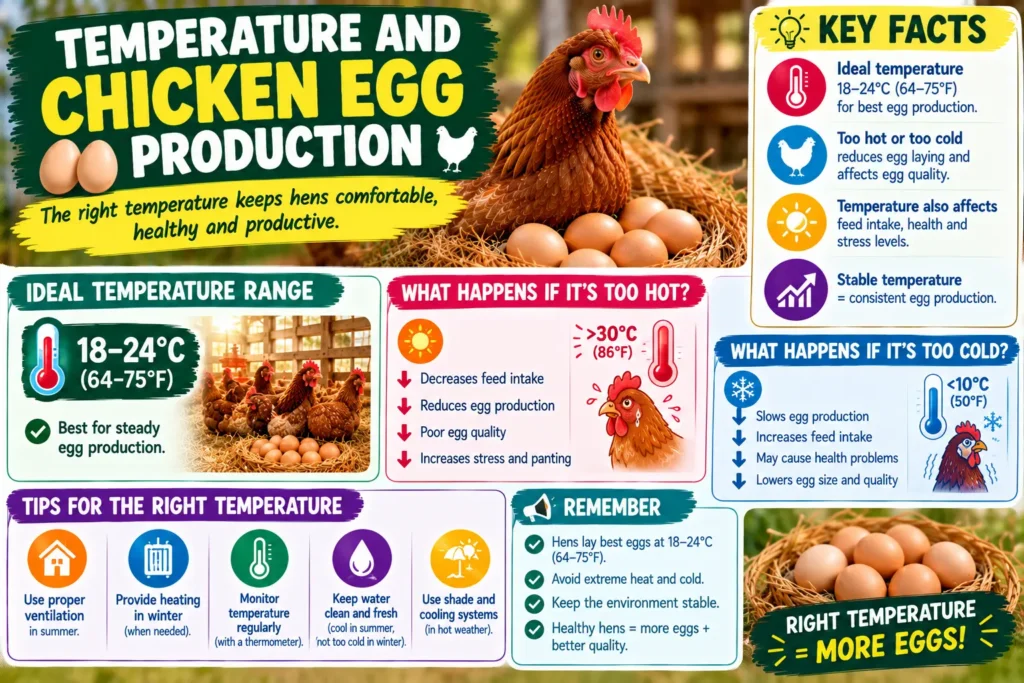
Temperature and chicken egg production follow a curve, not a simple hot-versus-cold split. Hens have a comfortable middle range where laying stays strong, with production tapering off in both directions as temperatures move toward either extreme.
This guide puts heat and cold effects on the same scale so you can see exactly where your current conditions fall, rather than treating summer heat and winter cold as two completely separate topics. For deep, season-specific detail on managing each end of the spectrum, the dedicated winter and summer guides go further into practical steps; this page focuses on the comparative picture.
Quick Answer: Chickens lay most consistently between about 45°F and 75°F (7°C to 24°C). Below this range, cold stress diverts energy toward maintaining body heat; above it, heat stress redirects energy toward cooling. Both directions reduce egg production through a similar underlying mechanism: less energy left over for reproduction once survival needs take priority.
Table of Contents
The Chicken Thermal Comfort Zone
Where Laying Is Most Consistent
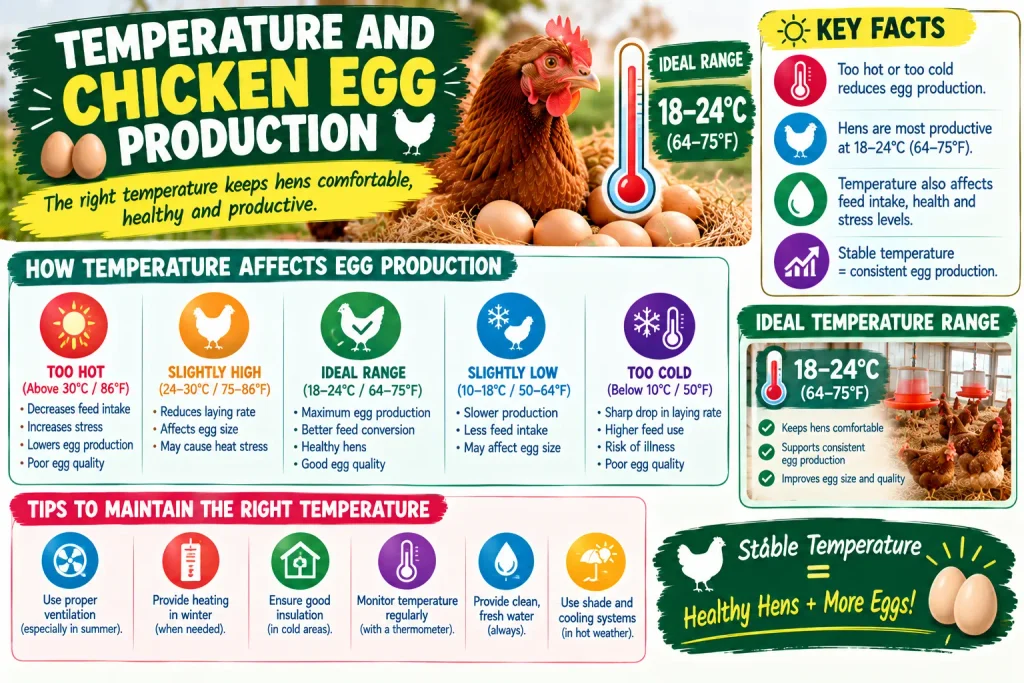
Most hens lay most reliably within a moderate temperature band, generally accepted as roughly 45°F to 75°F (7°C to 24°C), depending somewhat on breed and acclimation. Within this range, a hen’s body doesn’t need to divert significant energy toward temperature regulation, leaving more available for egg formation.
| Temperature Range | Effect on Laying | Zone |
| Below 20°F (-7°C) | Severe cold stress, significant decline likely | Cold extreme |
| 20–45°F (-7–7°C) | Moderate cold stress, some decline | Cold stress zone |
| 45–75°F (7–24°C) | Comfortable, consistent laying | Thermal comfort zone |
| 75–85°F (24–29°C) | Mild heat stress, slight decline possible | Heat stress zone |
| 85–95°F (29–35°C) | Significant heat stress, noticeable decline | Heat stress zone |
| Above 95°F (35°C) | Severe heat stress, sharp decline or stop | Heat extreme |
Did You Know? Chickens tolerate cold somewhat better than heat overall, largely because their feathers provide effective insulation against cold but offer no equivalent cooling mechanism, since chickens don’t sweat the way mammals do.
How Cold Stress Reduces Egg Production
The Energy Diversion
In cold conditions, a hen’s body prioritizes maintaining core temperature, burning additional calories simply to stay warm. This diverts resources away from egg formation, similar in principle to how heat stress works, just through the opposite physical mechanism.
Signs of Cold-Related Decline
- Fluffed feathers and huddling behavior
- Reduced activity and feed-seeking behavior in extreme cold
- Gradual production decline correlating with temperature drops
- Combs and wattles occasionally showing frostbite risk in severe cold
How Heat Stress Reduces Egg Production
The Cooling Demand
In hot conditions, panting and other cooling behaviors consume energy that would otherwise support reproduction. Reduced feed intake during heat, since digestion generates internal heat, compounds this effect by limiting available nutrients.
Signs of Heat-Related Decline
- Panting, wings held away from the body
- Reduced feed intake, increased water consumption
- Thinner shells due to reduced calcium intake from lower feed consumption
- Sharp decline during acute heat waves specifically
| Factor | Cold Stress | Heat Stress |
| Primary energy diversion | Maintaining body heat | Cooling the body |
| Feed intake change | Often increases | Often decreases |
| Water intake change | May decrease | Increases significantly |
| Shell quality impact | Less direct | Thinner shells common |
| Chicken tolerance | Generally better | Generally more vulnerable |
Comparing Weather and Laying Across Breeds
Cold Tolerance
Heavily feathered, smaller-combed breeds like Orpingtons, Wyandottes, and Chanteclers generally handle cold better, developed historically in colder regions.
Heat Tolerance
Lighter-bodied, larger-combed breeds like Leghorns tend to handle heat better, since larger combs help dissipate body heat more effectively.
| Breed Type | Cold Tolerance | Heat Tolerance |
| Heavy, small-combed (Orpington, Wyandotte) | High | Lower |
| Light, large-combed (Leghorn) | Lower | High |
| Standard dual-purpose | Moderate | Moderate |
Choosing Breeds Based on Your Climate
Keepers in regions with extreme temperatures in either direction may find matching breed selection to local climate more effective long-term than trying to fully manage the environment for a poorly suited breed.
Read More: https://lashegg.com/how-much-light-do-laying-hens-need/
Step-by-Step: Assessing Your Current Conditions
- Check current and forecasted temperatures. Compare against the thermal comfort zone table above.
- Identify which direction of stress, if any, applies. This determines whether cooling or warming interventions are more relevant.
- Watch for breed-specific vulnerability. A heat-sensitive breed may need intervention sooner than a more heat-tolerant one at the same temperature.
- Apply targeted management. Shade and ventilation for heat; insulation and draft-proofing for cold, rather than a one-size-fits-all approach.
- Track egg production alongside temperature logs. This helps confirm whether temperature is truly the driving factor behind any changes you observe.
Expert Tip
Humidity meaningfully affects both ends of the spectrum, not just temperature alone. High humidity makes heat feel more oppressive by limiting a hen’s ability to cool through respiration, while damp cold conditions can feel harsher than the same dry temperature, so factor humidity into your assessment rather than relying on the thermometer alone.
Common Mistakes to Avoid
- Assuming only extreme heat matters while overlooking moderate cold stress effects
- Choosing a breed poorly matched to local climate extremes
- Ignoring humidity as a factor alongside raw temperature
- Overreacting to normal, brief temperature swings within the comfort zone
- Applying summer-specific advice during a cold snap, or vice versa, without adjusting the actual mechanism being addressed
Warning
Both severe heat and severe cold can become genuine emergencies, not just production concerns. Heatstroke and frostbite both require prompt intervention, and a bird showing labored breathing, collapse, or visible frostbite needs immediate attention rather than routine temperature management.
When to Call a Vet
Contact a poultry veterinarian if a hen shows labored breathing, collapse, or severe lethargy during extreme heat, or visible frostbite, severe lethargy, or an inability to stay warm during extreme cold. Production changes tied to normal seasonal temperature shifts rarely need veterinary care on their own, but acute physical distress at either temperature extreme does.
People Also Ask
What temperature is ideal for chicken egg production? Most hens lay most consistently between roughly 45°F and 75°F (7°C to 24°C), with production tapering off as temperatures move toward either extreme beyond that range.
Do heat and cold effects on laying work the same way? Both ultimately reduce laying by diverting energy away from reproduction toward temperature regulation, though the specific mechanisms, cooling versus warming, differ.
Which is worse for egg production, extreme heat or extreme cold? Chickens generally tolerate cold somewhat better than heat, since feathers provide effective insulation against cold but chickens lack an equivalent natural cooling mechanism for extreme heat.
Does weather and laying vary by chicken breed? Yes, heavily feathered, small-combed breeds tend to handle cold better, while lighter, large-combed breeds generally handle heat better.
Can temperature swings within a single day affect egg production? Significant daily swings, especially combined with humidity extremes, can add stress even if the average temperature looks reasonable, so consistency matters alongside the raw numbers.
Final Thoughts
Temperature and chicken egg production follow a single curve rather than two unrelated stories, with a comfortable middle zone and declining production toward both cold and heat extremes. Understanding both directions on the same scale makes it easier to recognize which type of stress your flock is actually facing at any given time.
Match your management approach, cooling or warming, ventilation or insulation, to the specific direction of stress your flock is experiencing, and reach out to a poultry veterinarian if temperature extremes produce signs of genuine physical distress rather than just a production dip.
5. FAQ
Q: How much does temperature and chicken egg production really change with the seasons? A: Production can shift meaningfully at both temperature extremes, though moderate seasonal variation within the comfort zone typically has a much smaller effect than genuine heat waves or cold snaps.
Q: Are heat and cold effects on laying permanent? A: No, in most cases production recovers once temperatures return to a more comfortable range, assuming no lasting physical harm occurred during the extreme event.
Q: Does weather and laying affect shell quality as well as quantity? A: Yes, particularly heat stress, which reduces feed intake and therefore calcium consumption, often showing up as thinner shells before egg quantity drops significantly.
Q: Can I fully climate-control a backyard coop? A: Full climate control is uncommon in backyard settings; most keepers instead focus on practical measures like shade, ventilation, insulation, and breed selection matched to their local climate.
Q: Is there a temperature at which chickens stop laying completely? A: There’s no single universal cutoff, but severe extremes in either direction, well below 20°F or well above 95°F, commonly cause a complete or near-complete temporary stop in many hens.